India This Week~February 13, 2026
India This Week~February 13, 2026
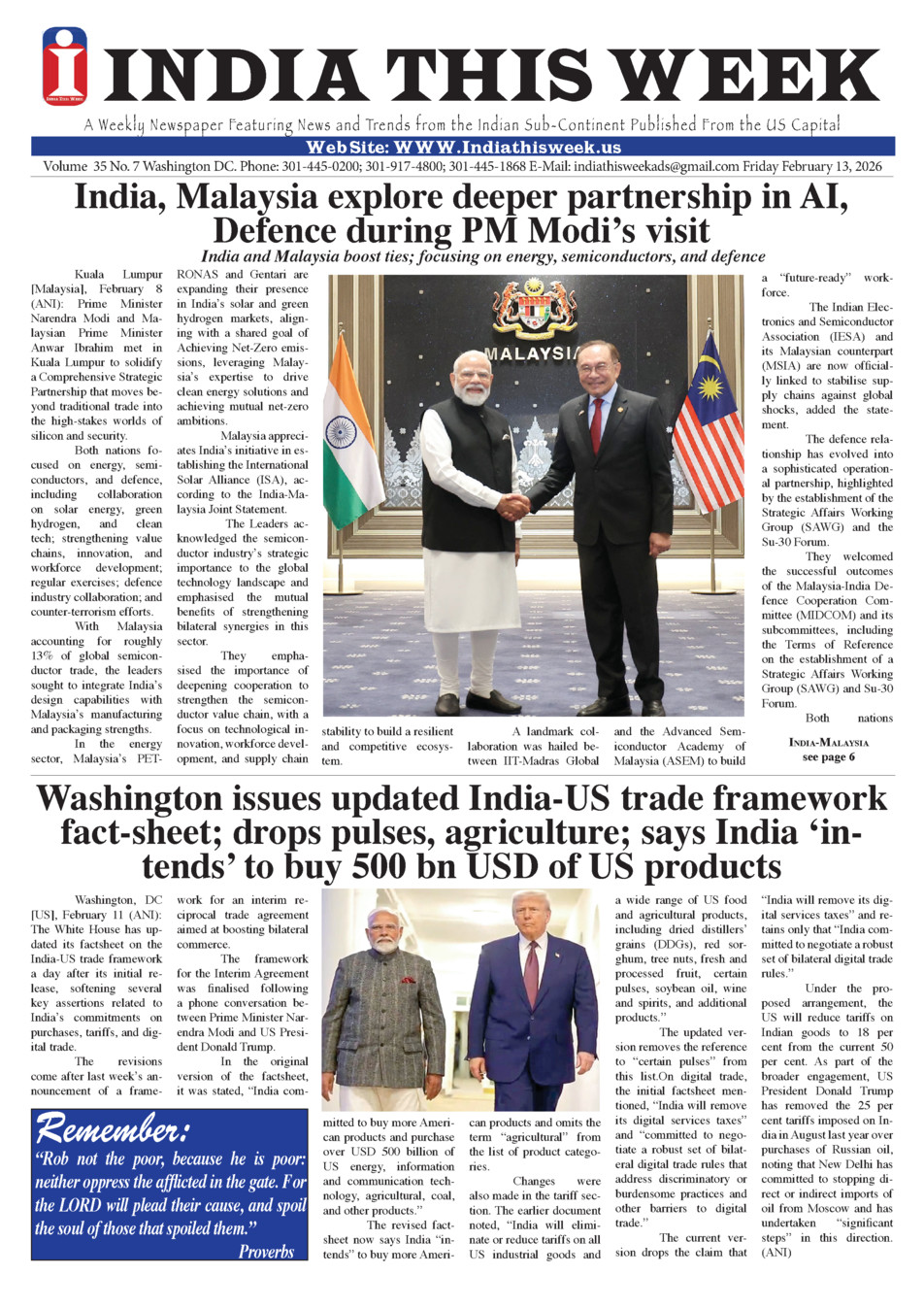
India This Week – February 13, 2026: A Comprehensive Outlook on Geopolitics, Economy, and Public Affairs
Overview of a week blending strategic partnerships, trade recalibrations, industrial expansion, and critical incidents
India This Week’ s February 13 edition provides a sweeping snapshot of ongoing shifts in global and regional alignments, the fast-evolving tech and energy landscape, large-scale infrastructure endeavours, and significant domestic developments. The issue foregrounds high-stakes diplomacy, economic recalibrations, and ground-level events that test governance, resilience, and social cohesion as nations seek steadier trajectories in a complex international environment. (Page 2)
In Kuala Lumpur, Prime Minister Narendra Modi and Malaysian Prime Minister Anwar Ibrahim advanced a broader Comprehensive Strategic Partnership that aims to move beyond conventional trade into realms where silicon, security, and sustainable energy intersect. The talks highlighted collaboration on energy, semiconductors, and defence, with ambitions to augment solar energy, green hydrogen, and clean technology, while strengthening value chains, innovation, and workforce development. The two leaders stressed regular joint exercises, closer defence industry ties, and enhanced counter-terrorism cooperation as pillars of bilateral resilience. Malaysia’s prominent role in global semiconductor markets was leveraged to envisage a deeper integration of India’s design capabilities with Malaysia’s manufacturing and packaging strengths. (Page 2)
The leaders underscored a shared interest in developing a robust semiconductor ecosystem that emphasizes innovation, skilled human capital, and stable supply chains to withstand global shocks. A landmark collaboration was announced between IIT Madras Global and Malaysia’s Advanced Semiconductor Academy (ASEM) to cultivate a “future-ready” workforce, while Indian and Malaysian industry bodies – the Indian Electronics and Semiconductor Association (IESA) and Malaysia’s MSIA – formalized links to anchor supply chains and reduce vulnerability to external disruptions. The defence relationship has evolved into an intricate operational partnership, marked by the creation of a Strategic Affairs Working Group (SAWG) and the Su-30 Forum, with regular defence delegation interactions and joint participation in exhibitions such as Aero India and Langkawi events. (Page 2)
Both countries reaffirmed a shared commitment to combat terrorism and to counter transnational crime through strengthened bilateral and multilateral cooperation, including mechanisms within the UN and FATF. They also welcomed ongoing naval and air-power exchanges, and a trajectory that envisions closer collaboration across security domains, technology, and industry. The dialogue signaled that the partnership is intended to be broader than trade, embedding capabilities that can support resilient regional and global supply chains. (Page 2)
In a parallel thread, the edition reports revisions to the India–U.S. trade framework factsheet that softened several earlier commitments, including the scope of purchases and specific agricultural references. The White House updated the document to reflect a shift from bold purchase targets toward more pragmatic, negotiated outcomes within an interim reciprocal trade framework. Changes include reframing India’s commitments on tariffs and digital trade, with the omission of “agricultural” from some product lists and a more modest portrayal of future procurement intentions. The proposed arrangement envisions tariff concessions and a recalibrated digital-trade stance anchored in bilateral dialogue and mutual interests. (Page 2)
The revised factsheet also narrows the language around eliminating certain pulses and other agricultural items from tariff relief, while indicating a general pathway toward reducing tariffs on a broad set of U.S. industrial goods and select agricultural products. The update aligns with broader efforts to restore momentum in bilateral commerce, following conversations between Prime Minister Modi and U.S. President Donald Trump. The report notes a broader framework that includes measures to improve digital trade rules and to address discriminatory practices, underscoring the ongoing negotiation dynamics that shape how both powers balance strategic technology access with market access. (Page 2)
Meanwhile, the publication underscores that in a broader economic context, the United States has proposed tariff reductions on Indian goods down to 18 percent from higher levels, and has announced a policy reversal on 25 percent duties imposed in the prior year on certain energy and technology imports, including Russian oil, conditioned on India’s efforts to reduce direct or indirect imports from Moscow. The evolving framework illustrates the push-pull between strategic alignment and commercial concessions that characterizes contemporary Indo-American economic diplomacy. (Page 2)
Beyond macro diplomacy, the issue also highlights commercial and brand movements in the United States, including BK Franchise’s push to accelerate expansion with premium food-and-beverage concepts, and Ten Thousand Coffee’s ambitious growth trajectory. Ten Thousand, born in New York and rooted in Australia, has built a reputation for a high-quality, efficient specialty-coffee model, expanding rapidly through new franchise agreements and planning to roll out additional locations across New Jersey, California, Texas, and Illinois in 2026. The BK Franchise plan hinges on leveraging proven systems and a strong portfolio to capture rising demand for Asian-inspired culinary concepts across diverse U.S. markets. (Page 3)
Another feature profile spotlights L’AMI Bakery & Café, which reinterprets Korean bakery traditions for contemporary consumers and is set to inaugurate a new in-shop location in New Jersey as part of a flexible franchise strategy. The brand emphasizes in-house, daily-baked bread and signature Korean pastries, with a plan to expand through both in-shop and standalone formats to suit partner needs. The overarching message from BK Franchise emphasizes not just growth in footprint but the creation of a stable, mutually beneficial franchise model that accommodates brand-specific characteristics and partner aspirations. (Page 3)
The same section provides a reader-facing snapshot of the two brands and their growth ambitions, reflecting a broader trend of U.S. retail and foodservice markets embracing global flavours and premium experiences. It also signals that BK Franchise is actively courting new partners with tailored outreach and contact channels, inviting inquiries through official channels. (Page 3)
Turning to public safety and disaster response, the Meghalaya coal mine incident in the East Jaintia Hills district is documented with a focus on the rapid escalation of loss, the ongoing search-and-rescue operation, and the legal and administrative steps taken in its wake. Authorities reported the explosion in an illegal coal mine, with 18 fatalities confirmed and one person seriously injured who was subsequently hospitalized. Rescue teams, including the National Disaster Response Force (NDRF) and State Disaster Response Force (SDRF), mobilized immediately to manage the hazardous environment and recover victims. (Page 5)
The government and security framework reacted swiftly as the incident prompted a formal inquiry and a legal process that spans several statutes and measures. An FIR was registered under relevant provisions, and authorities pledged to pursue accountability through the investigation, underscoring the state’s commitment to clamp down on illegal mining activities that endanger lives. Prime Minister Narendra Modi announced ex-gratia assistance of Rs 2 lakh for families of the deceased and Rs 50,000 for the injured, with Meghalaya’s own government augmenting support by announcing an additional ex-gratia of Rs 3 lakh to kin of the deceased. These gestures reflect the central and state authorities’ emphasis on immediate relief and long-term accountability. (Page 5)
Meghalaya’s Chief Minister reiterated the government’s determination to conduct a comprehensive inquiry and enforce accountability, stressing that there would be no tolerance for illegal mining and safety lapses. He announced administrative actions, including directing cabinet ministers to review the situation on the ground, and emphasized the government’s commitment to scientific mining practices as a pathway to reduce such risks in the future. The leadership also emphasized coordination among police, NDRF, SDRF, and mining officials to ensure a thorough investigation and robust rescue operations. (Page 5)
In parallel political coverage, senior national figures—such as President Droupadi Murmu and Prime Minister Narendra Modi—expressed condolences and solidarity with the affected families, while political actors across parties called for accountability and appropriate relief measures. The government’s response highlighted a multi-layered support system, including central assistance through PMNRF and state-level relief, and a clear stance against illicit mining activities. Public statements from the Home Ministry and other ministers underscored the need for a strong regulatory framework and proactive enforcement to prevent future tragedies. (Page 5)
As part of ongoing public discourse, prominent political leaders publicly expressed sympathy and demanded accountability, acknowledging the scale of loss and the imperative to safeguard workers and communities dependent on mining. The authorities indicated that the investigation would be thorough, with regular briefings and updates to inform the public about progress and any policy measures adopted to address systemic issues in mining regulation. The episode also highlighted the political salience of mining safety and the critical role of law enforcement in enforcing environmental and occupational standards. (Page 5)
On the defense and security front, the India–Malaysia axis further extended into maritime and air domains, with a continuing emphasis on deepening interoperability through joint exercises, information sharing, and industry collaboration. The Attendant security architecture includes active participation within the ASEAN Defense Ministers’ Meeting Plus (ADMM-Plus) framework, with India co-chairing the Counter-Terrorism Working Group for the 2024–2027 term and organizing collaborative tabletop exercises to test readiness against evolving threats. The dialogue also noted the significance of naval-to-naval engagements, visits by ships, and greater cooperation in hydrographic and maritime security tasks. (Page 6)
As a broader strategic signal, both governments welcomed ongoing industrial cooperation, including joint engagements with security ministries and defense industries, reflecting a shared intent to cultivate a resilient regional security architecture. The leaders reaffirmed a commitment to counterterrorism, information-sharing, and legal cooperation, while stressing that a holistic approach—combining hard security with science, technology, and industry—will be essential to confronting shared challenges. (Page 6)
Amid these strategic developments, an editorial component within the edition calls for introspection about rhetoric on land rights and national identity. The piece argues that public discourse must be anchored in actions, accountability, and tangible policy outcomes rather than performative claims, urging readers to measure words against deeds. It cautions against political grandstanding while highlighting the responsibilities of those in power to translate rhetoric into constructive reforms that benefit society as a whole. (Page 6)
In Delhi, a tragic case of acid ingestion involving a 16-year-old girl from Geeta Colony is reported with a sequence of contested circumstances and a complex investigative path. The complainant, the girl’s father, alleges familial involvement and a timeline that points to October 2025 as the initial incident, with subsequent death in February 2026 after treatment delays and evolving statements. Police inquiries have explored potential sexual assault allegations as part of the case, with multiple legal provisions invoked in the FIR. The evolving narrative has prompted scrutiny of institutional responses and the adequacy of preventive measures in the wake of such incidents. (Page 7)
The medical-legal chronology notes that the death followed a period of uncertainty, with the medico-legal records initially citing acid ingestion and later inquiries suggesting additional allegations. Investigations are ongoing, with authorities seeking to piece together timelines, corroborating witness statements, and the full context of events leading to the patient’s death. The case has drawn attention to the interplay between domestic violence, coercive circumstances, and child protections laws, underscoring the need for robust safeguarding mechanisms for vulnerable youths. (Page 7)
Alongside the Delhi case, the edition includes a concise report on the ongoing investigation and police updates, including the formalities of recording statements, the status of the FIR, and the autopsy results. The reporting emphasizes that the case remains under legal review, with further inquiries anticipated to clarify responsibilities and to guide future preventive measures. (Page 7)
In another important development, Indian Railways announced a broad slate of projects designed to expand capacity, enhance safety, and improve the reliability of both passenger and freight services. The approved plans cover multiple zones, including Southern, Northern, and South Eastern Railways, and encompass line doubling, third and fourth line additions, bypass corridors, and the deployment of advanced electronic interlocking systems. The package includes the Barbenda–Damrughutu and Damrughutu–Bokaro Steel City upgrades in Jharkhand, all aimed at alleviating congestion and supporting heavy industrial activity. (Page 4)
Key safety enhancements under the plan include the installation of Kavach train protection systems at numerous stations, plus significant investments in electronic interlocking to upgrade signalling reliability and enable higher train frequencies on high-density routes. A central feature is the Rajpura bypass line, which will streamline freight movements by connecting directly to the New Shambhu DFC station and bypassing the congested Rajpura Yard, thereby reducing detentions and enabling smoother integration with the dedicated freight corridor. (Page 4)
Other crucial elements of the rail expansion involve removing single-line constraints on the Ernakulam–Turavur–Kayankulam route, enabling nine additional passenger services per day and boosting freight capacity, which is projected to yield substantial economic value by accelerating inter-state movement and improving the efficiency of coastal and southern corridors. The Palakkad bypass is expected to reduce locomotive reversals and shorten detentions, while the Irugur–Podanur doubling is seen as a pivotal upgrade that could unlock around a dozen new passenger trains and significantly increase freight capacity, ultimately transforming the Chennai–Coimbatore–Podanur belt into a four-line corridor. (Page 4)
Together, these rail infrastructure decisions are portrayed as a strategic lever to support industrial growth, improve energy logistics, and strengthen supply chains across key markets. By enabling faster journeys and more reliable freight operations, the plan is positioned to bolster regional development, enhance competitiveness, and sustain economic momentum in the face of rising demand. The broader objective is to deliver a modern, scalable railway network that aligns with India’s ambition to be a strong global manufacturing and logistics hub. (Page 4)
Taken together, the edition presents a portrait of a country navigating a mosaic of opportunities and challenges: forging strategic partnerships with major regional players, recalibrating trade and digital policies with the United States, expanding high-value consumer brands in the United States, responding to industrial accidents with swift relief and accountability, and investing heavily in infrastructure to unlock enduring growth. The through-lines across articles point to a deliberate emphasis on resilience—whether through diversified energy alliances, robust supply chains, or capacity-building within critical sectors—while acknowledging the complexity and fragility that come with rapid change. (Page 2, 3, 4, 5, 6)