guidebook
guidebook
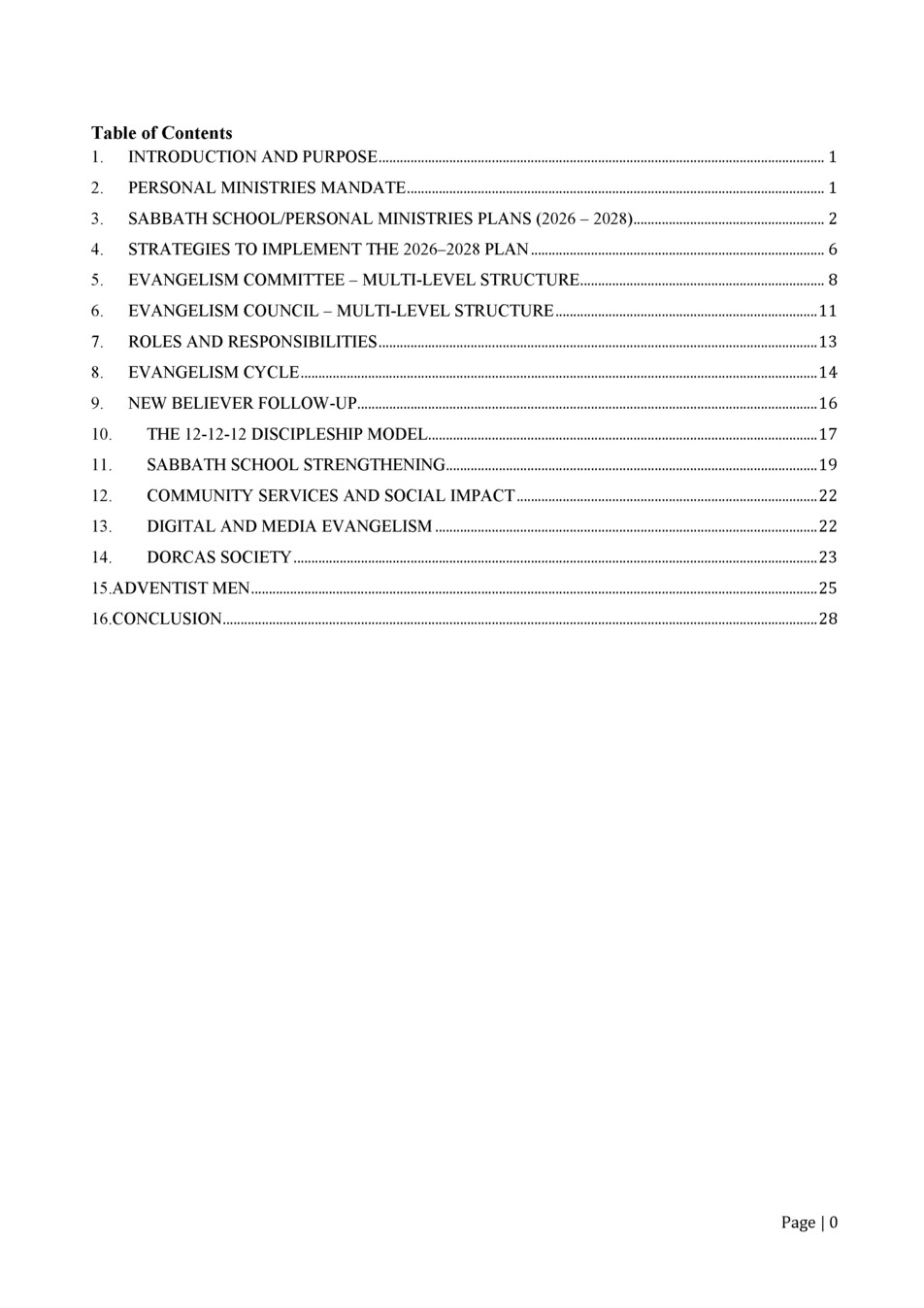
West Zambia Conference Personal Ministries Handbook (2026–2028): A Practical Guide to Mobilizing Churches for Discipleship, Evangelism, and Community Impact
Introduction and Purpose
The Personal Ministries initiative sits at the core of the Adventist mission, aiming to transform church participants into active, mission-focused disciples who engage in soul-winning, nurturing relationships, and community service. This handbook is designed for West Zambia Conference to prevent ministry from becoming merely event-driven and to establish a clear, actionable system. It outlines what must be done, who is responsible, when actions should occur, and how to execute tasks effectively, turning lofty goals into everyday practice. Page 1
In introducing this Operations Handbook, the goal is to provide a unified direction for all churches, ensuring continuity even as leadership changes, discouraging episodic evangelism, and fostering data-informed planning through structured reporting and measurable targets. It is intended as a practical field guide rather than a theoretical text, meant to be carried, read, applied, and regularly reviewed by PM leaders, pastors, Bible workers, Sabbath School teachers, lay preachers, and discipleship mentors across the West Zambia Conference. Page 1
Personal Ministries Mandate
The Personal Ministries Department is tasked with equipping the church to fulfill the Great Commission by mobilizing the entire congregation into active discipleship. It serves as the mission deployment arm of the church, coordinating broad-based outreach and ongoing discipleship rather than focusing on a single program. Page 1
Core mandate areas include leading soul-winning and evangelism through organized campaigns and small-group efforts, equipping members by training lay preachers and Bible study facilitators, and building a robust culture of discipleship that retains and nurtures new converts. It also calls for strengthening Sabbath School and mid-week spiritual life, mobilizing the church for community impact through various ministries, and implementing a disciplined system of tracking progress with accurate reporting. Page 1
A guiding principle emphasizes that Personal Ministries should activate the entire membership, not merely operate as a department for a few. Success is measured by the number of engaged members, the souls won and discipled, and the ongoing growth of the entire body. Page 1
The biblical motivation highlights the harvest as plentiful while laborers are few, and acknowledges that every believer is called to ministry, reinforcing the inclusive, participatory nature of the plan. Page 1
Core Objectives for 2026–2028
Several strategic objectives anchor the plan, including facilitating a thriving communion with God by elevating spiritual practices, expanding discipleship pathways, and boosting retention of new believers. The aim is to harmonize life in the church with a structured drive toward deeper faith, stronger doctrinal understanding, and tangible outreach outcomes. Page 1
Key performance targets emphasize increasing participation in prayer meetings and Sabbath School to elevated levels, deepening doctrinal knowledge through Bible schools and mentorship, expanding baptisms and church planting, training lay evangelists, and advancing digital outreach. The overarching aim is to foster an identity in Christ and ensure mission engagement across all disciples. Page 1
Sabbath School / Personal Ministries Plans (2026–2028) – Implementation Plan
In the Sabbath School and Personal Ministries planning track, the implementation plan centers on strengthening personal spiritual disciplines, Sabbath School attendance, and leadership development. The plan calls for coordinated leadership training across PM, AY (Adventist Youth), Dorcas, Adventist Men, and other groups, alongside structured worship and Bible study initiatives. Page 2
There is a focus on increasing daily engagement with Scripture and prayer, as well as enhancing access to Ellen G. White writings through reading plans, library initiatives, and related resources. The plan also emphasizes spiritual revival activities such as week-long emphasis programs and youth-led devotionals, as well as collaborative events that foster stronger family and community life. Page 2
Identity in Christ
The Identity in Christ objective seeks to deepen understanding of Adventist beliefs and cultivate a robust discipleship culture. Action plans include strengthening doctrinal literacy, articulating core beliefs clearly, and developing structured pathways for mentorship and discipleship that guide members from learning to living out faith in everyday practice. Page 3
Plans call for sustained spiritual mentoring, ongoing participation by district pastors in local mentorship initiatives, and a broad emphasis on mobilizing more members into active ministry roles. The goal is to cultivate a church where leadership development and broad member involvement become standard, with formal pathways that connect new believers to ongoing nurture and service. Page 3
Unity Through the Holy Spirit
This objective aims to foster unity, collaboration, reconciliation, and safe environments within the church. It includes maintaining a zero-tolerance stance toward abuse, promoting unity across departmental doctrines, and encouraging collaborative mission work. A measurable outcome is an uptick in joint programs across districts and institutions and the cultivation of safer, more welcoming congregations. Page 3
The plan anticipates increased interchurch fellowship and deeper unity among pastors, PM leaders, and other church leaders, with ongoing, practical steps to reduce divisions and strengthen cooperative ministry. Page 3
Mission for All
The Mission for All objective focuses on equipping members for evangelism, discipleship, and community impact. It envisions a large pool of trained lay preachers, a strong post-baptismal nurture process, and the adoption of the “12–12–12” Discipleship Model to sustain retention of new believers. It also includes plantings of new worship centers in underserved areas and a renewed emphasis on community service as a conduit for evangelism. Page 4
The strategy includes expanding media ministries and digital outreach to broaden reach, with targeted campaigns that culminate in significant baptisms and broad congregational participation. Specific campaigns across major zones are designed to maximize mass evangelism while maintaining sustained involvement from existing members. Page 4
Additionally, the plan highlights ongoing evangelistic rallies, reclamation efforts for believers who have drifted away, and the establishment of worship venues in new territories to extend church presence and influence. The objective is to realize a measurable wave of conversions and a revitalized culture of mission involvement across the conference. Page 4
Strategies to Implement the 2026–2028 Plan
The implementation framework is divided into two major strategic streams: leadership/system strengthening and spiritual revival plus member engagement. Each stream includes concrete steps, responsible parties, and tangible outcomes to ensure accountability and momentum. Page 5
Leadership and System Strengthening focuses on creating a district-level Personal Ministries Implementation Committee, empowering team-based local implementation through mini-teams in each church, and producing annual work plans and budgets that translate mission targets into funded activities. Capacity building covers training for elders, PM leaders, Sabbath School leaders, lay preachers, and Bible workers, along with standardized reporting to capture baptisms, retention, attendance, and campaign outcomes. Page 5
Spiritual Revival and Member Engagement strategies emphasize cultivating daily devotion habits through digital and print devotionals, increasing midweek attendance via themed prayer meetings and testimonies, and strengthening Sabbath School through clinics and teacher training. EGW reading is promoted through challenges, mobile libraries, and focused sermon themes, reinforcing a culture of spiritual renewal and participation. Page 6
Additional emphasis is placed on promoting practical acts of service through collaboration with women’s ministries, Dorcas societies, health ministries, and youth programs, using compassionate outreach as a gateway for evangelism. The plan envisions a broader media and digital evangelism footprint, with measurable metrics such as online Bible study subscribers and expanded reach through social and radio platforms. Page 6
Implementation Notes and Future Outlook
While the handbook lays out structured approaches to multiplication, continuity, and accountability, its success hinges on consistent application, robust data collection, and a culture that prioritizes discipleship over events. The Document emphasizes practical tools, clear lines of responsibility, and a shared sense of mission to ensure that every church becomes a hub for patient follow-up, sustained growth, and meaningful community impact. Page 6
In summary, the West Zambia Conference Personal Ministries plan for 2026–2028 seeks to convert a church that primarily gathers into a movement that multiplies disciples, strengthens doctrinal understanding, engages the whole membership in service, and expands the church’s footprint through new worship centers and innovative outreach. The initiative is built on governance, spiritual renewal, and active participation by lay members, all aimed at a durable transformation of church life and society. Page 6