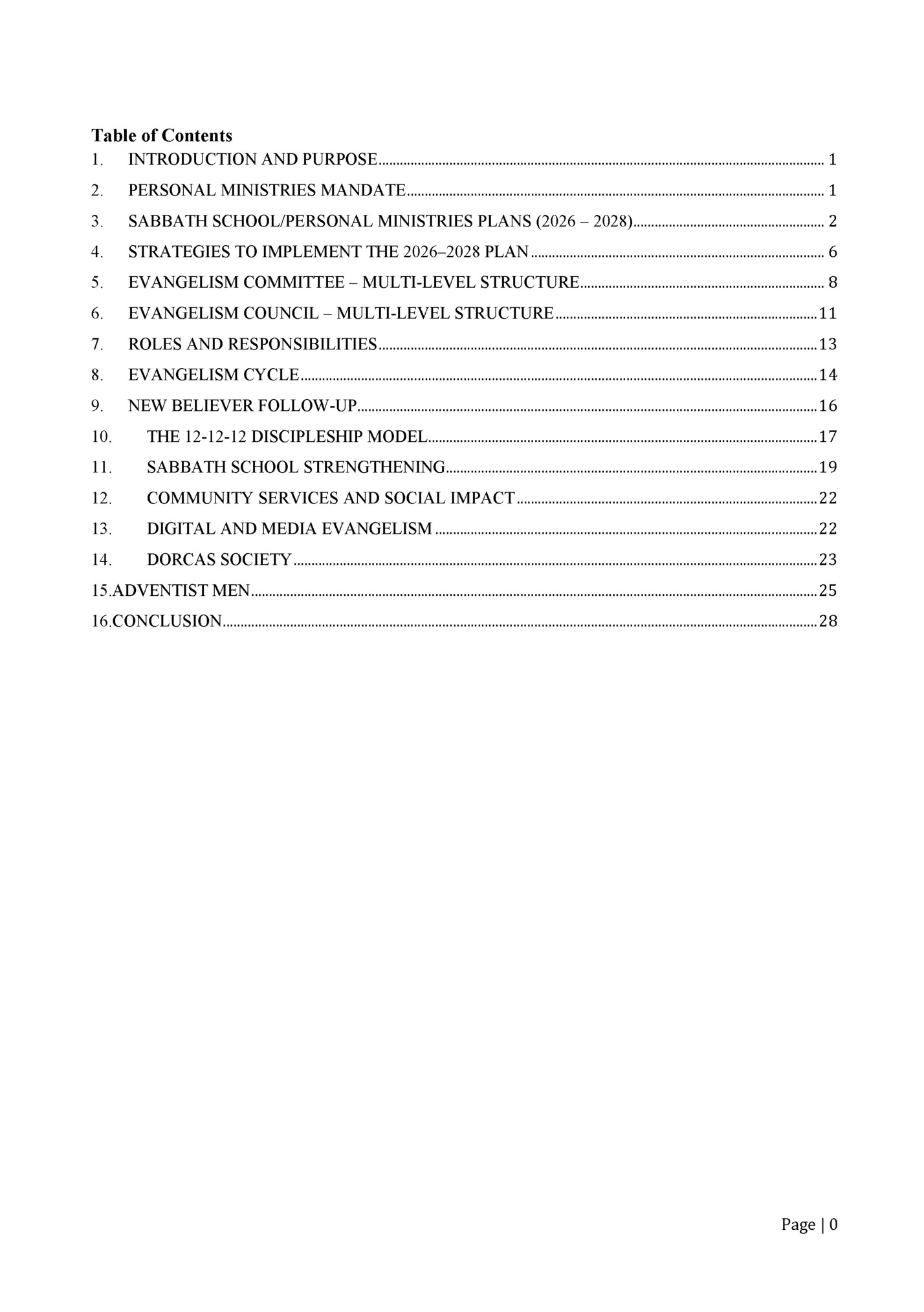
1. INTRODUCTION AND PURPOSE .............................................................................................................................. 1 2. PERSONAL MINISTRIES MANDATE ...................................................................................................................... 1 3. SABBATH SCHOOL/PERSONAL MINISTRIES PLANS (2026 – 2028)...................................................... 2 4. STRATEGIES TO IMPLEMENT THE 2026–2028 PLAN ................................................................................... 6 5. EVANGELISM COMMITTEE – MULTI-LEVEL STRUCTURE ..................................................................... 8 6. EVANGELISM COUNCIL – MULTI-LEVEL STRUCTURE .......................................................................... 11 7. ROLES AND RESPONSIBILITIES ............................................................................................................................ 13 8. EVANGELISM CYCLE .................................................................................................................................................. 14 9. NEW BELIEVER FOLLOW-UP .................................................................................................................................. 16 10. THE 12-12-12 DISCIPLESHIP MODEL.............................................................................................................. 17 11. SABBATH SCHOOL STRENGTHENING......................................................................................................... 19 12. COMMUNITY SERVICES AND SOCIAL IMPACT ..................................................................................... 22 13. DIGITAL AND MEDIA EVANGELISM ............................................................................................................ 22 14. DORCAS SOCIETY .................................................................................................................................................... 23 15.ADVENTIST MEN ................................................................................................................................................................ 25 16.CONCLUSION ........................................................................................................................................................................ 28 Page | 0
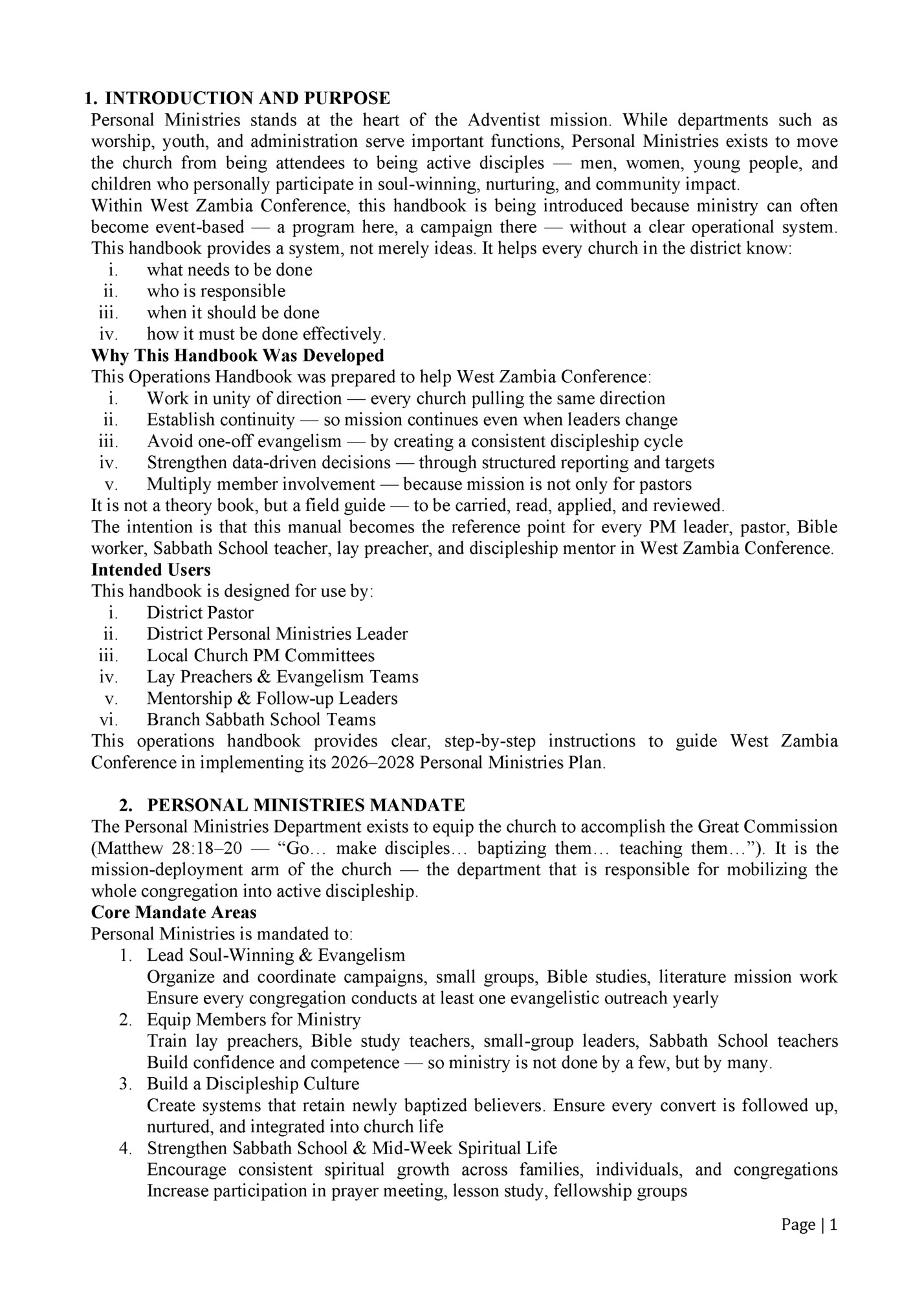
Personal Ministries stands at the heart of the Adventist mission. While departments such as worship, youth, and administration serve important functions, Personal Ministries exists to move the church from being attendees to being active disciples — men, women, young people, and children who personally participate in soul-winning, nurturing, and community impact. Within West Zambia Conference, this handbook is being introduced because ministry can often become event-based — a program here, a campaign there — without a clear operational system. This handbook provides a system, not merely ideas. It helps every church in the district know: i. what needs to be done ii. who is responsible iii. when it should be done iv. how it must be done effectively. Why This Handbook Was Developed This Operations Handbook was prepared to help West Zambia Conference: i. Work in unity of direction — every church pulling the same direction ii. Establish continuity — so mission continues even when leaders change iii. Avoid one-off evangelism — by creating a consistent discipleship cycle iv. Strengthen data-driven decisions — through structured reporting and targets v. Multiply member involvement — because mission is not only for pastors It is not a theory book, but a field guide — to be carried, read, applied, and reviewed. The intention is that this manual becomes the reference point for every PM leader, pastor, Bible worker, Sabbath School teacher, lay preacher, and discipleship mentor in West Zambia Conference. Intended Users This handbook is designed for use by: i. District Pastor ii. District Personal Ministries Leader iii. Local Church PM Committees iv. Lay Preachers & Evangelism Teams v. Mentorship & Follow-up Leaders vi. Branch Sabbath School Teams This operations handbook provides clear, step-by-step instructions to guide West Zambia Conference in implementing its 2026–2028 Personal Ministries Plan. 2. PERSONAL MINISTRIES MANDATE The Personal Ministries Department exists to equip the church to accomplish the Great Commission (Matthew 28:18–20 — “Go… make disciples… baptizing them… teaching them…”). It is the mission-deployment arm of the church — the department that is responsible for mobilizing the whole congregation into active discipleship. Core Mandate Areas Personal Ministries is mandated to: 1. Lead Soul-Winning & Evangelism Organize and coordinate campaigns, small groups, Bible studies, literature mission work Ensure every congregation conducts at least one evangelistic outreach yearly 2. Equip Members for Ministry Train lay preachers, Bible study teachers, small-group leaders, Sabbath School teachers Build confidence and competence — so ministry is not done by a few, but by many. 3. Build a Discipleship Culture Create systems that retain newly baptized believers. Ensure every convert is followed up, nurtured, and integrated into church life 4. Strengthen Sabbath School & Mid-Week Spiritual Life Encourage consistent spiritual growth across families, individuals, and congregations Increase participation in prayer meeting, lesson study, fellowship groups Page | 1
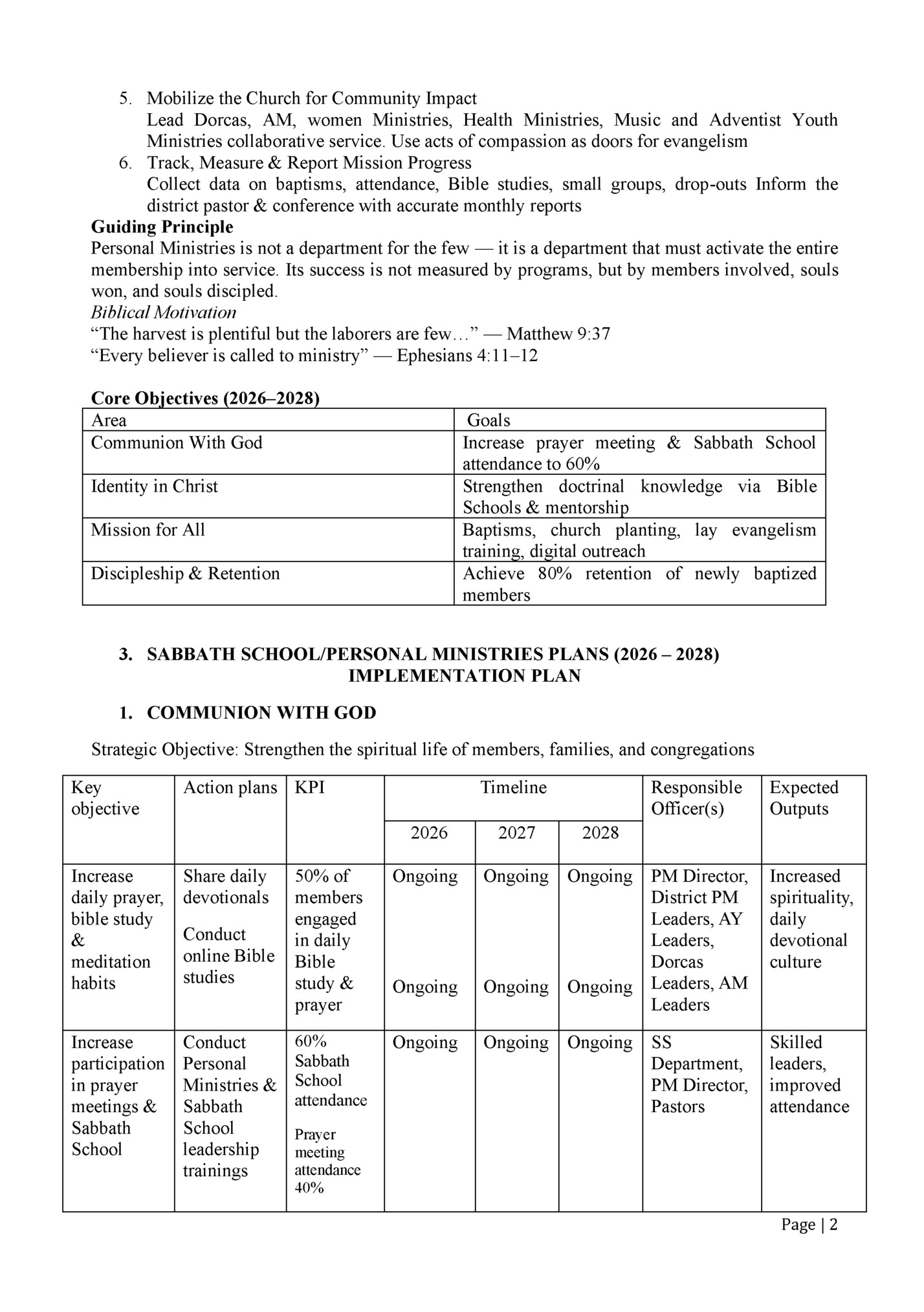
Lead Dorcas, AM, women Ministries, Health Ministries, Music and Adventist Youth Ministries collaborative service. Use acts of compassion as doors for evangelism 6. Track, Measure & Report Mission Progress Collect data on baptisms, attendance, Bible studies, small groups, drop-outs Inform the district pastor & conference with accurate monthly reports Guiding Principle Personal Ministries is not a department for the few — it is a department that must activate the entire membership into service. Its success is not measured by programs, but by members involved, souls won, and souls discipled. Biblical Motivation “The harvest is plentiful but the laborers are few…” — Matthew 9:37 “Every believer is called to ministry” — Ephesians 4:11–12 Core Objectives (2026–2028) Area Communion With God Goals Increase prayer meeting & Sabbath School attendance to 60% Strengthen doctrinal knowledge via Bible Schools & mentorship Baptisms, church planting, lay evangelism training, digital outreach Achieve 80% retention of newly baptized members Identity in Christ Mission for All Discipleship & Retention 3. SABBATH SCHOOL/PERSONAL MINISTRIES PLANS (2026 – 2028) IMPLEMENTATION PLAN 1. COMMUNION WITH GOD Strategic Objective: Strengthen the spiritual life of members, families, and congregations Key objective Action plans KPI Increase daily prayer, bible study & meditation habits Share daily devotionals Increase participation in prayer meetings & Sabbath School Conduct Personal Ministries & Sabbath School leadership trainings Conduct online Bible studies Timeline 2026 2027 2028 50% of members engaged in daily Bible study & prayer Ongoing Ongoing Ongoing Ongoing Ongoing Ongoing 60% Sabbath School attendance Ongoing Ongoing Ongoing Responsible Officer(s) Expected Outputs PM Director, District PM Leaders, AY Leaders, Dorcas Leaders, AM Leaders Increased spirituality, daily devotional culture SS Department, PM Director, Pastors Skilled leaders, improved attendance Prayer meeting attendance 40% Page | 2
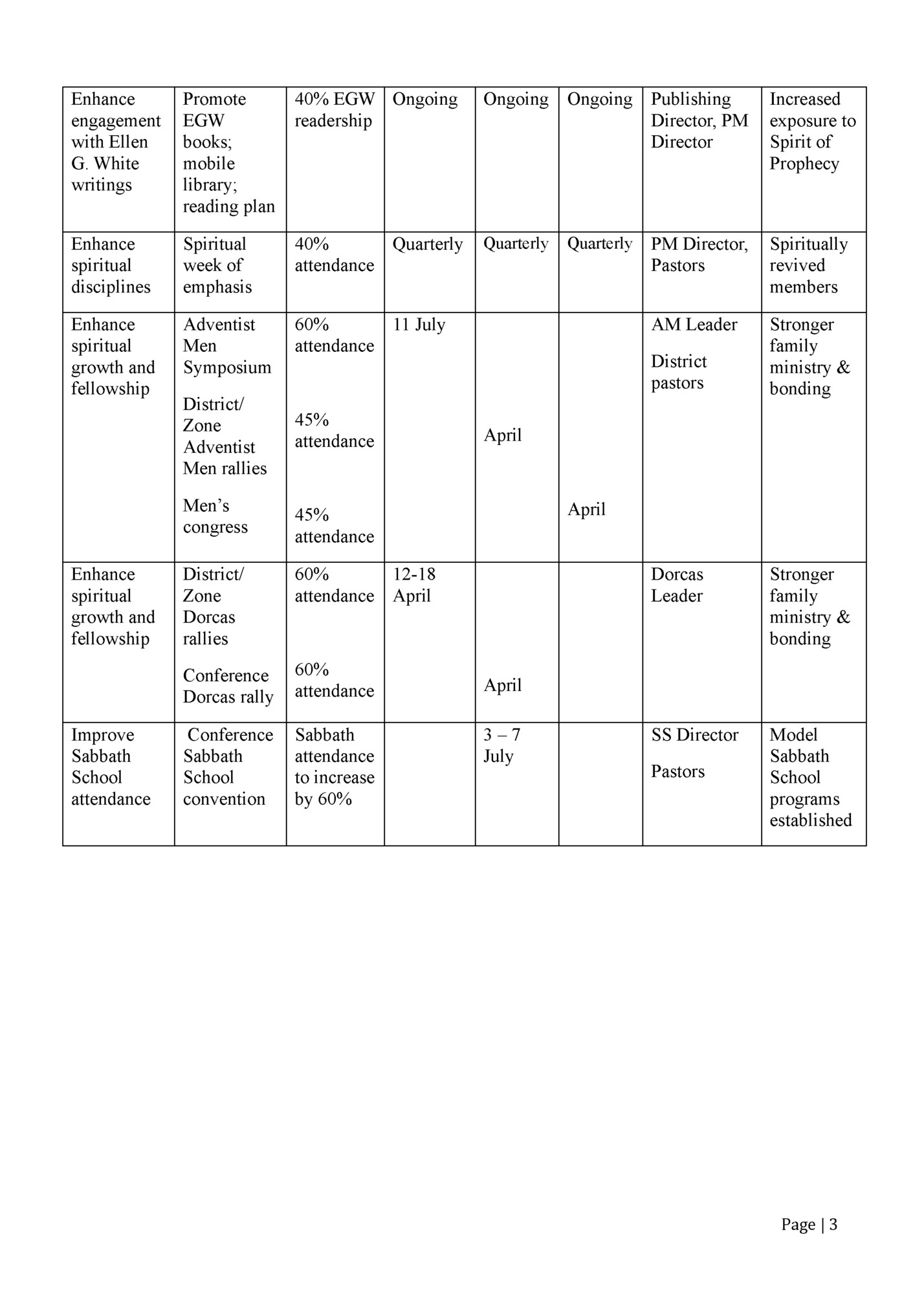
engagement with Ellen G. White writings Promote EGW books; mobile library; reading plan 40% EGW Ongoing readership Ongoing Ongoing Publishing Director, PM Director Increased exposure to Spirit of Prophecy Enhance spiritual disciplines Spiritual week of emphasis 40% Quarterly attendance Quarterly Quarterly PM Director, Pastors Spiritually revived members Enhance spiritual growth and fellowship Adventist Men Symposium 60% 11 July attendance AM Leader Stronger family ministry & bonding District/ Zone Adventist Men rallies Men’s congress Enhance spiritual growth and fellowship Improve Sabbath School attendance 45% attendance District pastors April April 45% attendance District/ Zone Dorcas rallies 60% 12-18 attendance April Conference Dorcas rally 60% attendance Conference Sabbath School convention Sabbath attendance to increase by 60% Dorcas Leader Stronger family ministry & bonding SS Director Model Sabbath School programs established April 3–7 July Pastors Page | 3
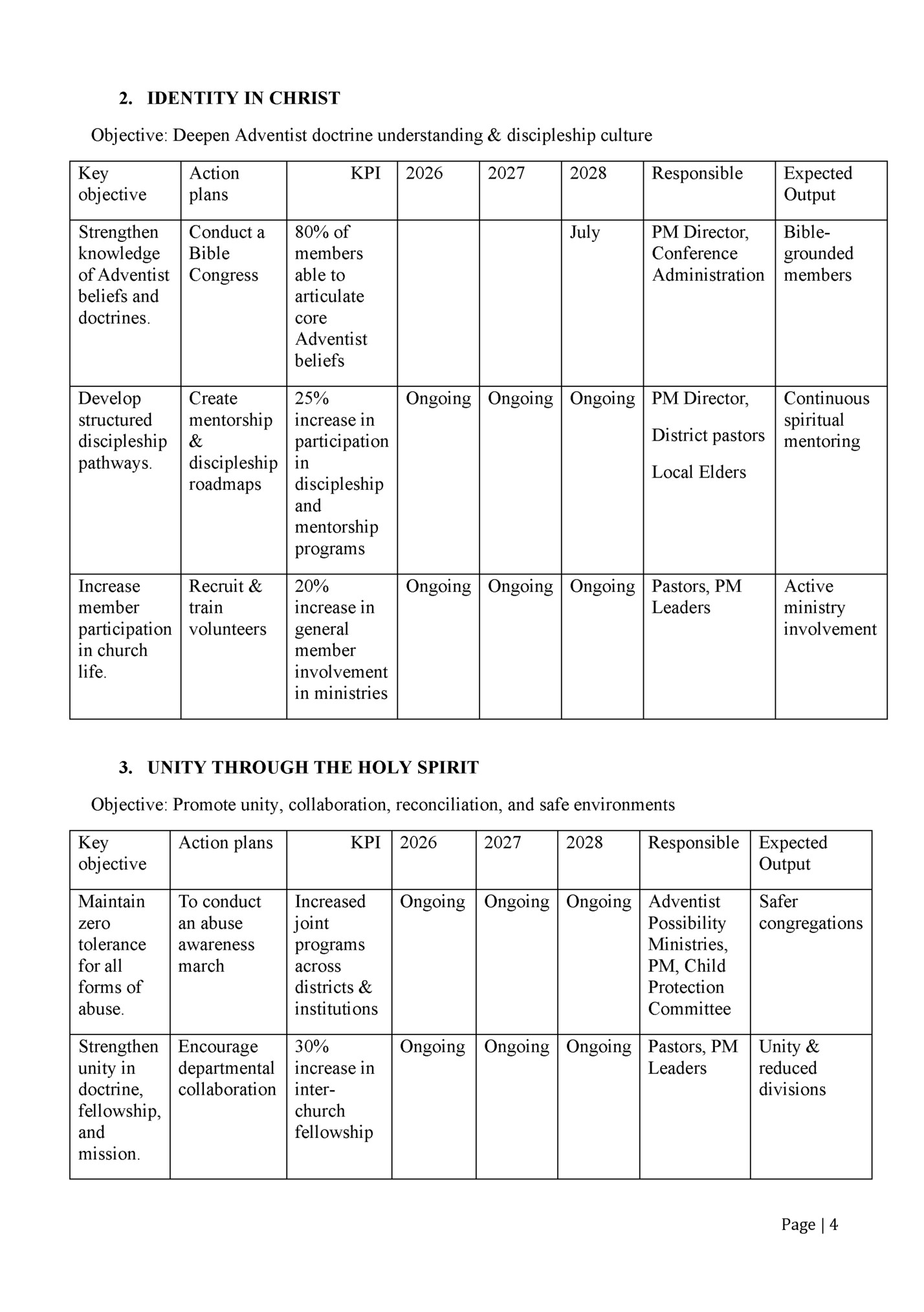
Objective: Deepen Adventist doctrine understanding & discipleship culture Key objective Action plans Strengthen knowledge of Adventist beliefs and doctrines. Conduct a Bible Congress 80% of members able to articulate core Adventist beliefs Develop structured discipleship pathways. Create mentorship & discipleship roadmaps 25% Ongoing Ongoing Ongoing PM Director, increase in District pastors participation in Local Elders discipleship and mentorship programs Continuous spiritual mentoring 20% Ongoing Ongoing Ongoing Pastors, PM increase in Leaders general member involvement in ministries Active ministry involvement Increase Recruit & member train participation volunteers in church life. KPI 2026 2027 2028 Responsible Expected Output July PM Director, Conference Administration Biblegrounded members 3. UNITY THROUGH THE HOLY SPIRIT Objective: Promote unity, collaboration, reconciliation, and safe environments Key objective Action plans Maintain zero tolerance for all forms of abuse. To conduct an abuse awareness march Strengthen Encourage unity in departmental doctrine, collaboration fellowship, and mission. KPI 2026 2027 2028 Responsible Expected Output Increased joint programs across districts & institutions Ongoing Ongoing Ongoing Adventist Possibility Ministries, PM, Child Protection Committee Safer congregations 30% increase in interchurch fellowship Ongoing Ongoing Ongoing Pastors, PM Leaders Unity & reduced divisions Page | 4
Objective: Equip members for evangelism, discipleship & community impact Key objective Action plans Empower members for personal and public evangelism. Conduct a lay preacher’s Convention Strengthen post-baptismal nurture and discipleship. 2026 2027 2028 1500 newly trained lay preachers 2 – 6 April 25 – 29 March 13-17 April PM Director, Ministerial Strong pool of evangelists Implement the “12 – 12 – 12” Discipleship Model 80% retention of newly baptized members Ongoing Ongoing Ongoing PM, Clergy, Elders New believers remain in church Establish new worshipping centers Plant worshipping centers in unentered territories 20 new worshipping centers December December December PM, District Pastors Expanded church presence Strengthen community service as a witness tool. Build a skills centre 50% completion December Community services Impact Day Positive community reputation Every quarter 31 May 30 May 28 May Dorcas, Community Services Director Expand media ministries and digital evangelism. Facebook, radio, WhatsApp outreach 1,500 online Bible study subscribers Ongoing Ongoing Ongoing Media Ministry Team Broader evangelistic reach Reclaiming the backslidden Reclamation Sabbath Baptism of the reclaimed 20 June 19 June 17 June PM director, District Pastor Restoration of the backslidden Conduct major evangelistic campaigns Impact Luampa To baptize 1,200, and 50% involvement 17 – 26 September PM, Pastors, Evangelism Committee Mass baptisms; Church growth Impact Mongu To baptize 1,200, and 50% involvement Impact Zambezi Plains Conduct evangelistic campaign in every worshipping place KPI October To baptize 1,200, and 50% involvement 100% participation by congregations, 6800 baptisms, 50% member involvement PM, Pastors, Evangelism Committee October 24 May – 6 June May May Page | 5
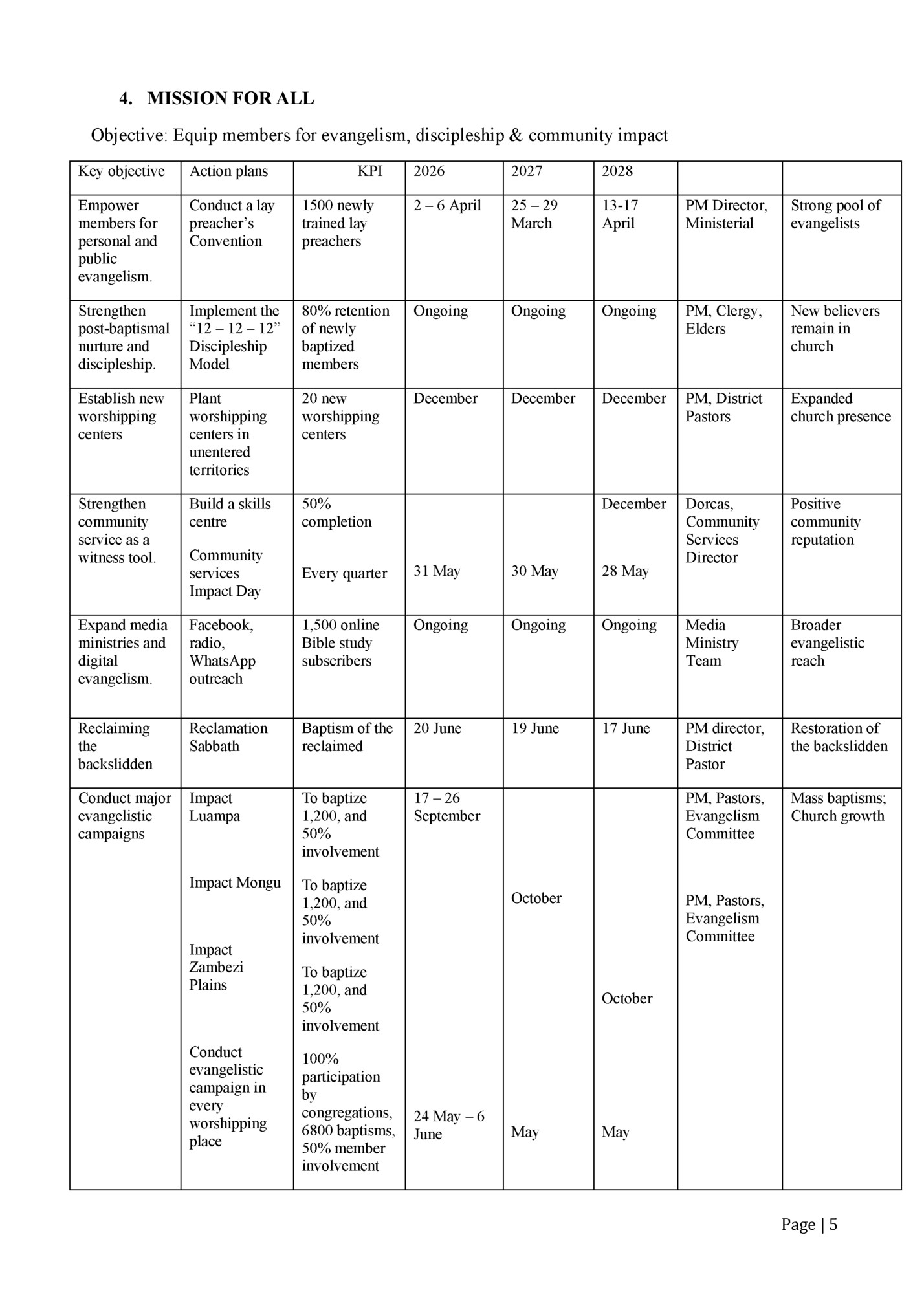
mission commitment Conduct Mission rallies in churches/zones 30% participation in mission Ongoing Ongoing Ongoing PM, Pastors Renewed mission spirit 4. STRATEGIES TO IMPLEMENT THE 2026–2028 PLAN i. Leadership and System Strengthening Strategies These ensure structure, accountability, and readiness before implementation. Strategy How It Will Be Done Form a Personal District appoints PM Implementation Committee (PM leader, AM, Ministries Dorcas, SS , Media, Youth & Pastors). Each church forms a miniImplementation team for weekly follow-up. Taskforce Annual Work Plans & Budgets Each year, conference and districts prepare localized mission calendars with costed budgets and targets (souls, rallies, campaigns). Capacity Building Train Elders, PM Leaders, SS Leaders, Lay Preachers & Bible Workers (skills: preaching, discipleship, reporting, online evangelism). Standardized Reporting Use monthly templates to submit: baptisms, retention, attendance, discipleship participation, outreach activities. ii. Spiritual Revival & Member Engagement Strategies These bring spiritual life into the plan so it produces transformation, not just activities. Strategy How It Will Be Done Revival Through Daily Devotion Culture WhatsApp morning devotionals, printed quarterly guides, youth devotion plans, couples study groups. Midweek Attendance Improvement Strategy Introduce theme-based prayer meetings, testimonies night, home fellowship groups Sabbath School Enhancement Conduct quarterly SS teacher clinics; children & youth SS training. Ellen G. White Reading Create reading challenge competitions; mobile book carts; monthly Promotion EGW sermon theme focus. Page | 6
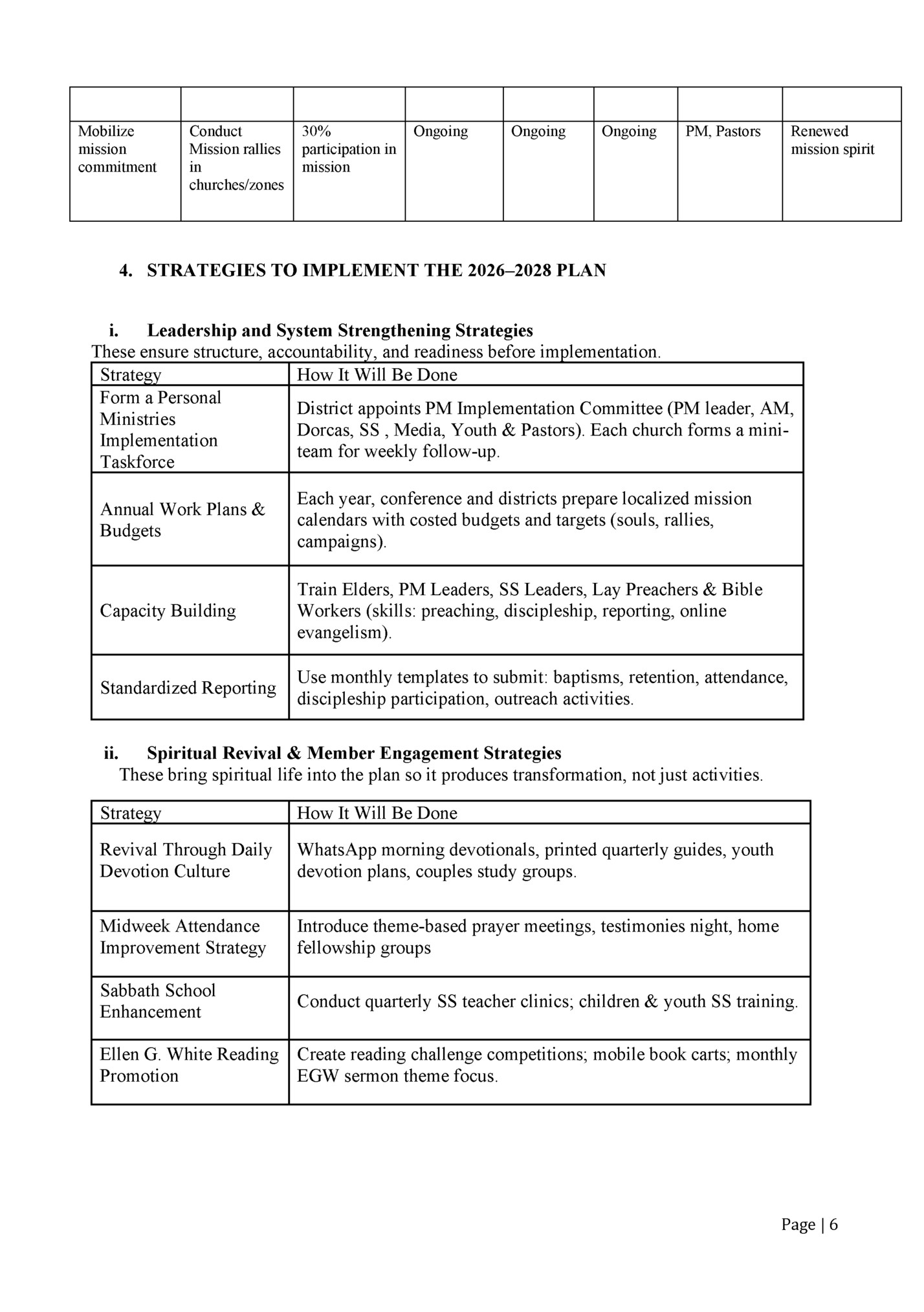
Strengthening Adventist belief and preparing members to disciple others. Strategy How It Will Be Done Adopt Structured Discipleship Pathways Implement 12-12-12 Model, Choose a Discipleship Coordinator, Assign mentors to all newly baptized. District Bible Schools each district starts Bible Study Schools where members complete a 12-week doctrine course. iv. Evangelism & Mission Expansion Strategies For member participation, baptisms, community impact, and church growth. Strategy Zone-Based Evangelistic Cycles (Instead of One-Off Campaigns) How It Will Be Done Each district conducts 3 cycles yearly: 1) Pre-work (small groups, health expos, community services), 2) Public campaigns, 3) Postbaptism nurturing. Decentralized Evangelism Ownership Each congregation to conduct an evangelistic campaign each year, the conference to conduct a campaign annually in an identified district Door-to-Door & Small Group Evangelism Each church forms home-groups of 8–12 that meet weekly, pray, study, invite friends → act as feeders to campaigns. Lay Preacher Empowerment Lay preacher convention trains speakers → assign them to campaigns; preacher bank created. Community Social Action = Evangelism Dorcas, AM, Youth, Health Ministries lead health screenings, food aid, water projects → each ends with gospel presentations and interest list creation. v. Digital, Media & Communication Strategies To reach the unreachable and the youth. Strategy How It Will Be Done Social Media Gospel Hubs Each district runs WhatsApp evangelistic Bible study groups & Facebook livestream sermons. Youth-Led Digital Missions Senior Youths trained as “Digital Missionaries” to post devotionals, Bible reels, share SS lessons. Online Soul Tracking System Create shared Google/Excel sheet or simple app to track interests → pastors + PM leaders monitor weekly. Page | 7
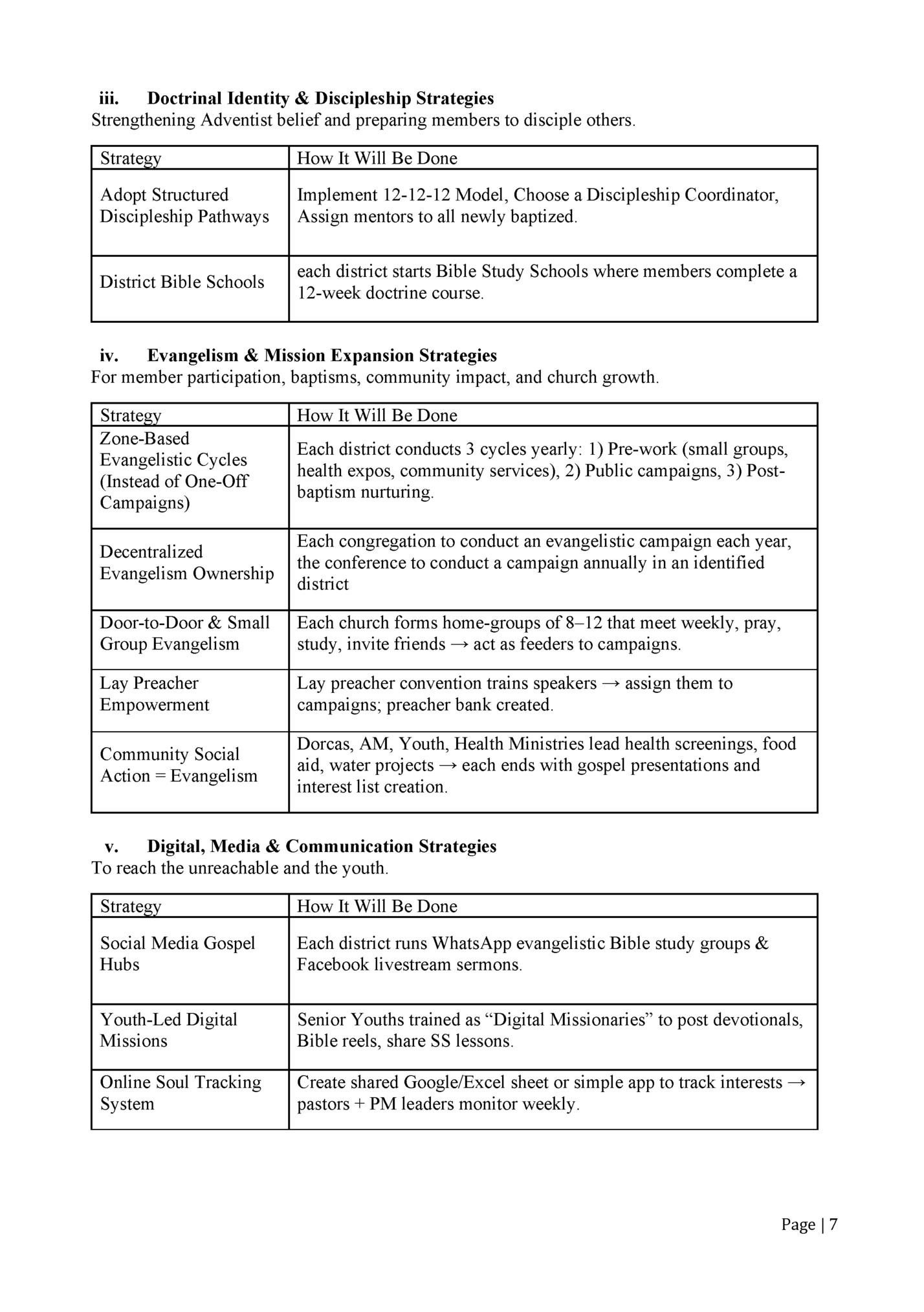
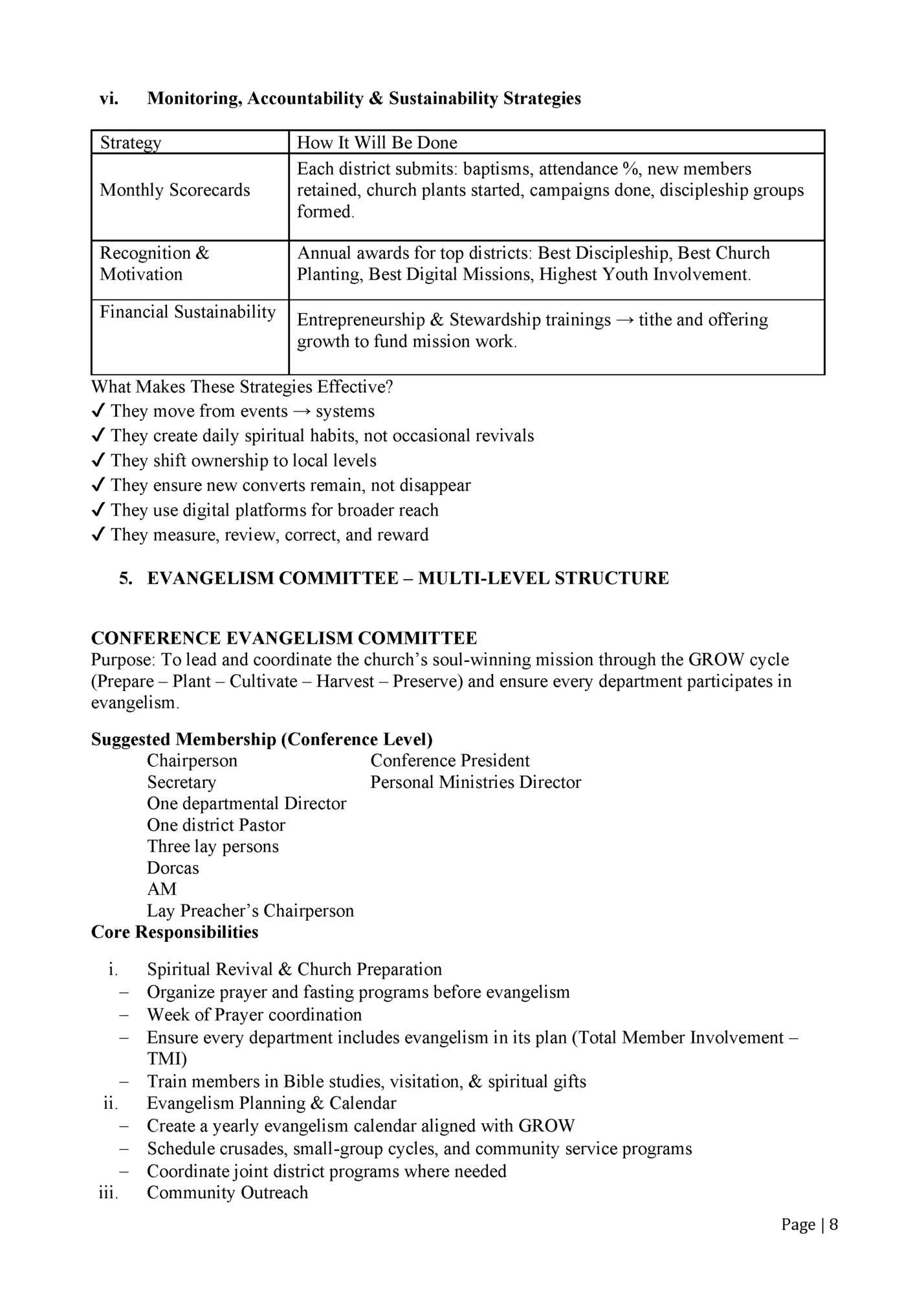
Monitoring, Accountability & Sustainability Strategies Strategy Monthly Scorecards How It Will Be Done Each district submits: baptisms, attendance %, new members retained, church plants started, campaigns done, discipleship groups formed. Recognition & Motivation Annual awards for top districts: Best Discipleship, Best Church Planting, Best Digital Missions, Highest Youth Involvement. Financial Sustainability Entrepreneurship & Stewardship trainings → tithe and offering growth to fund mission work. What Makes These Strategies Effective? ✔ They move from events → systems ✔ They create daily spiritual habits, not occasional revivals ✔ They shift ownership to local levels ✔ They ensure new converts remain, not disappear ✔ They use digital platforms for broader reach ✔ They measure, review, correct, and reward 5. EVANGELISM COMMITTEE – MULTI-LEVEL STRUCTURE CONFERENCE EVANGELISM COMMITTEE Purpose: To lead and coordinate the church’s soul-winning mission through the GROW cycle (Prepare – Plant – Cultivate – Harvest – Preserve) and ensure every department participates in evangelism. Suggested Membership (Conference Level) Chairperson Conference President Secretary Personal Ministries Director One departmental Director One district Pastor Three lay persons Dorcas AM Lay Preacher’s Chairperson Core Responsibilities i. − − − − ii. − − − iii. Spiritual Revival & Church Preparation Organize prayer and fasting programs before evangelism Week of Prayer coordination Ensure every department includes evangelism in its plan (Total Member Involvement – TMI) Train members in Bible studies, visitation, & spiritual gifts Evangelism Planning & Calendar Create a yearly evangelism calendar aligned with GROW Schedule crusades, small-group cycles, and community service programs Coordinate joint district programs where needed Community Outreach Page | 8
Fleepit Digital © 2021