India This Week~August 28, 2026
India This Week~August 28, 2026
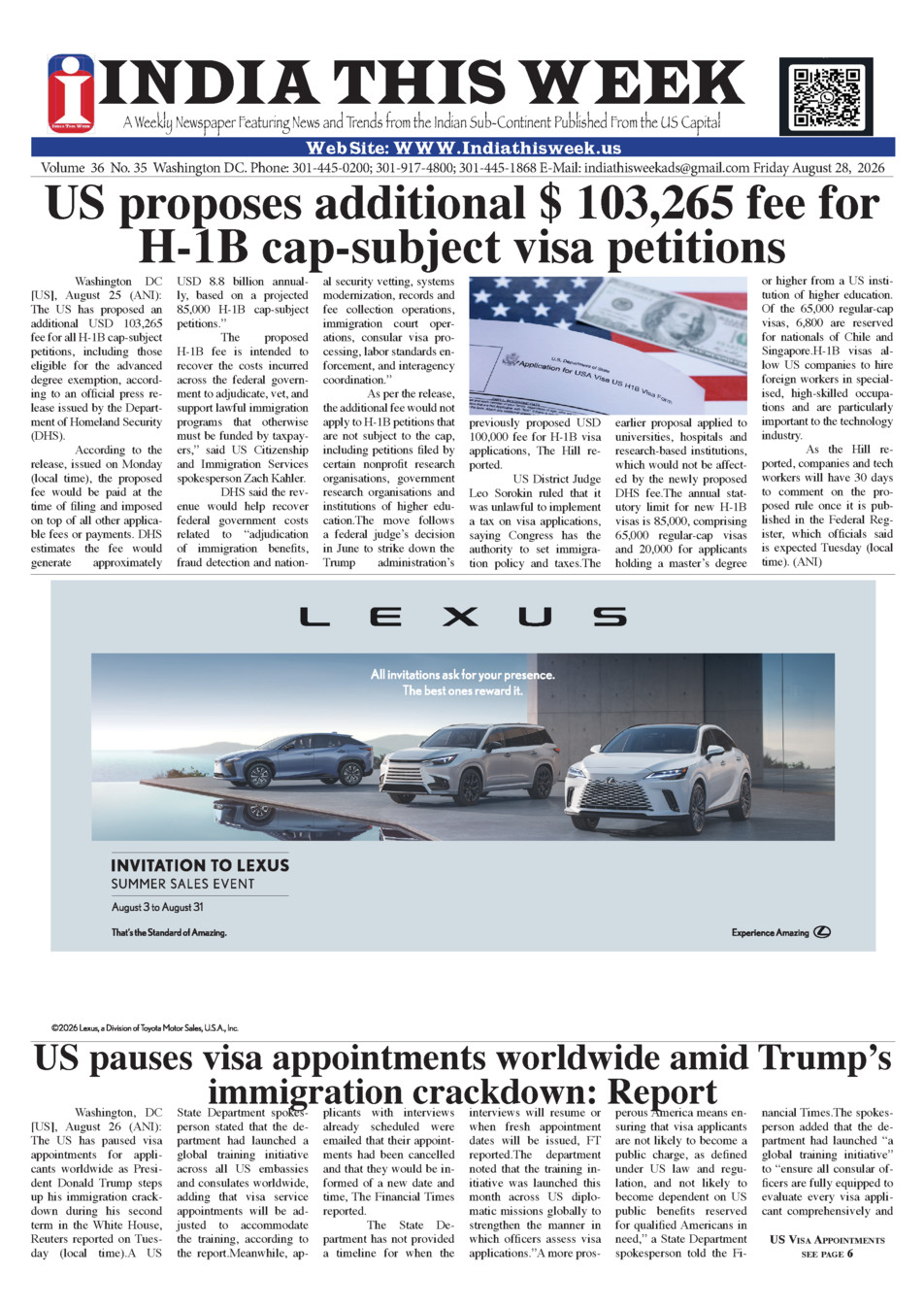
India This Week — Highlights of August 28, 2026: H-1B Fee Proposal, Diwali Recognition in California, Caste Census Debate, IOSV Talks, Delhi Lakshmi Yojna
Page 1 – U.S. H-1B Fee Proposal and Global Visa Appointment Pause
Washington officials floated a new surcharge of 103,265 dollars on every H-1B petition that falls under the cap, including those eligible for the advanced degree exemption. The extra fee would be due at filing and would be in addition to existing charges. Government estimates suggest this levy could yield as much as 8.8 billion dollars each year, assuming around 85,000 cap-subject petitions are filed. (Page 1)
The underlying aim of the proposed fee is to offset the costs borne by multiple federal agencies in adjudicating, vetting, and supporting immigration programs, with the revenue intended to lessen the burden on taxpayers. (Page 1)
Petitions not subject to the cap—such as those filed by certain nonprofit research organizations, government research bodies, and higher education institutions—would not be subject to the new charge. A prior court ruling had blocked a separate Trump-era proposal that sought to impose a 100,000-dollar fee on H-1B applications. (Page 1)
Currently, the annual cap on new H-1B visas stands at 85,000, split into 65,000 regular slots and 20,000 reserved for master’s degree holders from U.S. institutions. Among the regular-cap visas, a portion is set aside for nationals of Chile and Singapore. (Page 1)
H-1B visas enable U.S. firms to hire highly skilled foreign workers, and they are particularly vital for the technology sector. Following the referenced developments, stakeholders will have a 30-day window to submit public comments once the rule appears in the Federal Register. (Page 1)
Separately, Washington also announced a pause of visa appointments worldwide as part of a broader immigration enforcement push during the current administration. The pause, linked to a global training program for consular staff, will affect interview schedules, with affected applicants receiving notices about rescheduling as the training proceeds. (Page 1)
Authorities indicated that the training aims to improve the way consular officers evaluate visa applications to ensure applicants are evaluated comprehensively and in line with public-interest standards. No precise timeline was provided for when interviews would resume, and existing appointments were canceled or postponed with new dates to be issued in due course. (Page 1)
Page 2 – California Recognizes Diwali Day; Drowning Tragedy in Rohru
In a move signaling strong support for the Indian-American community, California’s State Assembly passed a resolution recognizing Diwali on November 8, 2026, and conveying its deepest respect to those celebrating the Festival of Lights. House Resolution 137, introduced by Assembly Members Darshana Patel and Ash Kalra, honors the festival’s cultural and spiritual significance and encourages participation from Californians across communities. (Page 2)
The measure emphasizes that Diwali is observed by Hindus, Sikhs, Buddhists, and Jains not only in the United States but worldwide, underlining California’s commitment to cultural diversity. Patel explained the timely nature of the recognition, noting that lawmakers chose to mark the occasion ahead of the festival since the Legislature would be out of session when it falls in November. (Page 2)
The resolution describes Diwali as “a row of lamps” symbolizing light triumphing over darkness and highlights its broader themes of generosity, unity, and renewal. It also references the tradition of decorating homes, preparing colorful designs, sharing meals, and gathering for music and community celebrations as expressions of shared values like truth, duty, and family. The measure builds on a 2025 statute that formally added Diwali to California’s official state holidays, reflecting the state’s growing recognition of its diverse Indian-American community. (Page 2)
Meanwhile in Rohru, Himachal Pradesh, two 16-year-old students died after drowning while swimming in the Pabbar River. Local authorities, aided by the National Disaster Response Force and rescue teams, recovered the bodies, and relief funds were provided to the families in accordance with applicable rules. The tragedy has deeply affected the community, and officials pledged continued support and condolences to the bereaved families. (Page 2)
Page 3 – Caste Census Debate: Opposition Versus Government
The national caste census has become a focal point of political contention after Congress leaders Mallikarjun Kharge and Rahul Gandhi urged Prime Minister Modi to withdraw the current questionnaire. The Opposition argues that an open-ended caste entry format, rather than a precompiled list, risks producing unreliable data due to variations in spelling, subcaste names, and local terms, potentially undercounting disadvantaged groups. (Page 3)
Kharge and Gandhi warned that without a standardized, verified list of castes, the counting exercise could fragment data across thousands of entries and fail to accurately capture the share of Other Backward Classes and other marginalized groups. They publicly urged consultations with parties, experts, and the public, and called for canceling the current form in favor of a structured approach similar to caste surveys conducted in Telangana and Bihar. (Page 3)
Other Congress voices, including Jairam Ramesh and KC Venugopal, described the process as a “deception” and criticized the questionnaire for lacking explicit options for backward classes. They pressed for a comprehensive, collaborative reform that aligns with proven state methodologies. (Page 3)
In response, the BJP defended the move to include caste enumeration as a necessary step toward social justice, arguing that the government’s approach reflects a commitment to equity. UP leaders and other officials characterized the opposition’s objections as political maneuvering ahead of forthcoming state elections, noting that Telangana and Bihar demonstrate the value of structured caste data collection. (Page 3)
Page 4 – India-U.S. Talks on Indian Ocean Strategic Venture (IOSV)
Foreign Secretary Vikram Misri and U.S. Under Secretary of State Allison M. Hooker held a phone discussion to explore ways to broaden cooperation in the Indian Ocean region, with emphasis on maritime security, strategic infrastructure, and connectivity. The External Affairs Ministry stated that both sides examined practical avenues for greater coordination and complementarity in line with shared regional priorities. (Page 4)
The IOSV initiative, launched by Indian and U.S. leaders in 2025, seeks to deepen practical cooperation across the Indian Ocean by focusing on key domains such as security, infrastructure, and economic links. The dialogue highlighted the potential for collaboration that aligns with partner nations’ priorities while promoting stable, resilient regional connectivity. (Page 4)
Particular attention was given to undersea cable networks and New Delhi’s role in cable maintenance, repair, and financing through trusted vendors. The discussions also opened possibilities for partnerships spanning the Western Indian Ocean, West Asia, and the Indo-Pacific region, spanning defense, technology, energy, and critical minerals. The talks underscore a broader effort to strengthen connectivity and security across a critical maritime domain. (Page 4)
Page 5–6 – Delhi Lakshmi Yojna Launched; The Poetic Pen on Gratitude
Delhi’s government launched the Delhi Lakshmi Yojna, a program designed to empower women economically by providing monthly financial support of 2,500 rupees. The launch event at Talkatora Stadium was attended by Union Minister of State Harsh Malhotra, the Delhi Lieutenant Governor, the Chief Minister, and other dignitaries, with sanction letters presented to a group of beneficiaries. To date, more than 4,000 women have received sanction letters under the scheme. (Page 5)
Eligible women between 21 and 60 years old will receive 2,500 rupees each month via direct bank transfers starting September 1, giving them greater financial autonomy to address household needs and personal ambitions. Senior government officials highlighted that the program embodies the Modi administration’s commitment to welfare and empowerment for mothers and daughters, complemented by the Delhi government’s efforts to create opportunities and improve living standards. (Page 6)
Officials emphasized that the Delhi Lakshmi Yojna represents a significant step toward strengthening women’s financial security and self-reliance, with assurances that the scheme will be backed by robust implementation and transparency. Congratulatory messages from the Delhi LG and the Chief Minister highlighted the collaboration between city and central authorities to fulfill this pledge, and Prime Minister Modi’s broader agenda of social welfare was cited as the guiding framework. (Page 6)
In a tangential yet reflective note, The Poetic Pen by Rajan George reflects on gratitude, arguing that expressing thanks to those who help us is a sign of virtue rather than flattery. The piece suggests gratitude elevates the giver and strengthens communal bonds, urging readers to acknowledge benefits received as a source of motivation for others. It frames gratitude as an act rooted in love, sacrifice, and the desire to sustain positive relationships. (Page 6)