India This Week~August 14, 2026
India This Week~August 14, 2026
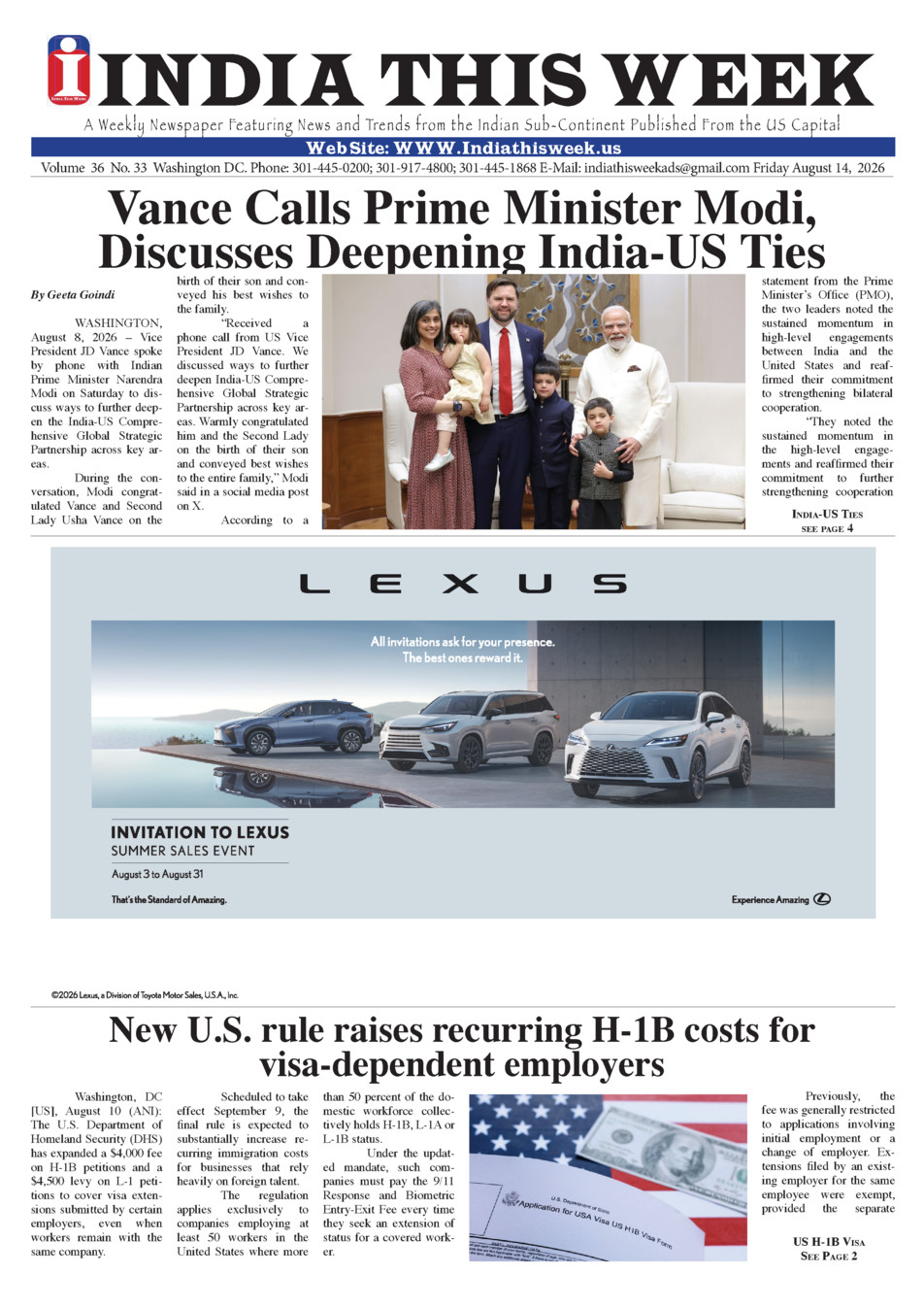
India This Week – August 14, 2026: A Comprehensive Blog Summary of Key Developments in India-US Ties, Immigration Policy, Diaspora Recognitions, Space Cooperation, and Disaster Updates
Page 1 – Immigration policy evolutions in the United States: expanded fees for visa extensions and their potential impact
The U.S. Department of Homeland Security has broadened the application of a biometric fee framework that adds substantial recurring costs for employers who sponsor skilled workers on H-1B visas and, in some cases, L-1 visas. The new rules will take effect later in the year and require employers to cover a biometric entry-exit charge every time a worker’s status is extended, even when the employee remains with the same company. This marks a meaningful expansion beyond the prior practice, which largely tied such fees to initial employment or intercompany changes of employer. (Page 1)
Under the updated policy, firms that employ at least fifty workers in the United States and where more than half of the domestic workforce holds H-1B, L-1A or L-1B status hold the responsibility to pay a $4,000 fee for qualifying H-1B extensions and a $4,500 fee for L-1 extension filings. The intent is to fund the biometric verification system that tracks entries and exits of foreign nationals. The government argues that this financial obligation falls squarely on employers and that the change remains a modest expense relative to overall payrolls and recruitment costs. (Page 1)
Analysts and industry voices have warned that this policy could indirectly influence hiring strategies, the cost structure of tech services, and the prospect of retaining highly skilled foreign workers, especially in a landscape already contending with lengthy green card backlogs. DHS defended the move, noting that the number of affected filings would be concentrated among a subset of companies and that the revenue raised supports critical border and identity checks. Projections suggested tens of millions in incremental revenue for the federal biometric program in the coming years. (Page 1)
Page 2 – A shift in U.S. immigration policy under a presidential administration: executive actions targeting birth tourism and citizenship recognition
Two executive orders issued by the White House seek to reform the treatment of birth tourism and to recalibrate how U.S. citizenship is recognized for certain individuals, framed in the context of safeguarding the integrity of immigration rules. The first order labeled as aimed at ending birth tourism asserts that citizenship should not be accessible through schemes that are designed to exploit temporary visa channels for the purpose of giving birth on American soil. The administration describes such practices as deceptive and as undermining the broader immigration system, which in turn burdens enforcement resources and public trust. (Page 2)
The second order, focused on preserving the meaning and value of American citizenship, responds to a Supreme Court ruling in late June that clarified aspects of the Citizenship Clause. It directs federal agencies to adjust their policies so that documents asserting U.S. citizenship are not issued or recognized in specific circumstances where the parentage or other conditions disqualify an individual from birthright citizenship under current interpretations. Officials are instructed to publish implementing guidance within a limited timeframe, and the orders anticipate that agencies may deny visas, refuse entry, or take removal actions against those engaging in birth tourism. The directives are designed to be applied within existing statutory authorities and remain amenable to judicial review. (Page 2)
Collectively, the orders aim to preserve the integrity of the nation’s immigration framework, deter the misuses of temporary visa channels, and safeguard what the administration describes as the essential meaning of U.S. citizenship. The plans emphasize policy alignment with ongoing legal processes and note that any further challenges would be resolved in the courts. (Page 2)
Page 3 – Urban emergency: a large fire on Church Road in Mumbai results in fatalities and extensive rescue operations
A major blaze swept through the 11th floor of a multi-storey building on Church Road in the western suburb of Mumbai, triggering a rapid response from eight fire tenders and leading to multiple casualties. Rescuers evacuated residents from various parts of the structure, and a number of people were pulled to safety from the building’s terrace, highlighting the perils of densely populated urban housing during a fire incident. (Page 3)
Initially, two people died—an adult woman and a young child—while several others were hospitalized as fire suppression and cooling operations continued. Authorities indicated that the exact cause would be determined after a thorough investigation, and they noted that a related incident had occurred earlier at a Byculla police station, though the two events are distinct. The broader context points to ongoing challenges in managing indoor fires in crowded urban settings. (Page 3)
The scene involved extensive coordination between fire services and municipal authorities, and later updates identified the victims by age and designation, with additional injured individuals reported as stable. The casualty figures reflect the severity of the blaze and the importance of rapid, organized response in highly built environments. (Page 3)
Page 4 – India-US ties: high-level talks, trade negotiations, space diplomacy, and diaspora symbolism
In a substantive exchange, U.S. Vice President JD Vance spoke with Indian Prime Minister Narendra Modi by phone to explore ways to intensify the long-standing Comprehensive Global Strategic Partnership between India and the United States. The two leaders acknowledged the momentum of ongoing high-level engagements and reaffirmed their shared commitment to deepening cooperation across strategic domains while recognizing personal moments, such as Modi’s congratulatory message to Vance and his family. (Page 4)
The dialogue occurred amid sensitive negotiations over a bilateral trade agreement, with both capitals signaling the importance of a robust economic framework in addition to security and technological collaboration. Complicating the picture, the U.S. Senate passed legislation aimed at Russian oil and gas purchasers, which could drive tariffs on nations that continue to procure Russian energy. Although penalties would not automatically reach the maximum level, a process involving tariff determination and potential presidential waivers creates a complex backdrop for the India-U.S. trade talks. (Page 4)
Officials on both sides suggested that negotiations were approaching a favorable landing, with parliamentary committees urging swift conclusions that still respect India’s domestic interests and market-access needs for key products. The outreach also touched on the establishment and significance of the Consulate General in Boston as a milestone in people-to-people diplomacy and economic and cultural exchange. Separately, space diplomacy featured in public messages as Russian cosmonauts congratulated India on the eve of its 80th independence anniversary, tying together historical space collaboration with contemporary aims like India’s Gaganyaan program. (Page 4)
Page 5 – Diaspora recognition and city-level celebrations: India Day proclamations in Massachusetts and Boston
The state of Massachusetts officially designated August 15, 2026 as India Day, celebrating the Indian-American community’s substantial contributions to science, medicine, technology, education, business, and civic life. The proclamation highlighted the community’s role in enriching the state’s social and economic fabric and noted the broader historical significance of India’s independence in 1947 as a defining milestone for the world’s largest democracy. The governor framed the occasion as a moment to honor achievements and to encourage continued civic engagement and cultural exchange. (Page 5)
In the city of Boston, the mayor also proclaimed India Day, underscoring the vibrant Indian-American presence and its enduring alliance with the United States. The emphasis on entrepreneurship, scholarship, innovation, and community service reflected a broader narrative of bilateral friendship that extends beyond economic ties into education and cultural diplomacy. The proclamations tied into broader commemorations, including the city’s celebration of its own historical milestones and the ongoing demonstration of cultural diversity as a foundation for strong international relationships. (Page 5)
In the same vein, the news coverage highlighted ongoing exchanges and the establishment of Indian-language and cultural programs in the Boston area, as well as acknowledgments of organizations dedicated to fostering a sense of belonging and collaboration. The reports cited the Consulate General’s role in promoting exchanges across academia, trade, and cultural performance, illustrating how diaspora communities are integral to the relationship between India and New England. (Page 5)
Page 6 – International space ties and regional goodwill: India-Russia friendship and space collaboration signals
A video message from Russian cosmonauts aboard the International Space Station offered greetings to India as it prepared for a major Independence Day milestone. The crew invoked the shared history of space cooperation, referencing early collaborations like Aryabhata and Rakesh Sharma’s milestone, and celebrated the ongoing development of India’s Gaganyaan program. The message framed space exploration as a central pillar of the bilateral relationship and highlighted the enduring friendship between India and Russia. (Page 6)
Cosmonaut remarks also drew attention to the broader spirit of cooperation across space science, including joint activities arranged through Roscosmos, ISRO, and other space agencies. The greetings reinforced the symbolic importance of space ties as a forward-looking element of diplomacy and scientific collaboration, tying past achievements to India’s contemporary efforts to establish human spaceflight capabilities. (Page 6)
Additionally, the coverage acknowledged the broader context of Russia-India cooperation in science and technology and the enduring legacy of historical ties that continue to inform present-day partnership in space exploration. The dialogue around space was presented as a positive emblem of friendship and mutual interests between the two nations. (Page 6)
Page 7 – A cultural reflection: The Poetic Pen contemplates hospitality, discernment, and the dangers of unguarded generosity
The Poetic Pen piece delves into a meditation on hospitality, cautioning readers to balance kindness with wisdom when welcoming outsiders. The poem explores the tension between extending aid and safeguarding one’s own social boundaries, suggesting that even well-intentioned acts can be exploited if discernment is lacking. The author uses a blend of colorfully framed images and admonitions to emphasize the potential for guests to shift from grateful visitors to opportunists who undermine a host’s cultural norms and resources. (Page 7)
Across the lines of the verse, the reader is urged to recognize that generosity must be paired with vigilance, lest hospitality become a doorway for those who would seek to gain power or alter a community’s foundations. The poem argues for keeping a balance such that acts of grace do not erode shared values or the mutual trust that sustains a culture. It also acknowledges the complexities of welcoming newcomers while preserving the integrity and dignity of the host society. (Page 7)
Ultimately, the piece cautions against naiveté in social exchanges, urging a principled approach to charity and aid. It contends that a community can be open and welcoming while still guarding its core principles, ensuring that kindness remains genuine and not a vehicle for coercion or domination. The closing thought emphasizes that a wise approach to hospitality preserves both the virtues of generosity and the resilience of a community’s social fabric. (Page 7)
Page 6 (Additional) – The Himachal monsoon report: toll, infrastructure damage, and ongoing restoration efforts
In an extensive situational update from Himachal Pradesh, authorities summarized a period of intense monsoon activity that has left a heavy human and material toll. Over the 43-day window from late June to mid-August, the state recorded a rising death toll from disaster-related incidents and a high number of road closures due to landslides and weather-related damage. The official counts reveal a grim picture of vulnerability in mountainous terrain and the critical importance of rapid response and rehabilitation planning. (Page 6)
The latest figures show that seventy people died in direct disaster-related events, with a significant share of fatalities resulting from landslides and injuries sustained from falls on unstable slopes. The vast majority of road networks remain compromised, with more than two hundred highways and feeder roads blocked, complicating the movement of relief supplies and emergency crews. The numbers underscore the need for sustained logistics and disaster-management support. (Page 6)
Concurrently, the assessment highlighted substantial damage to public property, with a total estimated loss exceeding Rs 910 crore. The Public Works Department bore the largest burden, followed by impacts to power infrastructure and water supply networks. The disruption has affected a wide array of systems, from distribution transformers to regional water schemes, with particular concentration in districts such as Mandi, Kullu, Sirmaur, and Lahaul-Spiti. (Page 6)
Restoration efforts have focused on clearing landslides, reopening key routes, restoring electricity supply, and repairing drinking water systems, while public health, livestock, and agricultural assets are also being addressed. Authorities warn that continuing rainfall and the risk of fresh slides demand cautious operational planning and robust coordination among state agencies, district administrations, and emergency responders. Despite progress, the path to full normalization remains challenging, given the scale of damage and the rugged geographic context. (Page 6)
Page 7 – Conclusion and reflections: synthesis of the week’s major themes
This week’s coverage presents a mosaic of geopolitical, domestic, and humanitarian developments that together illuminate evolving dynamics between India, the United States, and other key actors. The immigration policy shifts in Washington—whether in expanding biometric fees or reinterpreting birthright citizenship—signal a broader emphasis on enforcement, oversight, and the recalibration of how skilled labor and diasporic communities intersect with national priorities. At the same time, bilateral relations with India are marked by high-level conversations about strategic cooperation, trade negotiations, and people-to-people ties expressed through diaspora recognitions and city-level acknowledgments. (Page 7)
The Mumbai fire incident and the Himachal monsoon update remind readers that rapid change occurs not only in geopolitics but also in daily life and public safety. Urban emergencies demand coordinated, well-resourced responses, while natural disasters in vulnerable regions require sustained recovery and resilience-building. Taken together, these stories illustrate the multi-layered nature of contemporary realities—where policy decisions in capitals ripple into labor markets and visa processes, and where acts of diplomacy are mirrored by acts of aid, habitat protection, and cultural exchange. (Page 7)
As India approaches a significant milestone in its independence celebration, the period’s international gestures—from space cooperation to diplomatic proclamations honoring the Indian diaspora—underscore a spirit of collaboration and mutual interest that transcends borders. The juxtaposition of policy shifts, governance choices, and humanitarian stories paints a holistic view of a world in which economic strategy, security concerns, and cultural ties intertwine to shape a shared future. (Page 7)