India This Week~August 7, 2026
India This Week~August 7, 2026
India This Week — Aug 7, 2026: A Comprehensive, Paraphrased Digest of Key Stories, Developments, and Cultural Highlights
Five Indian-American Girls Among 10 Finalists in the 2026 3M Young Scientist Challenge
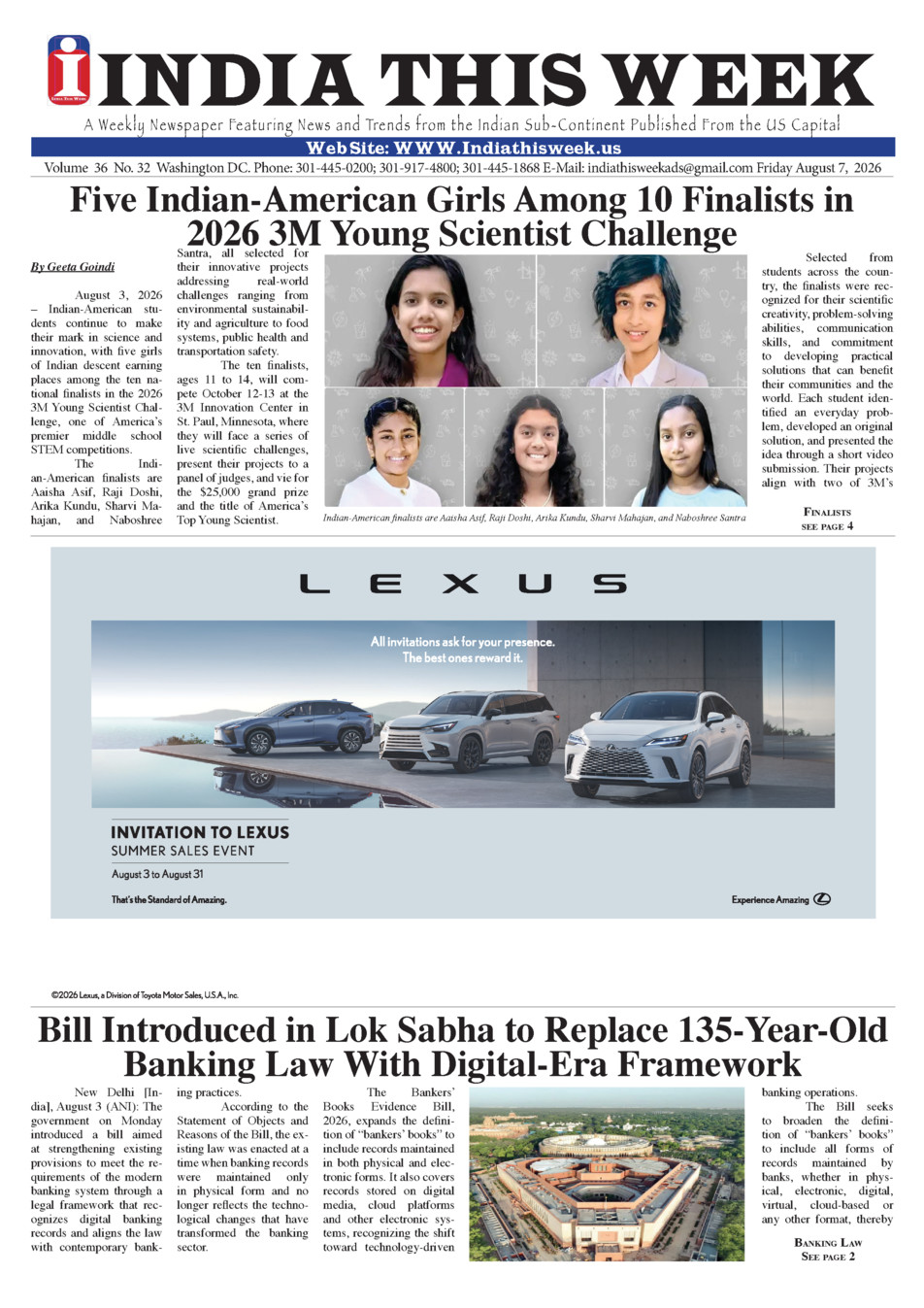
The 2026 cohort of finalists for a major U.S. middle-school STEM competition includes five young women of Indian heritage, all distinguished for turning everyday problems into inventive solutions. These competitors, aged 11 to 14, were selected from across the country to participate in a challenge that blends hands-on science with communication and mentorship. They will travel to the 3M Innovation Center in Minnesota in October to present their ideas to judges and engage in live problem-solving activities, with a grand prize of $25,000 and the honor of being named America’s Top Young Scientist. (Page 4)
Aaisha Asif, 12, from Sarasota, Florida, devised an eco-friendly adhesive inspired by the natural bonding mechanisms of mussels. Her aim is to reduce reliance on traditional glues that emit volatile organic compounds, thereby improving air quality and health outcomes. She emphasizes drawing lessons from natural adhesion to create a sustainable, high-performance alternative. (Page 4)
Raji Doshi, 12, of Farmington, Connecticut, explored a coastal-improvement approach using algae and naturally occurring buffers to help neutralize ocean acidity and promote marine ecosystem health. Her work reflects a sense of urgency about climate-related impacts and prioritizes solutions with tangible community benefits. (Page 4)
Arika Kundu, 13, from Shorewood, Minnesota, introduced a method called LIGNEX that uses agricultural waste—such as peanut shells—to remove pesticide residues from produce, aiming to make food safer and more accessible. Her motivation stems from practical, scalable applications that mainstream audiences can benefit from. (Page 4)
Sharvi Mahajan, 14, based in San Diego, California, developed NeuroDrive Alert, a system designed to monitor driver fatigue and predict microsleeps to improve safety in high-risk environments. She aspires to pursue computational neuroscience or start a technology venture, guided by a passion for brain science and AI. (Page 4)
Naboshree Santra, 11, from Oviedo, Florida, created biodegradable soil-shade balls intended to curb evaporation and conserve soil moisture, offering a simple, environmentally friendly tool for drought-prone farming. She envisions taking her concept from idea to real-world use. (Page 4)
Rounding out the finalists are several other talented students, including Ahmed Abdelsalam, Aiden Jo, Roy Kim, Millie Pradawong, and Abigail Stein. This class features a gender mix with seven girls and three boys, reflecting broad participation in STEM at an early age. The finalists will receive a summer mentorship from 3M scientists to refine their ideas ahead of the national finals. (Page 4)
Discovery Education partners with 3M to support the Young Scientist Challenge, providing learning resources and coordinating the mentorship program. Industry leaders emphasize that the event demonstrates how curiosity, resilience, and clear communication can transform youthful curiosity into practical innovations with real-world impact. (Page 4)
In remarks accompanying the announcement, the chief executive of Discovery Education highlighted the value of giving young scientists access to mentorship and hands-on guidance as they translate ideas into tangible products. The 3M leadership stressed a commitment to nurturing talent that can contribute to climate technology and safety—two focus areas among the finalists’ projects. (Page 4)
Bill Introduced in Lok Sabha to Replace 135-Year-Old Banking Law With Digital-Era Framework
The Indian government introduced a legislation package meant to modernize the framework governing banking records and evidence, acknowledging the shift from paper-based processes to digital systems. The proposed Bankers’ Books Evidence Bill, 2026, seeks to align legal standards with contemporary banking practices by expanding how banking records are defined and used in legal settings. (Page 1)
Key changes include broadening the definition of “bankers’ books” to encompass both physical and electronic records, including those stored in digital media and cloud environments. The aim is to ensure that electronic records can be admissible as evidence under a unified, technology-neutral standard, without requiring original documents whenever certifiable copies can demonstrate authenticity. (Page 1)
The bill also contemplates a formal certification regime for banking records and envisions the central government’s authority to prescribe additional criteria as technology evolves. By extending the law’s reach to entities engaged in banking activities through official notification, the government seeks to future-proof evidence rules in a digital era while maintaining reliability and trust in court proceedings. (Page 1)
Officials emphasize that the modernization effort is driven by the realities of modern banking, where most records are created and stored electronically. The objective is to ensure that evidence handling keeps pace with technological advances, safeguarding the integrity of financial transactions and related legal processes. (Page 1)
The bill situates itself within a broader push to standardize how digital financial records are certified and admitted as evidence, reducing legal obstacles that arise from outdated definitions tied to physical media. It also signals a governmental intent to adapt the legal framework to evolving financial technologies and market practices. (Page 1)
US Student Visas to Indian, Chinese Nationals See Sharp Decline in 2025, CIS Report
A Center for Immigration Studies report highlights a notable drop in F-1 visa issuances to Indian and Chinese nationals during the 2025 May–August window, a period typically characterized by the highest visa activity ahead of the school year. The shifts are significant, with implications for both the U.S. higher-education ecosystem and broader workforce dynamics. (Page 2)
For Indian applicants, the number of F-1 visas issued in this peak period fell to 22,149 in 2025, a drop of about 60% from the long-term average of the 2017–2019 and 2021–2024 periods. This figure also marks a substantial decrease relative to 2024. (Page 2)
Chinese applicants experienced a 46% decline in the same window, with 40,034 visas issued in 2025, compared with higher historical averages and a drop from 2024 figures. The data underscore a broader trend regarding select nationalities during this critical departure period. (Page 2)
The CIS analysis relies on data from the Institute of International Education and emphasizes that Indians and Chinese collectively accounted for more than half of all foreign students enrolled in U.S. postsecondary institutions during the 2024–25 academic year. (Page 2)
The report notes that the Optional Practical Training (OPT) program remains a central pathway for international students to gain work experience in the United States, with a sizable portion of participants coming from India and China. In 2024–25, roughly 294,253 students on OPT were working in the U.S. after graduation, with Indians and Chinese representing the majority of OPT participants. (Page 2)
Authorities argue that reduced intake of students from these two countries could influence the OPT pipeline and the availability of foreign workers in U.S. labor markets, particularly in STEM fields. The report also discusses concerns about national security and technology transfer, noting expert cautions about risks associated with foreign students in sensitive disciplines. (Page 2)
As the analysis contrasts OPT with H-1B visa limits, it highlights the CAPs and policy tensions that shape how foreign graduates participate in the U.S. economy. The CIS study implies that shifts in student migration patterns could have long-term consequences for American universities, industry sectors, and workforce demographics. (Page 2)
Over 1 Lakh Senior Citizens and 4.63 Lakh Women Lodged Financial Cyber Fraud Complaints in 2025: Govt
New Delhi officials released statistics showing a substantial number of financial cybercrime complaints in 2025, with seniors and women representing a large share of victims. The data, drawn from the National Cyber Crime Reporting Portal, reveal a multi-crore impact that underscores the vulnerability of diverse demographic groups to digital fraud. (Page 3)
In 2025, more than 1 lakh senior citizens and over 4.6 lakh women filed complaints related to financial cyber fraud, totaling approximately Rs 7,769 crore in losses. The figures come from parliamentary briefings and reflect the scale of cybercrime across the country. (Page 3)
The Ministry of Home Affairs explains that cybercrime prevention and response are primarily state subjects, while the central government provides policy guidance, technical support, and financial resources to strengthen enforcement. The National Cyber Crime Reporting Portal (NCRP) is part of the Indian Cybercrime Coordination Centre (I4C) initiative to streamline reporting and coordination. (Page 3)
To facilitate immediate reporting and prevent fund siphoning, the Citizen Financial Cyber Fraud Reporting and Management System (CFCFRMS) was launched in 2021, enabling rapid action in the event of fraud. The statistics highlight ongoing challenges but also emphasize federal and state collaboration to safeguard digital financial activity. (Page 3)
Bypoll Shockwave: Youth anger costly for BJP as Prashant Kishor Shatters Saffron Stronghold in Bankipur; Congress Retains Datia
In a sequence of by-elections, the Bharatiya Janata Party faced a setback in Bankipur, Bihar, where Jan Suraaj Party founder Prashant Kishor secured a decisive victory by more than 19,000 votes. The victory marks Kishor’s first electoral win since launching the political platform and signals a potential shift in regional sentiment amid youth-led demonstrations and concerns about unemployment. (Page 3)
Meanwhile, in Madhya Pradesh’s Datia, the Congress retained the constituency by defeating its BJP rival by a margin of just over 6,000 votes. The outcome sustains the opposition party’s foothold in the region, even as the ruling coalition touts gains elsewhere. (Page 3)
In Gujarat’s Manjalpur seat, BJP managed to hold the seat with a margin exceeding 30,000 votes, though this win came with a notable decline from previous margins. The results followed a broader pattern of voter fatigue and disillusionment with the governing party in several parts of the country. (Page 3)
After the votes were counted, Kishor framed Bankipur as a broader message to national leadership, stressing that the mandate was about governance and national progress rather than a single locality. Opposition voices, including Arvind Kejriwal and Akhilesh Yadav, linked the BJP’s losses to the broader political climate, and Kejriwal congratulated Kishor on his win. (Page 3)
The Datia race saw the Congress’s Ghanshyam Singh secure victory, while the BJP’s Ashutosh Tiwari acknowledged the electorate’s support and pledged to work with renewed vigor. Observers noted that turnout and engagement in these bypolls reflect heightened political competition and public demand for accountability. (Page 3)
Analysts say the results underscore a shifting political landscape in northern and central India, with youth activism and responses to examination policies and unemployment shaping voter behavior. The Bankipur outcome, in particular, is being watched for its potential to influence party strategies ahead of upcoming state and national elections. (Page 3)
The Poetic Pen: If Today Were My Last
This reflective verse contemplates mortality and the legacy one leaves behind, urging readers to consider what truly matters beyond personal wealth. It invites readers to measure life by acts of love, service, and generosity, rather than by possessions or status, and to aim for a lasting impact on others. The poem emphasizes ethical living, empathy, and contributions that transcend material gains, suggesting a spiritual perspective on life’s finite nature. (Page 5)
“All 13 Indian Nationals Have Been Rescued”: MEA After Indian Vessel Sinks Off Yemen After Attack
The Indian government condemned an attack on an Indian-flagged vessel near Yemeni waters, which subsequently capsized and sank, but all crew members were rescued. The MEA confirmed that 14 seafarers, including 13 Indians and one Yemeni national, were saved and evacuated to safety. The incident prompted diplomatic engagement with Yemeni authorities and a coordinated search-and-rescue effort by maritime authorities. (Page 7)
In a public statement, Union Minister Sarbananda Sonowal reiterated India’s commitment to safeguarding its sailors and ensuring their swift repatriation and welfare. He noted that all rescued personnel were treated to medical care as needed and were accounted for by Yemeni Coast Guard facilities. (Page 7)
Initial reporting indicated the vessel, MSV Faize Noore Oliya, was struck near Yemeni territorial waters, leading to a capsize and sinking. The government emphasized the broader concern over maritime security in the Red Sea region and called for an immediate restoration of safe, unobstructed navigation through international waterways. (Page 7)
The ongoing situation is viewed within the context of regional tensions, including naval activity along the Bab al-Mandab Strait and renewed security concerns following various maritime incidents involving commercial shipping. The government pledged continued vigilance and cooperation with allied authorities to protect Indian seafarers abroad. (Page 7)