India This Week~June 12, 2026
India This Week~June 12, 2026
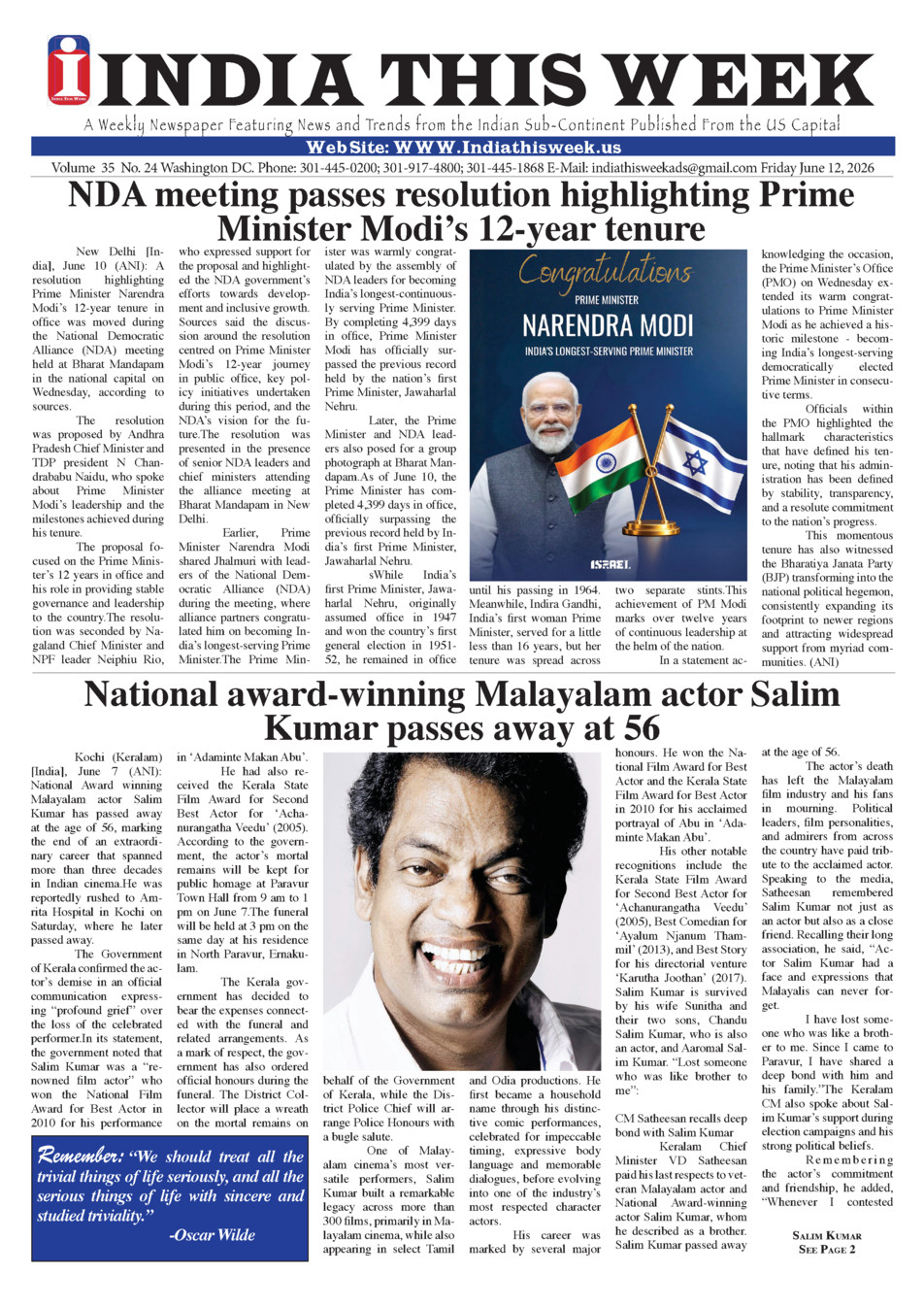
India This Week – Highlights and Analyses: Key Developments Across Politics, Culture, and Global Policy (June 12, 2026)
NDA Meeting: Modi’s 12-Year Tenure Highlighted
During a National Democratic Alliance gathering at Bharat Mandapam, a formal resolution was introduced to commemorate Prime Minister Narendra Modi’s twelve years in public office, praising the stability and direction his leadership has provided to the nation. The proposal originated from Andhra Pradesh Chief Minister and TDP president N. Chandrababu Naidu and found backing from Neiphiu Rio, the Nagaland Chief Minister and NPF leader, who spoke in favor of recognizing Modi’s governance and policy milestones. The message conveyed at the meeting emphasized continuity of governance and the NDA’s ongoing commitment to inclusive development. (Page 1)
The discourse surrounding the resolution focused on Modi’s two-decade-plus period in office, highlighting major policy priorities and the administration’s impact on national growth, governance transparency, and social progress. Participants discussed the administration’s achievements in areas such as economic reform, public service delivery, and regional cohesion, while outlining a forward-looking agenda that envisions continued expansion of development initiatives. (Page 1)
In a customary gesture of camaraderie, Modi was seen sharing a light moment—snacks known as Jhalmuri—with NDA colleagues, after which alliance partners commended him for extending the longest uninterrupted tenure in India’s democratic history. The NDA’s collective mood reflected pride in the milestone, as leaders posed for photographs at Bharat Mandapam after the remarks. (Page 1)
Official remarks from the Prime Minister’s Office framed Modi’s tenure as a period of stability, clarity, and progress, underlining how the BJP emerged as a dominant national force. The narrative suggested that the party’s reach broadened across regions and communities, reinforcing the view that the NDA has shaped national political dynamics through steady leadership. (Page 1)
By June 10, Modi’s time in office had logged over 4,399 days, surpassing Jawaharlal Nehru’s earlier record as the longest-serving Indian prime minister. The occasion was portrayed as a historic milestone rather than a routine political event, with leaders appreciating the continuity of policy direction and governance that has accompanied Modi’s leadership. (Page 1)
The broader historical context included comparisons with past prime ministers, such as Nehru and Indira Gandhi, to emphasize the unprecedented duration and continuity Modi achieved. Officials stressed that this milestone reflects a sustained era of political stability and reform-oriented governance that the NDA hopes to sustain in the coming years. (Page 1)
Overall, the episode was framed as both a recognition of Modi’s leadership and a signal of the NDA’s continued resolve to advance a reform agenda, while expanding its political footprint across the country. The discussion also foreshadowed how the alliance intends to translate this milestone into momentum for future policy initiatives and electoral strategies. (Page 1)
Salim Kumar Passes Away: A Storied Malayalam Cinema Career Comes to a Close
Salim Kumar, a National Award-winning actor whose prolific work spanned more than three decades in Malayalam cinema, died at the age of 56 after a period of illness. Reports indicate he was rushed to Amrita Hospital in Kochi, where he subsequently passed away, prompting an official expression of grief from the Kerala government and a public acknowledgment of his artistic contributions. (Page 2)
The government’s response emphasized his status as a celebrated performer who had earned the National Award for Best Actor in 2010 for his portrayal in Adaminte Makan Abu, among other accolades that marked his distinctive acting range. The state acknowledged his enduring influence on cinema and his role in shaping the industry’s contemporary landscape. (Page 2)
Funeral arrangements and public tributes were announced, with the District authorities arranging a formal homage to allow fans and colleagues to pay respects. The state authorized ceremonial honors during the final rites, reflecting the esteem in which Kumar was held by the public and film communities alike. (Page 2)
Salim Kumar’s career was notable for its versatility: he began as a popular comedian, later earning critical acclaim in dramatic roles and earning widespread respect for his craft. His body of work included more than 300 films across Malayalam cinema and select projects in Tamil and Odia cinema, making him a prominent figure in the industry’s modern era. (Page 2)
Tributes from politicians and cinema personalities highlighted his influence beyond entertainment, with leaders and colleagues recalling his on-screen talent as well as his off-screen involvement in public life and campaigns. The outpouring reflected a broad consensus that Kumar left an indelible mark on Indian cinema and culture. (Page 2)
Prominent figures, including Mammootty, shared emotional tributes emphasizing the actor’s unique ability to blend humor with poignant emotion, while political leaders underscored his enduring commitment to public life. The tributes reinforced the sense of loss felt across Kerala’s cultural and political communities. (Page 2)
Priti Sheth Honored with Takoma Park Legacy Business Award for Outstanding Community Service
In Takoma Park, Maryland, Priti Sheth—founder of Priti Fashions, and owner of Aanchal Boutique and Nina Jewelers—was selected to receive the Legacy Business Award, recognizing decades of dedicated service, business excellence, and meaningful contributions to the local community. The accolade reflects not only commercial success but a sustained commitment to supporting immigrant communities and promoting cultural heritage in the region. (Page 4)
The award highlights Takoma Park’s reputation as a diverse, inclusive city that has become home to many immigrant families, including those of Indian origin. Sheth’s businesses have served a broad customer base by offering traditional and contemporary attire, jewelry, and accessories that reflect cultural preferences while adapting to evolving fashion trends. (Page 4)
Beyond entrepreneurship, Sheth has been acknowledged for extensive community service and volunteer efforts aimed at helping immigrant families, cultural organizations, and charitable groups. The recognition cites her active participation in community programs and events that foster a sense of belonging and cultural continuity within a diverse population. (Page 4)
The award was presented with praise from Takoma Park’s leadership, which highlighted Sheth’s leadership, integrity, and lasting impact on the city’s social and economic fabric. The citation noted that her work has strengthened community ties and served as an example to aspiring entrepreneurs who balance commerce with civic responsibility. (Page 4)
As part of the ceremony, officials noted Sheth’s broader honors, including the Presidential Lifetime Achievement Award for her volunteer contributions under the Biden administration, underscoring a sustained record of service that extends beyond business success. Her businesses are described as trusted institutions in the regional retail landscape, reflecting a legacy that local residents and industrial peers alike recognize and respect. (Page 4)
US Court Blocks Trump’s USD 100,000 H-1B Fee Plan
A federal judge in Washington, D.C. blocked President Donald Trump’s attempt to impose a USD 100,000 fee on employers filing new H-1B petitions for high-skilled foreign workers. The ruling, grounded in concerns about the separation of powers, found that the proclamation and its swift implementation by the State Department and the Department of Homeland Security overstepped constitutional boundaries. (Page 3)
Proponents of the fee argued that the H-1B program had been exploited to displace American workers in favor of lower-wage foreign hires. They claimed the surcharge would deter misuse and bolster wages for U.S. workers in specialized occupations. The ruling, however, rejected this framing as an unconstitutional expansion of executive authority. (Page 3)
The decision followed earlier legal developments in which a separate court had ruled in favor of the Trump administration’s approach, though subsequent court actions and later Supreme Court rulings on tariff-related disputes influenced judicial reasoning. The latest judgment underscored the courts’ role in balancing immigration policy with constitutional limits. (Page 3)
The H-1B visa program allows employers to petition for international talent to fill specialized roles that require at least a bachelor’s degree, with annual caps and exemptions for certain organizations. The case against the fee emphasized procedural and distributive concerns, including potential selective enforcement risks and implications for critical sectors such as education and healthcare. (Page 3)
Experts noted that the ruling constrains executive prerogatives in this area, forcing policymakers to pursue any revenue-raising or reform initiatives through legislative channels rather than executive proclamations. The decision was welcomed by opponents who argued that abrupt fees could discourage essential recruitment efforts and undermine international collaboration in science and technology. (Page 3)
Yvette Cooper’s India Visit: Advancing Maritime Security and Critical Minerals Cooperation
UK Foreign Secretary Yvette Cooper concluded a diplomatic itinerary focused on strengthening UK-India partnerships, including engagement with India’s leadership and with China. The visit stressed an approach of proactive engagement rather than retreat from global discussions, highlighting that Britain should participate in multilateral dialogues that shape economic and security outcomes. (Page 3)
During meetings with Prime Minister Modi and External Affairs Minister Jaishankar, Cooper outlined a vision for deeper collaboration on maritime security, supply chain resilience, and diversification of critical supply chains in areas such as minerals essential to modern technology and energy infrastructure. The discussions emphasized shared interests in maintaining open, secure routes for global trade. (Page 3)
A notable outcome of the talks was the launch of a flagship initiative designed to bolster regional maritime security and resilience, including the establishment of an observatory and collaboration mechanisms to monitor and respond to security challenges in shipping corridors. This was presented as a practical step to fortify cooperation under the broader Vision 2035 framework. (Page 3)
Additionally, the two countries agreed to advance critical minerals collaboration, with the UK supporting India’s role in securing diverse mineral supply chains. An AI-based tool was introduced to map global mineral flows and identify vulnerabilities, reflecting a modern approach to strategic material management. The plan also included joint funding for a satellite observatory campus to be hosted at IIT Dhanbad in collaboration with Cambridge University. (Page 3)
In bilateral discussions with India’s coal and mines portfolio, the UK signaled its intent to align with India on research and development around resource extraction, processing, and policy frameworks that ensure sustainable and secure mineral supply chains, further anchoring the UK-India partnership in advanced technologies and governance cooperation. (Page 3)
Trinamool Congress MPs Seek Alignment With NDA
In a development signaling potential realignment in Indian politics, around 20 Trinamool Congress MPs conveyed to the Lok Sabha Speaker their intention to support the BJP-led NDA, suggesting a shift in West Bengal’s parliamentary dynamics and national coalition configurations. The move was confirmed by rebel MP Kakoli Ghosh Dastidar, who expressed approval through a public message. (Page 5)
The signatories’ intent appears to reflect strategic calculations following electoral losses in West Bengal, where the BJP formed the state government for the first time. The dissident faction convened in New Delhi, while party leadership, including Mamata Banerjee, attended an INDIA bloc gathering, underscoring tensions within the party’s leadership and direction. (Page 5)
The dissenters claim enough cross-party support to meet the two-thirds requirement under the anti-defection law’s merger provisions, potentially shielding them from disqualification if the move is recognized by parliamentary authorities. The All India Trinamool Congress countered by reaffirming its official leadership and structures, including the appointment of Kalyan Banerjee as Chief Whip, which they argued nullified the rebels’ claims. (Page 5)
Former president of the All India Trinamool Mahila Congress, Kakoli Dastidar, had resigned amid concerns about internal governance and misgivings about party practices, further fueling the intra-party upheaval. The broader context involves Ritabrata Banerjee’s expulsion and the emergence of a parallel faction within the West Bengal legislative assembly, adding complexity to how party discipline and loyalty will be adjudicated in future proceedings. (Page 5)
Analysts suggest that the situation could lead to a reconfiguration of alliances at both the state and national levels, with implications for parliamentary arithmetic and governance coalitions. For now, the leadership remains steadfast in defending the party’s organizational structure, while opponents push for legal and procedural avenues to formalize any changes in allegiance. (Page 5)
In summary, this episode captures a pivotal moment in regional and national politics, where factional movements and strategic alignments could reconfigure the opposition landscape and shape legislative dynamics for the coming months. The outcome will hinge on legal validations, party decisions, and the ability of lawmakers to navigate the constitutional framework governing defections and mergers. (Page 5)
Closing Notes and Context
This compilation of articles from India This Week on June 12, 2026 highlights a blend of political milestones, cultural losses, community recognitions, and global policy developments. It juxtaposes domestic political milestones with international diplomacy and reflects a media landscape that tracks leadership narratives, public service, and the evolving balance of power. (Page 6)
From commemorations of long-serving leadership and tributes to a celebrated cinema figure, to awards recognizing community entrepreneurship and legal developments in immigration policy, the edition provides a snapshot of how events across different spheres intersect to shape public discourse. Readers can glean both the immediate details of each story and the broader implications for governance, culture, and international collaboration. (Page 6)
For those following Indian politics, the convergence of the NDA’s governance narrative with regional party dynamics, ongoing policy debates around labor and immigration, and partnerships on security and supply chains offers a rich tableau for understanding the country’s trajectory in a complex global environment. (Page 6)