India This Week~June 12, 2026
India This Week~June 12, 2026
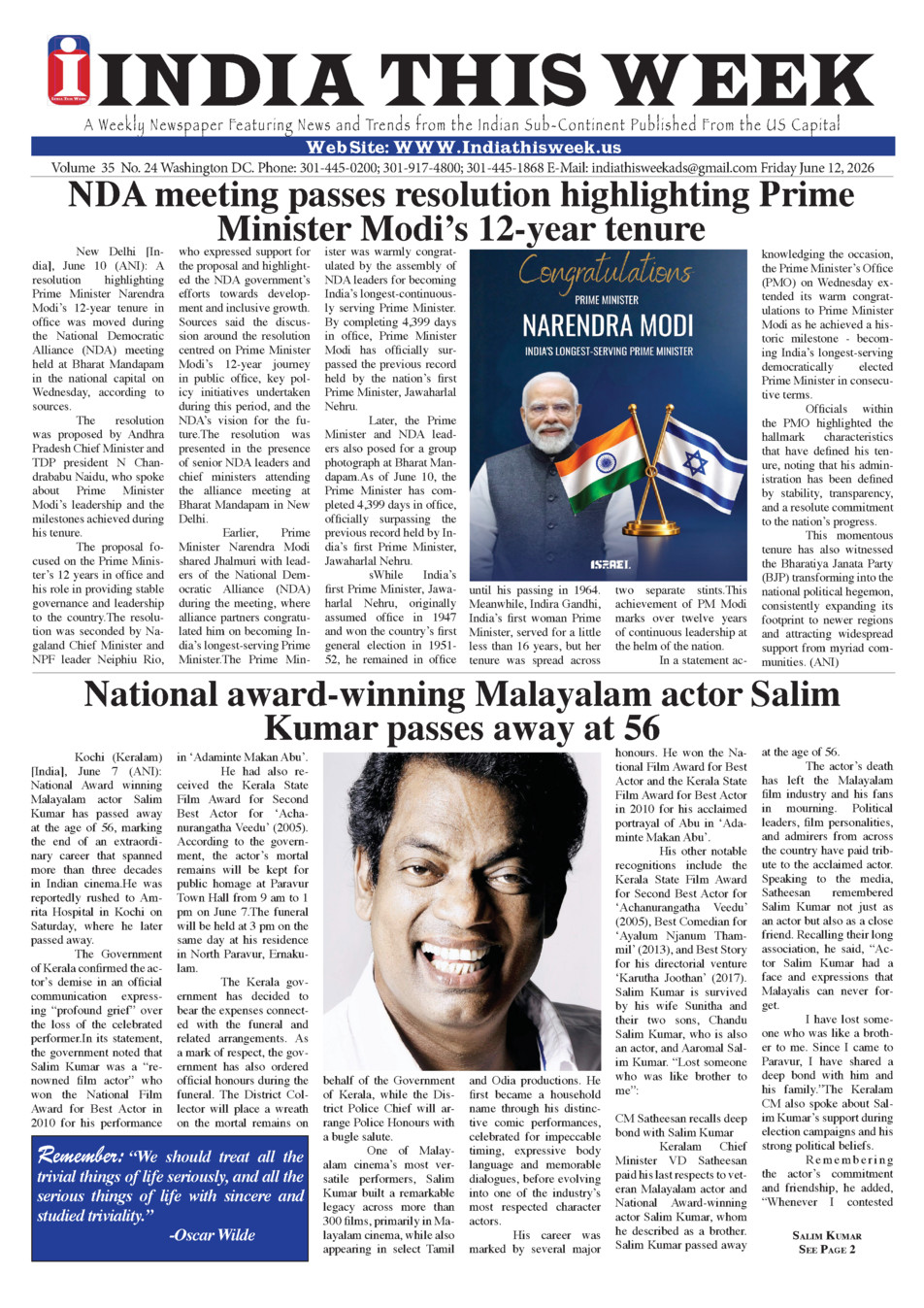
India This Week – June 12, 2026: A Comprehensive Summary of Key Developments Across Indian Politics, Culture, and Global Engagement
NDA resolution marks Modi’s 12-year tenure with emphasis on stable governance and transformative milestones
In a gathering convened at the Bharat Mandapam in New Delhi, the National Democratic Alliance (NDA) introduced a formal resolution to highlight Prime Minister Narendra Modi’s twelve years in office, underscoring a period characterized by consistent governance, policy continuity, and a forward-looking approach to development. The motion, brought forward by Andhra Pradesh Chief Minister and Telugu Desam Party (TDP) president N. Chandrababu Naidu, centered on Modi’s leadership trajectory, drawing attention to notable policy initiatives and the broader NDA vision for the nation’s trajectory. The proposal received a robust show of support from Neiphiu Rio, Chief Minister of Nagaland and a leading NDA voice, who seconded the resolution and articulated gratitude for the government’s inclusive growth agenda and developmental momentum. The discourse surrounding the resolution focused on Modi’s twelve-year journey in public life, mapping out key policy priorities and governance milestones while outlining the alliance’s perspective on future challenges and opportunities. The event was attended by senior NDA leaders and chief ministers, signaling a unified stance within the alliance as it celebrated what officials described as a period of stability and expansion of the NDA’s influence across diverse regions and communities. (Page 1)
In the lead-up to and during the gathering, Prime Minister Modi himself received informal accolades from NDA colleagues, who cheered him for becoming India’s longest-serving prime minister in continuous tenure. Informal exchanges, including a casual act of sharing a traditional Jhalmuri with NDA partners, were highlighted as symbols of camaraderie and political solidarity. Official statements from the Prime Minister’s Office underscored the enduring attributes of Modi’s administration—transparency, stability, and an unwavering focus on national progress. The PMO also noted the BJP’s expanded political footprint, portraying the party as a central organizing force that has consolidated power, broadened governance to regional levels, and attracted a broad spectrum of support across diverse communities. The duration cited—more than twelve years and counting—was framed as a historical milestone that places Modi among a select group of leaders who have steered India through a long, transformative phase. The narrative positioned Modi’s tenure as one marked by a steady hand on governance, a clear reform orientation, and a commitment to advancing the country’s strategic interests on the global stage. (Page 1)
Observers pointed to the procedural and symbolic significance of the resolution, noting that it functioned as a ceremonial reaffirmation of the NDA’s priorities as India approaches critical electoral cycles and regional challenges. The framing emphasized stability and predictable governance as essential ingredients for securing ongoing development, investment, and social welfare initiatives. While the resolution celebrated past achievements, it also spoke to a shared NDA outlook for the future—continued economic reform, expansion of infrastructure, and a governance model designed to sustain momentum in a rapidly changing global environment. The moment was also marked by a public acknowledgment of Modi’s leadership, as officials highlighted the administration’s ability to maintain policy continuity while adapting to evolving domestic and international circumstances. (Page 1)
In summation, the NDA’s resolution served a dual purpose: it celebrated a significant political milestone while positioning Modi’s twelve-year tenure as a foundation for ongoing reform and inclusive growth. It reinforced the alliance’s narrative of stability amid complexity and framed the next phase as a continuation of the governance philosophy that has defined Modi’s time in office. The formal occurrence at Bharat Mandapam, with its ceremonial tone and testimonial remarks, functioned as both a retrospective and a strategic signal to political allies, voters, and observers about where the NDA intends to steer the country next. (Page 1)
Farewell to a renowned Malayalam actor: Salim Kumar’s passing sparks widespread tributes and state honors
The death of National Award-winning Malayalam actor Salim Kumar at the age of 56 has triggered an outpouring of condolences and a sequence of official commemorations, underscoring a career that spanned over three decades and more than 300 films. Reports indicate that he was shortly after admitted to Amrita Hospital in Kochi, where he subsequently passed away, prompting the Government of Kerala to issue a formal expression of grief. The government acknowledged his stature as a celebrated film artist who received the National Film Award for Best Actor in 2010 for his role in Adaminte Makan Abu and also earned the Kerala State Film Award for Second Best Actor for Achanurangatha Veedu, among other honors. Following the announcement, public homage arrangements were announced, with a plan to display his mortal remains for public viewing at Paravur Town Hall for a defined period before the funeral, which was scheduled at his home in North Paravur, Ernakulam. (Page 2)
Tributes poured in from political leaders, film personalities, and fans across Kerala. The government’s statement characterized Salim Kumar as a versatile performer whose contributions encompassed both comedy and serious acting, reflecting a breadth of talent that resonated with audiences. High-profile leaders such as the Chief Minister and prominent Congress figures joined others in paying respects, with statements noting his influence in cinema and, at times, his political engagements. The ceremonial tributes extended beyond the immediate family, highlighting the actor’s impact on regional cinema and his role as a cultural icon whose body of work helped shape Malayalam film storytelling for generations. The funeral, conducted with customary reverence and state honours, brought together a spectrum of public figures and supporters reflecting the artist’s enduring prominence in the cultural landscape of Kerala. (Page 2)
Commentary from colleagues and fans alike emphasized Salim Kumar’s artistic versatility—from his early comic timing to more nuanced performances that conveyed emotional depth. He was described as an actor capable of seamlessly transitioning between genres and roles, a quality that earned him admiration across the industry. In the wake of his passing, the film community and political circles acknowledged his enduring legacy, not only in terms of his accolades but also through the impact of his performances on audiences and aspiring actors. Tributes also reflected a shared sense of loss within the broader Indian cinema ecosystem, where his distinctive voice, body language, and comic sensibilities left an indelible mark. The evolving narrative of Salim Kumar’s career was presented as a testament to his dedication to his craft and his enduring influence on Malayalam cinema. (Page 2)
The broader response from the political sphere highlighted the intersection of culture and public life in Kerala, with leaders emphasizing the importance of honoring artists who shape regional identity and contribute to the country’s artistic achievements. Prominent actors, including Mammootty, offered personal condolences, underscoring the deep connections Salim Kumar had formed within the entertainment fraternity. The coverage also reflected on how a career rooted in regional cinema can cultivate cross-genre respect and national recognition, illustrating how Malayalam film talent continues to contribute to the broader Indian cultural landscape. The tributes, public acknowledgments, and the forthcoming ceremonial arrangements collectively documented a moment of collective grief and a public resolve to honor a performer whose work resonated far beyond the screen. (Page 2)
Priti Sheth and her legacy in Takoma Park: Legacy Business Award recognizes decades of service and community impact
In Takoma Park, Maryland, Priti Sheth, the driving force behind Priti Fashions, along with its notable divisions Aanchal Boutique and Nina Jewelers, has been honored with a prestigious Legacy Business Award conferred by the city’s mayor. The accolade acknowledges decades of devoted service, business excellence, and meaningful contributions to the local community. Takoma Park, celebrated for its cultural diversity, has long hosted immigrant communities from around the world, including substantial Indian associations, and the award underscores how businesses rooted in cultural heritage can become cornerstones of neighborhood life. Under Sheth’s leadership, these ventures have earned a reputation for offering a carefully curated mix of traditional and contemporary fashion, jewelry, and accessories, appealing to customers across Maryland, Virginia, and the broader Washington metropolitan area. (Page 3)
Beyond commercial success, Sheth’s profile is closely tied to public service and community engagement. The award highlights her sustained commitment to supporting immigrant families, cultural organizations, charitable initiatives, and community events—efforts that have helped preserve cultural traditions while fostering a sense of belonging among residents from diverse backgrounds. The mayor’s remarks framed Sheth’s enterprise as a model for how businesses can integrate entrepreneurship with social responsibility, suggesting that the true value of a local company extends beyond revenue to its role in enriching community life. In receiving the Legacy Business Award, Sheth was lauded for upholding quality standards, maintaining integrity in customer service, and contributing to Takoma Park’s evolving cultural fabric. (Page 3)
The coverage emphasizes that the recognition encapsulates not only commercial persistence but also the broader benefits that immigrant-focused businesses bring to the community—economic vitality, job creation, and a sense of shared identity in a diverse urban landscape. Notable acknowledgments, including the Presidential Lifetime Achievement Award for volunteer service, were cited to illustrate how Sheth’s efforts have extended into civic engagement and philanthropy, reflecting a holistic approach to leadership that blends enterprise with public service. The award’s significance lies in its affirmation that small- and medium-sized businesses rooted in immigrant entrepreneurship can catalyze social cohesion, resilience, and inclusive growth in American towns that celebrate multicultural life. (Page 3)
US judicial intervention halts Trump’s proposed USD 100,000 H-1B visa fee, framing a constitutional balance between executive action and legislative prerogative
A federal judge in Washington, D.C., blocked President Donald Trump’s plan to impose a sweeping USD 100,000 fee on new H-1B visa petitions, marking a pivotal moment in the ongoing debate over how immigration policy should be administered. The ruling, delivered by Judge Richard Stearns, held that the proclamation and subsequent actions by the State Department and the Department of Homeland Security overstep constitutional boundaries by encroaching on legislative powers. The decision followed an earlier ruling from a different judge that had favored the Trump administration under a different set of legal interpretations; Stearns’ verdict distinguishes itself by emphasizing the separation of powers and the need for executive actions to align with congressional authority. (Page 4)
The H-1B program, designed to allow U.S. employers to recruit highly skilled foreign workers for specialty occupations requiring at least a bachelor’s degree, has long been a focal point of immigration policy debates. The proposed fee was justified by proponents as a mechanism to address labor-market distortions and national security concerns, arguing that the program could be misused to displace American workers or depress wages. Opponents, including the U.S. Chamber of Commerce and other business interests, warned that such a steep fee would deter essential talent recruitment, impede innovation, and undermine critical sectors such as education and healthcare. The ongoing legal contest reflects a broader struggle to balance protections for domestic workers with the realities of a globalized economy that relies on specialized expertise from around the world. (Page 4)
The judge’s rationale pointed to the risk that implementing the new fee could be selectively applied against certain employers or sectors, potentially undermining the rule of law and creating unpredictable regulatory conditions. The ruling noted the intent of Congress to regulate visa programs and highlighted concerns about unilateral executive-driven changes that bypass legislative checks and balances. Consequently, the decision preserves the existing framework for H-1B petitions and maintains the status quo for filing fees while legal concerns are resolved. Policy observers evaluated the implications for employers, workers, and institutions that rely on high-skilled foreign talent, emphasizing that the outcome will shape future legislative and administrative approaches to visa policy in the United States. (Page 4)
UK-India strategic cooperation deepens in maritime security and critical minerals through high-level talks and new initiatives
During a high-profile visit in which UK Foreign Secretary Yvette Cooper concluded engagements with Indian and Chinese counterparts, discussions underscored a shared interest in strengthening geopolitical cooperation and resilience in supply chains. Cooper emphasized the importance of staying engaged with global partners on pivotal international issues rather than retreating into isolation, arguing that sustained dialogue is essential for safeguarding growth, security, and mutual interests for both nations. Her meetings with Prime Minister Modi and External Affairs Minister Jaishankar focused on maritime security, supply chain resilience, and the strategic role of critical minerals in modern economies. (Page 5)
A notable outcome of the visit was the launch of a Regional Maritime Security Centre of Excellence (RMSCE), an initiative designed to bolster collaboration on maritime challenges and bolster resilience against disruptions to global shipping. In parallel, India and the UK announced the Critical Minerals Global Supply Chain Observatory (GSCO) as part of the UK-India Technology Security Initiative. This observatory, which leverages an AI-driven tool to monitor real-time flows of critical minerals and identify vulnerabilities, signals a concerted effort to diversify and secure essential supply chains. As part of the GSCO framework, India committed 1.2 million euros to establish a satellite observatory campus at the Indian Institute of Technology (IIT) in Dhanbad in collaboration with the University of Cambridge. The joint venture mirrors a broader trend toward deepening scientific and technological cooperation between the two countries in areas critical to future prosperity. (Page 5)
The dialogue also touched upon broader strategic themes, including energy transitions, digitization, and the development of resilient, diversified supply chains capable of withstanding global shocks. Ministers and officials highlighted how critical minerals underpin technologies ranging from electric vehicles to wind turbines and consumer electronics, reinforcing the urgency of secure, transparent, and ethically sourced supply chains. The partnership’s emphasis on research, innovation, and supply-chain intelligence points to a long-term, proactive approach to international cooperation, one that seeks to align economic incentives with national security and technological leadership. (Page 5)
West Bengal politics in flux: nearly two dozen TMC MPs signal potential alignment with NDA, forcing constitutional considerations and party responses
In a development that signals a potential realignment of national political dynamics, around twenty Members of Parliament from the All India Trinamool Congress (TMC) have formally indicated a willingness to align with the Bharatiya Janata Party-led National Democratic Alliance (NDA). The dissident bloc, led by Kakoli Ghosh Dastidar, communicated to Lok Sabha Speaker Om Birla their intention to extend support to the NDA, a move that could alter the balance of influence in Parliament depending on how it is recognized and validated under the constitutional framework. Dastidar publicly confirmed the move, framing it as a strategic shift in response to evolving political realities in West Bengal and the broader national landscape. (Page 6)
The development arrives amid internal turmoil within the TMC following electoral setbacks in West Bengal and the emergence of a rival faction under Ritabrata Banerjee, who has sought to mobilize support from a substantial bloc of MLAs. The dissidents’ push appears to leverage the anti-defection provisions of the Tenth Schedule, seeking protection from disqualification by securing two-thirds of the party’s parliamentary strength. With the TMC currently holding 28 Lok Sabha seats, the threshold for crossing the two-thirds mark—19 MPs—frames the calculation for any potential merger with the NDA. The All India Trinamool Congress has pushed back, reaffirming its organizational structure and denying that Kakoli Dastidar or the faction she leads holds any legitimate Chief Whip status, pointing to an officially documented appointment of Kalyan Banerjee to that role in the Lok Sabha. The party’s leadership contends that any claims by the dissidents lack legal validity without formal communication bearing signatures and a recognized process, signaling a broader clash over party authority and parliamentary prerogatives. (Page 6)
Analysts observe that the situation intensifies West Bengal’s political suspense, as the state has recently witnessed a BJP-led government at the regional level with significant implications for national politics and the opposition’s organizational cohesion. The unfolding sequence underscores the fragility and complexity of party dynamics within coalition systems, where internal dissent, leadership contests, and strategic alignments can reshape alliances at the national level. While the AITC maintains that the official chain of command remains intact, observers anticipate how the NDA might respond to these developments—whether through outreach to the dissidents, formal recognition of their parliamentary status, or other constitutional remedies designed to preserve party discipline and parliamentary stability. (Page 6)
Concluding reflections: diaspora connections, political realignments, and the evolving landscape of India’s global partnerships
Taken together, the narratives from this week illustrate a country navigating multiple dimensions of modernity: a political coalition’s calibrated celebration of leadership, the cultural legacy embodied by celebrated artists, the entrepreneurial contributions of immigrant communities shaping neighborhood life in places like Takoma Park, and the ongoing recalibration of immigration and labor policies in the United States with implications for international talent mobility. The diplomatic track between the United Kingdom and India emphasizes resilience in critical supply chains and strategic cooperation on advanced technologies and maritime security, signaling how transnational partnerships can reinforce regional stability and economic growth. Within India itself, the dynamic shifts in West Bengal’s political landscape reflect the persistent fragility and adaptability of party alliances, the interplay between regional ambitions and national coalition strategies, and the constitutional frameworks that govern parliamentary alignment and defection. As reporters, commentators, and citizens digest these developments, the overarching message remains one of continuity amidst change: leaders and communities alike are navigating a complex matrix of governance, culture, commerce, and international engagement, where decisions in one sphere ripple across borders and generations. (Page 7)