JSS 0251 & JSG 0308 Documentation: Building Defence-Ready Technical Literature
JSS 0251 & JSG 0308 Documentation: Building Defence-Ready Technical Literature
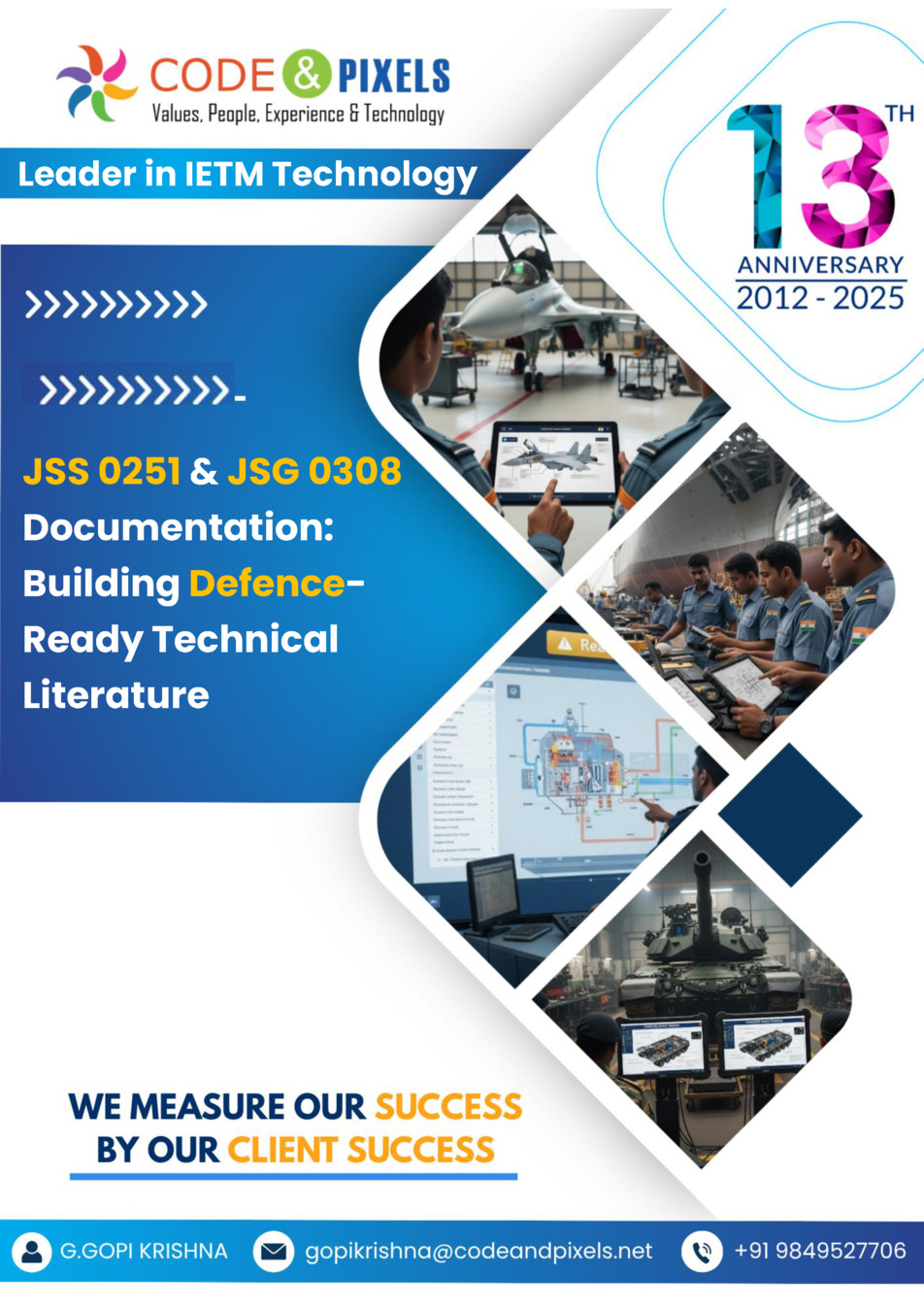
JSS 0251 & JSG 0308 Documentation: Building Defence-Ready Technical Literature — A detailed overview of how standardised formats guide IETM-ready manuals for India's defence sector, and what Code and Pixels brings to the table
Overview: why standardised formatting matters in defence documentation
Within defence documentation, the approach to formatting extends far beyond aesthetics. It is a deliberate and essential element that supports clear communication, uniform presentation, and strict compliance with mandated guidelines. For organisations acting as original equipment manufacturers or suppliers to India's Ministry of Defence, familiarity with the JSS 0251 and JSG 0308 frameworks is crucial. These standards set expectations that help ensure that manuals, guides, and associated literature are consistently navigable by operators, maintainers, and technicians, reducing ambiguity and accelerating access to critical information. The material here is produced to align with those requirements, underscoring how disciplined documentation practices translate into more reliable field performance. (Page 2)
Code and Pixels positions itself as a specialist in crafting high-quality technical literature that fully conforms to JSS 0251 and JSG 0308. The aim is not merely to meet a compliance checklist but to deliver manuals that improve usability, support lifecycle management, and streamline the vetting process. The emphasis remains on clarity, predictability, and reusability of information across both hard copy and electronic formats, which is particularly important in defence contexts where timely, accurate guidance can influence readiness and safety. (Page 2)
JSS 0251: a unified standard for electronic and electrical technical publications
JSS 0251 stands as a joint services specification issued by the Indian Ministry of Defence that governs how manuals for electronic and electrical equipment should be structured and presented. Rather than letting each supplier craft their own style, JSS 0251 establishes a single, coherent framework that facilitates quick location of operational details, maintenance steps, and spare parts information. This cohesion is vital for ensuring that anyone interacting with a device—whether in the field or in a workshop—can easily find and interpret the necessary data, regardless of the supplier or equipment type. (Page 2)
The formal scope of JSS 0251 is captured in its version JSS 0251-01:2015, which is the official standard for preparing and producing manuals supplied to the Indian Armed Forces across Army, Navy, and Air Force. The standard ensures a uniform look, standardized terminology, and a logical progression of content so that readers encounter familiar structures and sequences in every publication. It also specifies the inclusion of essential sections such as operational details, maintenance procedures, and spares information, cementing a comprehensive documentation baseline for both printed and digital formats. (Page 2)
Adherence to JSS 0251 is mandatory for all OEMs providing electronic or electrical systems to Defence, spanning the full spectrum of devices and platforms. By enforcing a consistent documentation approach, the standard reduces confusion, supports efficient training, and enhances the reliability of maintenance actions. In practice, this means that a technician can move between systems with a shared mental model for where to find critical information, which in turn lowers the risk of errors during operation or repair. (Page 2)
JSG 0308: emphasising parts lists and user guidance to support field reliability
JSG 0308 is a Joint Service Guide that concentrates on two pivotal document types: Illustrated Parts Lists (IPLs) and User Handbooks (UHBs). It complements JSS 0251 by prescribing how components, parts, and user-centric instructions should be presented so engineers and maintainers can quickly identify items and correctly apply procedures in the field. The joint guide ensures that the parts data is unambiguous, clearly tied to diagrams and drawings, and that user guidance is actionable and easy to follow under diverse conditions. (Page 3)
In its second revision (JSG 0308: 2017 – Second Revision), the guide formalises the structure and presentation rules for IPLs and UHBs. The standard is widely adopted across Army, Navy, and Air Force domains and is frequently implemented in conjunction with JSS 0251 as part of integrated Electronic Technical Manuals (IETMs). This synergy ensures a harmonised set of documents where parts identification, assembly relationships, and operational instructions align with overarching defence documentation practices. (Page 3)
JSG 0308’s core aim is to deliver consistent documentation formats that speed up recognition of parts, simplify ordering, and reduce the likelihood of misinterpretation when following usage or maintenance steps. By standardising how illustrations, part numbers, nomenclature, and related data are presented, the guide supports more efficient spares management and faster fault resolution, directly impacting mission readiness. (Page 3)
How standardisation raises the quality and usability of defence documents
One of the principal benefits of adhering to these standards is the creation of a uniform document architecture across different manuals. This includes consistent chapter order, consistent treatment of tables and graphics, and predictable formatting choices that help readers locate information without unnecessary searching. The predictable layout becomes a powerful tool in fast-paced or high-stress environments where technicians must access critical steps rapidly and accurately. (Page 4)
Another important improvement is the precision of parts identification. IPLs produced under JSG 0308 are designed to make it straightforward to pinpoint Part No., Nomenclature, Quantity, and related assembly details. Clear part identification reduces confusion during spares procurement and ensures that technicians replace the correct components, minimising downtime and the risk of compatibility issues. (Page 4)
A third advantage is the standardisation of user guidance. Following JSG 0308 means that user manuals present lifecycle information, handling precautions, and operational procedures in a uniform manner, enabling more dependable use and longer equipment life. Consistent guidance supports safer handling and more predictable operational outcomes across the lifecycle of complex engineering systems. (Page 4)
Finally, these standards are often contractually required within defence programmes. They provide a reliable framework that supports procurement and integration processes, including RFQs and purchase orders. By ensuring documents meet these expectations, contractors align with client requirements, improve auditability, and increase the likelihood of timely approvals and deliveries. (Page 4)
Documents that typically fall under JSS 0251 and JSG 0308 formats
Under JSS 0251, documentation categories commonly include design specifications, technical manuals, procurement drawings, packaging specifications, spare parts lists, carried spares lists, and user handbooks when they are not already formatted to JSG 0308. This set reflects the need to capture both functional information and maintenance considerations in a cohesive package that supports lifecycle support for defence equipment. (Page 4)
For JSG 0308, the primary document types are Illustrated Spare Parts Lists (ISPLs) and User Handbooks (UHBs) designed specifically for engineering equipment. These documents prioritise clear pictorial representations, precise part data, and practical user guidance that technicians can apply directly in the field. The combination of IPLs and UHBs is particularly valuable when documentation is integrated into IETMs, enabling seamless navigation and searchability within digital manuals. (Page 5)
In practice, the exact documentation format that a contract requires will be defined by RFQ or PO specifications. While some manuals fall squarely under JSS 0251 guidelines, others—such as IPLs and UHBs—may demand adherence to JSG 0308 standards. This alignment ensures that the information architecture supports both the technical content and the end-user experience in real-world operations. (Page 5)
Why Code and Pixels has deep familiarity with these standards
Code and Pixels works with defence documentation on a daily basis, ensuring that the output not only adheres to the letter of JSS 0251 and JSG 0308 but also remains practical and user-friendly for operators and maintainers. Their approach includes a continuous review of formatting rules related to text, imagery, tables, and chapter structure, with a focus on delivering coherent, vettable documents that pass compliance checks. (Page 5)
The team stresses that defence documentation is more than a collection of text and pictures; it represents an organised body of knowledge designed to support mission-critical activities. Proper formatting underpins this organization by maintaining logical information flow, enabling quick reference, and reducing the likelihood of misinterpretation under pressure. The backbone provided by JSS 0251 and JSG 0308 is what keeps such knowledge accessible and dependable. (Page 6)
To stay current, Code and Pixels continually refine their processes to reflect changes in standards and evolving best practices. They also bring experience from past engagements with OEMs and defence production units, helping these organisations deliver manuals that withstand vetting and compliance checks. This proactive stance helps ensure that documentation keeps pace with capabilities, equipment complexity, and regulatory requirements. (Page 6)
How to engage with Code and Pixels for defence-standard documentation
Code and Pixels positions itself as a partner for organisations pursuing defence-standard documentation or those seeking to optimise their manuals for both compliance and usability. They offer guidance on aligning deliverables with JSS 0251 and JSG 0308, and they can support clients across the lifecycle of a project—from initial drafting to final vetting and deployment within an IETM environment. (Page 6)
For interested teams, the company provides opportunities to learn more or request demonstrations of their IETM capabilities. Information for outreach typically includes the company website, a dedicated IETM email, and a direct phone line, making it straightforward to initiate a conversation about project needs, timelines, and compliance objectives. (Page 6)
Conclusion: the strategic value of JSS 0251, JSG 0308, and IETMs in India
In the Indian defence landscape, interactive electronic manuals (IETMs) are an increasingly important delivery method for technical documentation. JSS 0251 establishes mandatory documentation requirements for defence electronics and electrical equipment, while JSG 0308 provides the structured formats for IPLs and UHBs. Together, they enable robust, reusable, and easily navigable manuals that support training, operations, maintenance, and supply chain activities. Code and Pixels positions itself as a key partner in delivering compliant, sophisticated IETM solutions that meet these standards and help programmes achieve higher efficiency and reliability. (Page 7)
As a final note, the combined effect of these standards is to create a dependable documentation ecosystem that reduces error rates, accelerates parts identification and procurement, and enhances the overall effectiveness of defence programmes. For organisations seeking to optimise their technical literature, understanding and applying JSS 0251 and JSG 0308 is not just a regulatory necessity—it is a practical strategy for improving performance, safety, and mission readiness. (Page 7)
Learn more or request a demonstration of how these standards can elevate your manuals by visiting the Code and Pixels site, contacting the IETM team via email, or speaking with a representative by phone. The goal is to ensure your documentation is both rigorous and usable, delivering sustained value throughout the equipment lifecycle. (Page 7)
JSS 0251 & JSG 0308 Documentation: Building Defence-Ready Technical Literature - Flipbook by Fleepit