HKYJLR ISSUE 1 Final , OCT 2025
HKYJLR ISSUE 1 Final , OCT 2025
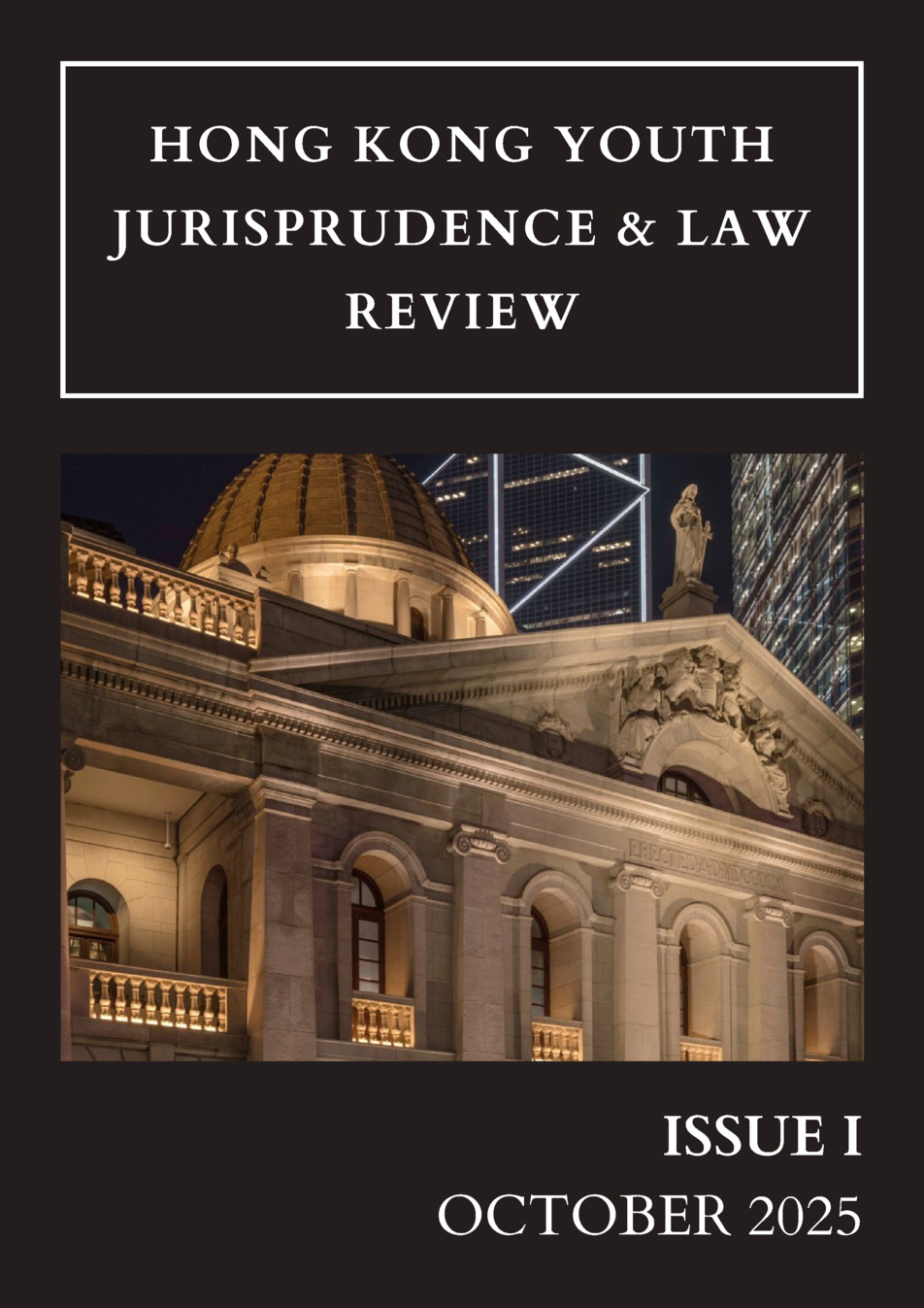
HKYJLR Issue I (October 2025): Exploring Confucian Influence on Hong Kong’s Common Law – A Cultural and Legal Synthesis
COLONISING LEGAL CULTURE?
Hong Kong presents an intriguing case where cultural norms intersect with a Western-style legal framework. Despite global patterns of youth crime, Hong Kong reports a remarkably low rate of youth-related arrests, with roughly two thousand young offenders across nine detention centres in a given year, figures drawn from official police and correctional sources. This backdrop raises questions about how social values, policing, and governance contribute to justice in a jurisdiction that operates under English Common Law while retaining a distinctive local culture. (Page 1)
The purpose of this essay is not to offer a conventional, textbook critique of legal theory. Instead, it foregrounds passion, curiosity, and a student-led desire to explore the broader questions at the intersection of philosophy, history, justice, and daily legal practice. It acknowledges that law can be intimidating for learners at the secondary level, yet argues that thoughtful inquiry into how law interfaces with culture can illuminate justice in practice. (Page 1)
At the heart of the discussion is a provocative question: to what extent does Confucian thought shape Hong Kong’s Common Law jurisdiction, and how does this influence compare with Judeo-Christian moral frameworks that have historically informed Western legal systems? The piece invites readers to consider how cultural legacies underpin legal conventions, and whether Hong Kong’s system represents a synthesis or a tension between continuity and change. (Page 1)
Philosophy of Chinese Law
There is a common misperception that Chinese law rests solely on Confucian moral teachings. In reality, Chinese legal history is a mosaic that includes strong strands of legalism—an approach emphasizing centralized control and utilitarian rules designed to extract benefits for the state. The earliest Chinese legal traditionfeatures rulers who governed through precise rules and harsh penalties, often justified by pragmatic aims rather than a universal moral code. (Page 1)
Over time, the legalistic approach has been associated with a distrust of natural moral capacity among the governed, yielding a system that relies heavily on coercive mechanisms to maintain social order. This consequentialist orientation prioritizes the effectiveness of the legal framework, sometimes at the expense of an explicit ethical dialogue about right and wrong. The historical persistence of legalist ideas shows that Chinese law cannot be reduced to a single philosophical lineage, but rather to a complex dynamic where rules, power, and social expectations intertwine. (Page 1)
English Common Law
To understand Hong Kong’s legal landscape, one must examine how English Common Law—rooted in a rich tradition of case-reliance and statutory authority—has been adapted within a distinctly Cantonese-speaking, Hong Kong context. The system emphasizes the development of law through precedents and the gradual refinement of principles via judicial decision-making, alongside the authority of statutes. (Page 1)
The debate here centers on how a global legal tradition, born in a fundamentally different cultural setting, migrates into a society characterized by a unique blend of local customs and a strong sense of collective responsibility. The nuanced transformation involves balancing the formalities of common-law reasoning with the practical realities of governance in a city where a deep respect for tradition and family norms persists. (Page 1)
Common Law in Hong Kong
In the period before the 1997 handover, Hong Kong’s legal system was deeply influenced by British administrative practices, yet it also showed signs of cultural friction—especially around bilingualism and the treatment of language in court proceedings. Some observers argued that the political and cultural inconsistencies could threaten the integrity of the legal framework, even as English law remained a foundational pillar. The Basic Law that followed the handover is understood as doctrinal yet capable of evolving with social change, and it provides a structure within which Confucian-influenced values can interact with a robust, precedent-driven legal system. (Page 1)
Despite language and cultural tensions, Hong Kong’s legal architecture has managed to fuse English common-law mechanisms with local realities. The result is a system that relies on the predictability and stability of precedent while remaining adaptable to shifting social norms and economic conditions. This fusion is often described as a pragmatic coexistence rather than a forced fusion, with the judiciary playing a central role in mediating between traditional values and contemporary law. (Page 1)
The Basic Law is frequently cited as the constitutional backbone that supports this synthesis, enabling a form of legal reasoning that is doctrinal yet responsive to the needs of a modern, rapidly changing society. In this context, the enduring influence of Confucian-oriented ethics—such as a focus on virtuous behavior, family responsibility, and social harmony—appears as a cultural overlay rather than a replacement for the legal framework. (Page 1)
Comparisons
Hong Kong’s crime statistics—particularly the relatively low youth-crime rates—are sometimes contrasted with other jurisdictions that share linguistic ties and historical pedigrees with the British legal tradition. For instance, Singapore, though ethnically Chinese, operates under a legal system that blends English Common Law with local policy preferences and a distinctive approach to governance. Both societies demonstrate how Confucian-inspired values can align with or shape legal practice without undermining the rule of law. (Page 1)
In the Singaporean example, the concept of governance guided by a benevolent authority, expressed through ethical leadership and ritual-based governance, can be seen as paralleling the way Hong Kong’s system seeks to balance formal legalism with social obligations. Yet these comparisons also reveal differences in institutional design, language use in the courts, and the precise articulation of virtue ethics within legal reasoning. (Page 1)
Like Singapore, Hong Kong shows a tendency to place emphasis on predictable decision-making and the reliability of legal outcomes. The presence of a culturally anchored ethos—such as filial piety and communal harmony—helps to understand how the law is perceived, interpreted, and enforced by the public. Both contexts illustrate that culture and law do not operate in isolation but instead interact in ways that shape the legitimacy and effectiveness of the justice system. (Page 1)
Conclusion
The overall argument presented here is that Hong Kong’s justice system benefits from a culturally informed ethical framework rooted in Confucian values, which complements the formal structure of English Common Law. This synergy supports a system where virtues like respect for the family, social harmony, and responsible conduct help to sustain the rule of law alongside corrective institutions such as the police and correctional services. In practical terms, this combination appears to contribute to lower recidivism rates and a generally stable legal environment, underscoring the capacity of a hybrid model to function effectively in a modern, global city. (Page 1)
Within this framework, the family as a unit remains an influential social unit, and the enduring emphasis on filial piety and ritual propriety (Li) continues to inform, albeit indirectly, the behavior of citizens and institutions. The result is a legal culture in which customary norms and formal rules reinforce each other, producing a judiciary that can preserve order while accommodating cultural values that emphasize humane and principled governance. Hong Kong thus stands as a case where Confucian-inspired ethics and Western legal reasoning interact to uphold justice, with measurable outcomes in terms of stability and public confidence. (Page 1)
Looking forward, the evolution of Hong Kong’s legal system seems likely to continue balancing the strength and clarity of case law with the cultural expectation of fairness and social responsibility. As long as Confucian-inspired values remain part of the societal fabric, they may continue to provide an informal check on legal processes, supporting the legitimacy of the common-law framework and the broader project of a just and orderly society in Hong Kong. (Page 1)
References and scholarly perspectives cited in the discussion further illuminate how cultural contexts shape the interpretation and application of law. By examining the interplay between tradition, legal technique, and institutional structure, this analysis highlights the importance of cross-cultural understanding in evaluating the resilience and adaptability of a hybrid legal system. (Page 1)