SCLA Journal 2025
SCLA Journal 2025
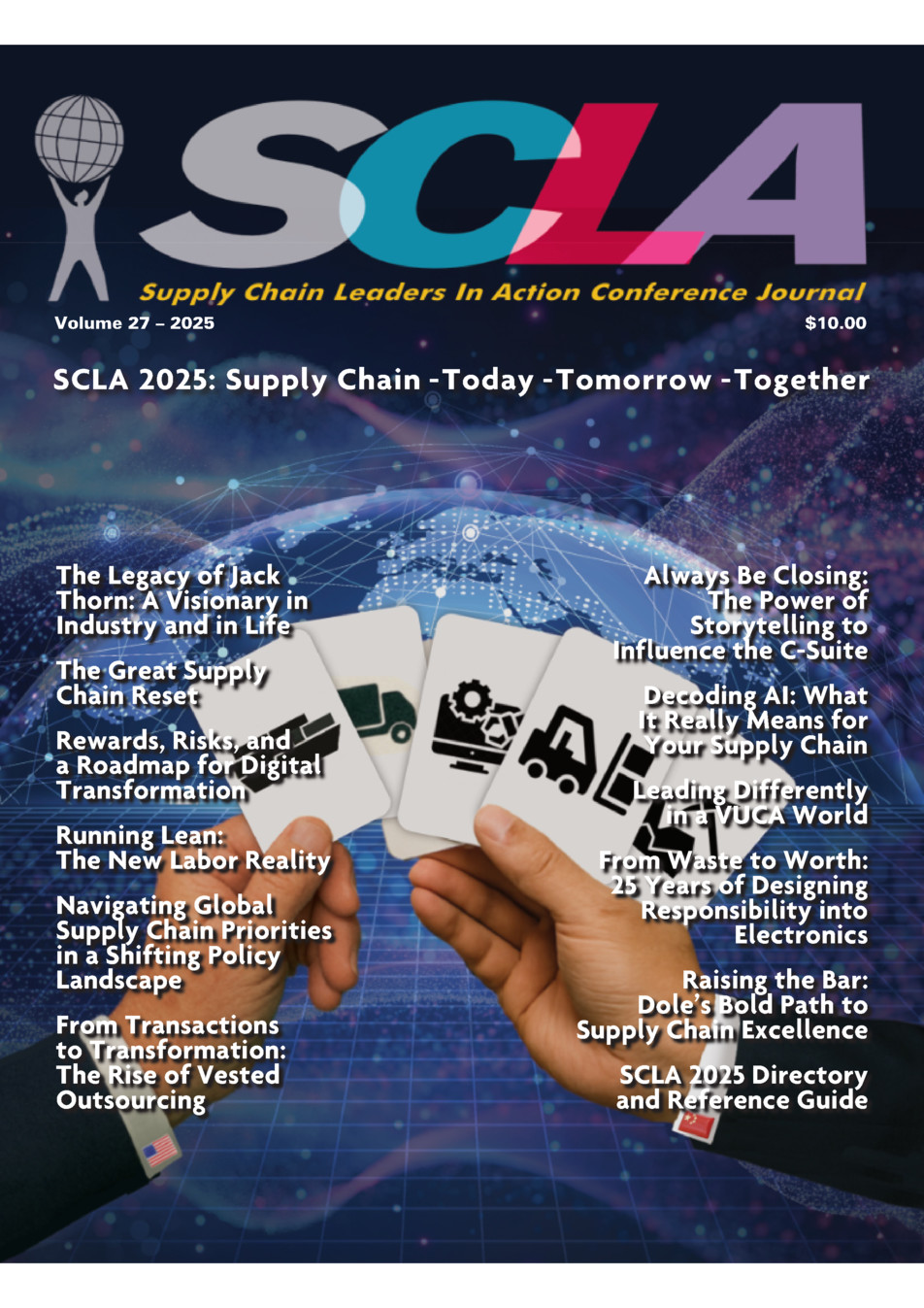
SCLA Journal 2025 — Volume 27: A Forward-Looking Overview of Supply Chain Leadership, Transformation, and Shared Purpose
Executive Summary
The 2025 edition of the SCLA Journal, Volume 27, captures the spirit of the annual Executive Forum where senior leaders gather to wrestle with today’s disruptions and imagine tomorrow’s possibilities. This issue extends the forum’s collaborative ethos by weaving together candid dialogue, peer-driven insights, and practical guidance designed to help practitioners translate ideas into action. It foregrounds the idea that supply chain leadership thrives when people, process, and technology align in service of resilient networks, responsible innovation, and sustainable value creation across the globe. Through a curated mosaic of perspectives, the journal outlines a trajectory from current realities toward a more integrated, tech-enabled, and human-centered future. Page 6.
A central thread of the volume is the enduring impact of leadership that blends industry expertise with a life of purpose. The tribute to Jack Thorn emphasizes a philosophy of work that treats industry as a human endeavor—where factory floors and vineyards alike reflect the same care for people, communities, and long-term stewardship. Thorn’s legacy is framed as a compass for how leaders can inspire teams, nurture trust, and pursue excellence while staying true to values that elevate the common good. Page 10.
Beyond homage, the journal lays out blueprint-level thinking for rebuilding supply chains in a world characterized by volatility and interdependence. The Great Supply Chain Reset envisions a reoriented global flow—one that emphasizes regional resilience, re-globalization, and technology-enabled capabilities to weather disruptions and sustain performance. The piece argues for strategies that balance efficiency with risk mitigation, and that leverage regional strengths to create more robust, adaptable networks. Page 14.
Digital transformation is reframed as a practical, risk-aware journey rather than a one-off project. The Rewards, Risks, and a Roadmap for Digital Transformations offers a structured approach to translating technological ambition into tangible competitive advantages, while highlighting common pitfalls and how to avoid them. The emphasis is on moving from isolated initiatives to integrated programs that deliver measurable business outcomes and improved customer value. Page 16.
Another core focus is the evolving labor landscape and its implications for supply chain design. Running Lean: The New Labor Reality uses data-driven analysis to demonstrate how labor shortages and workforce dynamics are reshaping capacity planning, network design, and service levels. The piece underscores the need for adaptive staffing models, automation where appropriate, and transparent, collaborative approaches with labor partners to stay ahead in a tightening labor market. Page 19.
The journal also foregrounds a shift in outsourcing models, highlighting the rise of Vested Outsourcing as a collaborative, win-win approach that aligns incentives and accelerates innovation. By moving from transactional arrangements to transformational partnerships, organizations can unlock long-term value, improve transparency, and foster shared success with suppliers and service providers. The narrative uses real-world references to illustrate how firms like Dell and Intel are rethinking outsourcing to capture broader business impact. Page 56.
From a sustainability and responsibility standpoint, From Waste to Worth investigates how electronics manufacturers have approached Extended Producer Responsibility over the past quarter-century. The article surveys what has worked, what remains challenging, and why the next phase must intensify emphasis on reuse, circularity, and eco-design as central pillars of responsible product stewardship. Page 59.
Storytelling is highlighted as a powerful tool for influencing decisions at the highest levels. Always Be Closing: The Power of Storytelling to Influence the C-Suite explains how compelling narratives help supply chain leaders secure executive sponsorship, align strategic priorities, and drive decisive action. The section reinforces that narratives are not just marketing devices; they are essential mechanisms for translating complex data into strategic commitment. Page 62.
Leading Differently in a VUCA World expands on how trust, agility, and strong supplier partnerships enable resilience during periods of uncertainty. The piece argues for leadership that prioritizes transparency, speed, and collaboration with external partners to navigate rapid shifts in geopolitics, technology, and market conditions. Page 62.
Alongside these thematic explorations, the Reference Guide section provides a strategic lens on how to navigate a divided world. It spotlights Supply Chain Crossroads: Strategic Navigation in a Divided World, which identifies five forces shaping global disruption and offers leaders a practical playbook for building resilience, adaptability, and strategic clarity. Page 44.
The publication also celebrates outstanding organizational achievement. The 2025 COE Winner: Dole’s Bold Path to Supply Chain Excellence profiles Dole Packaged Foods as an exemplary model of sustainability and innovation within the global food supply chain. The article highlights how the company is redefining performance through responsible practices, forward-looking partnerships, and a commitment to circularity. Page 49.
Recognition within the community is celebrated through a Distinguished Service Award presentation. Walmart’s Shayne Wahlmeier is acknowledged for leadership in automation and enduring contributions to advancing the SCLA Executive Forum. The honor reflects the ongoing emphasis on industry-wide collaboration, continuous improvement, and the cultivation of talent that accelerates progress across the sector. Page 54.
A dedicated feature, Decoding AI: What It Really Means for Your Supply Chain, breaks down four foundational definitions of artificial intelligence as they stand today. It translates technical concepts into practical implications for analytics, operations, and the broader ambition of achieving smarter, more autonomous supply chains. The article also considers the horizon toward AGI while maintaining a grounded view of how current capabilities shape daily decision-making. Page 60.
Leading Differently in a VUCA World is revisited to emphasize how trust, agile practices, and robust supplier partnerships contribute to sustained performance when market conditions are volatile and unpredictable. The discussion reinforces that resilient leadership rests on the ability to adapt, communicate with clarity, and co-create value with partners across the supply chain ecosystem. Page 62.
In sum, the 2025 SCLA Journal offers a curated compendium of ideas, strategies, and recognitions that map a path from present-day challenges to future opportunities. It celebrates leadership that is both pragmatic and transformative, champions responsible innovation, and underscores the importance of collective action in building resilient, sustainable, and collaborative supply chains. Page 6.