India This Week~April 10, 2026
India This Week~April 10, 2026
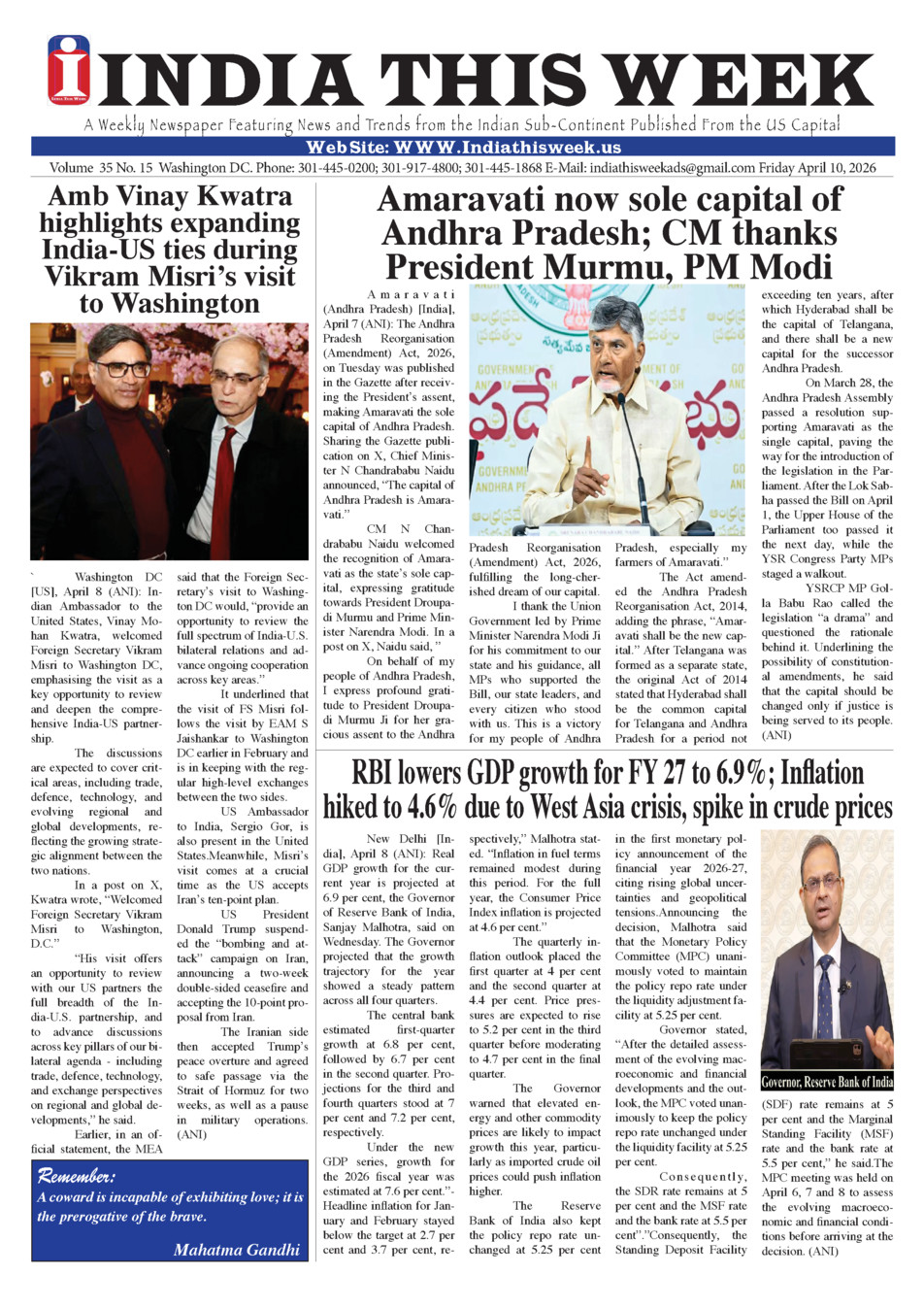
India This Week — Highlights and Key Developments (April 10, 2026)
India–US engagement and regional strategic dynamics
Diplomatic exchanges in Washington foregrounded a concerted effort to broaden the bilateral partnership between New Delhi and Washington, with Foreign Secretary Vikram Misri’s visit framed as a pivotal moment to assess the full spectrum of cooperation. The Indian ambassador to the U.S. signaled that discussions would span trade, defence, technology, and shared perspectives on evolving regional and global developments, underscoring a growing strategic alignment between the two democracies. (Page 1)
The outreach coincided with official statements that the visit would allow both sides to review and advance collaboration across central pillars of the India–U.S. agenda, highlighting progress on critical issues and identifying avenues for deeper engagement. A post on social media affirmed the welcome extended to the foreign secretary and the intent to explore broad bilateral cooperation. (Page 1)
In an official note, the MEA reiterated that FS Misri’s Washington itinerary would provide a chance to survey the entire landscape of bilateral ties and to push forward ongoing cooperation in targeted domains. This follows a pattern of high-level exchanges designed to sustain momentum in the India–U.S. partnership. (Page 1)
The timing of the visit also coincided with broader regional developments, including how the United States is recalibrating its approach to Iran, while regional security and energy considerations continue to influence diplomatic conversations. The confluence of these factors shaped the backdrop for discussions between senior Indian and American diplomats. (Page 1)
Amaravati becomes the sole capital of Andhra Pradesh
A landmark constitutional and administrative amendment received presidential assent, formalizing Amaravati as the sole capital of Andhra Pradesh after Telangana’s formation created a divided capital arrangement. The amendment’s gazette publication confirmed the capital’s designation, fulfilling a long-cherished aspiration of the state’s leadership and farmers in Amaravati. (Page 1)
Chief Minister N. Chandrababu Naidu publicly celebrated the development, expressing gratitude to President Droupadi Murmu and Prime Minister Narendra Modi for their support and leadership. The CM attributed the decision to the collective effort of state leaders and citizens who backed the legislative move through the legislative process. (Page 1)
Naidu’s remarks emphasized that the government sought to honor the wishes of Amaravati’s residents and stakeholders, viewing the move as a step toward stable governance and developmental clarity for the state. He acknowledged the historical context — including debates around the 2014 reorganization act and ensuing capital arrangements — and framed the amendment as a binding settlement for the state’s administrative future. (Page 1)
The amendment to the Andhra Pradesh Reorganisation Act, 2014, added language clarifying Amaravati as the capital, superseding the previous framework that saw Hyderabad as a shared, interim capital for a transitional period. The legislative path included a state assembly resolution supporting Amaravati as the sole capital, followed by parliamentary action and assent from the Union government. (Page 1)
Political reactions were varied, with some opposition voices challenging the rationale behind the change and raising questions about constitutional amendments. Lawmakers debated the timing and implications, while others welcomed the clarity and the potential for focused development in Amaravati. The broader debate underscored the ongoing recalibration of capital planning in a post- Telangana landscape. (Page 2)
Macroeconomic outlook and RBI policy
The late-2025–early-2026 outlook for India’s macroeconomy remained characterized by resilience amid global uncertainties, with a cautious trajectory for inflation and growth. Analysts highlighted that energy and commodity price pressures could influence inflation trajectories, even as domestic fundamentals stayed robust. (Page 2)
In its forthcoming policy communications, the Reserve Bank of India signalled a tentative stance on the policy rate amid global volatility, noting that the macro backdrop would guide any adjustments. The central bank underscored its intent to maintain monetary conditions that support growth while anchoring price stability, reflecting a balance between growth ambitions and inflation risks. (Page 2)
During the financial-year transition, RBI officials discussed inflation prospects, detailing quarterly expectations that pointed to a gradual easing later in the year, contingent on energy prices and external shocks stabilizing. The central bank also noted that exchange-rate dynamics would be managed to prevent disruptive volatility, rather than defending a specific rupee level. (Page 2)
Projections for the official gross domestic product (GDP) growth were revised lower for the current year, with expectations of growth around the high 6-percent range as the economy continued to navigate external headwinds and domestic demand conditions. The inflation outlook hovered near mid- to upper-single digits in quarterly milestones, with policy calibration aiming to support sustainable expansion. (Page 2)
Assam Assembly elections: preparations and electoral framework
Assam’s electoral landscape was poised for a high-stakes election, with more than 2.5 crore eligible voters set to cast ballots across 126 assembly constituencies. A total of 722 candidates were in the fray, reflecting a competitive contest that would shape the state’s political direction. The Election Commission underscored its readiness to conduct a free, fair, and peaceful vote. (Page 2)
To safeguard the integrity of the process, the EC implemented robust monitoring measures, including webcasting of voting at 31,490 polling stations and enhanced security deployments by Central Armed Police Forces. The aim was to ensure transparent and secure polling, with a focus on maintaining order and facilitating accessible voting. (Page 2)
Polling infrastructure was optimized to support a smooth process, including provisions for basic facilities at polling sites and careful scrutiny of election expenditure. Webcasting and micro-observers were deployed to strengthen oversight, while mobility and accessibility accommodations were arranged for voters, including those with disabilities. (Page 2)
Detailed voter statistics highlighted the diverse electorate, including a notable share of young voters, elderly citizens, and persons with disabilities. The EC’s preparations were designed to ensure that every eligible citizen could participate under equitable and transparent conditions, with the overall conduct framed as a model for peaceful democratic engagement. (Page 2)
The Assam poll process also featured arrangements to facilitate postal ballots for seniors and identified persons with disabilities, reinforcing inclusivity in this pivotal electoral exercise. (Page 2)
Regional political dynamics: Tamil Nadu, Tripura, and Bodoland
In Tamil Nadu, Deputy Chief Minister Udhayanidhi Stalin asserted confidence in the DMK’s return to power, arguing that national forces were attempting to undermine the state’s governance through perceived external influence. He highlighted welfare schemes under the DMK government, asserting that re-election would bolster support for women’s empowerment, student aid, and socio-economic measures. (Page 3)
Across Tripura, the BJP rolled out its manifesto for the Tribal Areas Autonomous District Council elections, detailing a platform focused on tribal welfare, administrative transparency, and infrastructure development, including medical education and educational institutions within tribal regions. The chief minister sought to project a momentum that could translate into a decisive electoral outcome. (Page 3)
In Kokrajhar, a high-stakes contest loomed as the Bodoland People’s Front faced off against the UPPL, with the Congress-led alliance seeking to consolidate minority and non-Bodo votes. The electoral discourse centered on issues such as connectivity, irrigation, job opportunities, and access to reliable drinking water, underscoring regional development alongside political alignment. (Page 3)
West Asia crisis and India’s evacuation efforts
As tensions in West Asia persisted, India confirmed the successful evacuation of 1,777 Indian nationals from Iran, with consular coordination involving Iran, Armenia, and Azerbaijan. The majority moved through Armenia before returning to India, including a significant number of students and fishermen who were repatriated amid the regional conflict. (Page 4)
External Affairs Minister S. Jaishankar publicly acknowledged Armenian counterparts for facilitating the evacuation and for coordinating the safe transit of Indian nationals from Iran. The operation also included incidental assistance to a few foreign nationals, reflecting India’s comprehensive diplomatic engagement in the crisis. (Page 4)
Officials provided a country-by-country breakdown of the evacuation, noting that the majority of evacuees crossed into Armenia before proceeding to India, with some transiting through Azerbaijan. The broader toll included casualties and ongoing challenges in repatriation efforts, all framed within a larger objective of safeguarding Indian citizens. (Page 4)
The West Asia episode also impacted global markets and energy flows, highlighting the interconnected nature of regional conflicts and international economic stability. Indian authorities emphasized that their response prioritized evacuation, consular support, and continuity of trade and maritime activity where possible. (Page 4)
West Bengal and national political developments: Women’s Reservation and parliamentary process
Prime Minister Narendra Modi publicly aligned with calls to back the proposed amendment to the Women’s Reservation Bill, underscoring the goal of securing one-third female representation in Parliament and state legislatures by the 2029 elections. He urged the Congress party to avoid parliamentary obstruction and to support the amendment, framing it as a broad-based, non-partisan goal aligned with gender empowerment. (Page 4)
In parallel, Modi’s remarks were met with counterpoints from Congress leaders, who argued that timing and procedural conduct should respect constitutional norms and political realities. The government indicated it would move forward with a special sitting of Parliament in mid-April to advance the necessary delimitation and reservation changes, while advocating for cross-party consensus. (Page 4)
In related developments, the government signaled readiness to pursue a Delimitation Bill and associated measures alongside the Women’s Reservation Act, seeking large-scale reform that would extend reserved representation to both Parliament and state assemblies. Political actors debated the balance between rapid reform and constitutional process. (Page 4)
Meanwhile, the Modi administration reiterated its commitment to women’s empowerment as a central national objective, stressing the importance of broad-based support and cooperation across parties to ensure timely implementation. The political dialogue around these constitutional changes underscored the high stakes of gender inclusion in India’s democratic framework. (Page 4)
Maritime logistics and India’s LPG shipments in a volatile region
The government announced that two Indian-flagged vessels carrying over 60,000 metric tonnes of liquefied petroleum gas (LPG) had recently transited the Strait of Hormuz and were expected to reach Indian ports within the week, illustrating the ongoing resilience of energy supply chains amid regional tensions. (Page 4)
Officials provided operational details, noting that a broader fleet of Indian-flagged ships remained active in the Western Persian Gulf, with specific vessels carrying LPG and other cargo. The administration highlighted ongoing monitoring of shipping movements and port operations to protect Indian nationals abroad while ensuring uninterrupted maritime trade. (Page 4)
Data showed a sizable workforce of Indian seafarers aboard these vessels, and authorities emphasized safe evacuation and repatriation capacity for seafarers amidst the security situation. The overall message was one of steady vigilance to preserve trading links and supply lines during geopolitical volatility. (Page 4)
Port authorities and the shipping ministry reported that port operations in India remained normal, with no significant congestion, and that sea transport continued to function under the supervision of state maritime boards across multiple states. The government also highlighted the successful repatriation of a large number of Indian seafarers during the period. (Page 4)
Election Commission’s silence period and the political communications ban
The Election Commission declared a 48-hour silent period ahead of polling for the Assam Legislative Assembly, prohibiting all campaigning, opinion polls, and outreach through electronic media. The silence period, commencing a few hours before the polls close, aimed to ensure a fair and quiet closing phase to the campaign. (Page 5)
In its order, the EC emphasized that bulk SMS campaigns, phone calls, and online political messages would be suspended during the period, with strict enforcement to prevent any activity that could influence voters. The Commission urged political parties, candidates, and media outlets to comply, warning of penalties for violations. (Page 5)
Chief Electoral Officer Anurag Goel urged candidates and parties to adhere to the guidelines and cautioned that non-compliance could invite legal consequences under electoral law. The silence period was designed to create an even playing field and preserve the integrity of the vote. (Page 5)
Separately, Union Minister Nitin Nadda commented on the electoral climate in Assam, suggesting broad public support for the NDA and lauding the Modi government's policies at the grassroots level. His remarks reflected the ongoing political rhetoric around the election, even as the EC maintained a neutral, rules-based framework for the campaign period. (Page 5)
Rahul Gandhi legal case and the Supreme Court of political discourse
In a high-profile legal matter, the Allahabad High Court reserved its judgment on a petition challenging Rahul Gandhi’s remarks during the inauguration of the Congress party’s Indira Bhawan headquarters. The case centers on a statement that linked the opposition to a broader political struggle and questioned the status of institutions in India. (Page 6)
The petition had previously been directed to respond or appear in court following a notice issued by a district court amid a complaint over Gandhi’s characterization of the BJP, RSS, and the Indian state. Supporters and opponents debated the implications for free speech, political rhetoric, and the responsibilities of public figures when addressing sensitive issues. (Page 6)
As the legal process unfolded, the court’s forthcoming ruling was anticipated with interest across the political spectrum, reflecting the ongoing tension between political communications and potential implications for public policy and governance. The case highlighted the larger debate about the boundaries of political critique in a vibrant democracy. (Page 6)
The Poetic Pen: The Emu and the Komodo Dragon
A reflective piece explores a mother emu’s steadfast defense of her chicks when confronted by a Komodo dragon, portraying a moment of primal courage tethered to the tenderness of maternal care. The narrative uses a stark juxtaposition between feathered guardianship and ancient predator strength to illuminate a universal truth about love’s power to shield the vulnerable. (Page 7)
The poem’s drama centers on a sudden, intimate confrontation in the wild, where the mother’s decisive, relentless action interrupts death’s advance and redirects the course of fate for her offspring. The encounter culminates in a reassertion that love’s protective force can surpass raw aggression, inspiring a broader appreciation of the enduring, sacrificial nature of motherhood. (Page 7)
Through its imagery and cadence, the piece invites readers to contemplate how devotion, courage, and responsibility converge to safeguard life’s most fragile beings. It frames the maternal instinct as an enduring pillar that can redefine outcomes in the face of danger, leaving a resonant message about the sanctity and ferocity of maternal love. (Page 7)
Closing reflections and journalistic note
The edition brings together a mosaic of India’s domestic developments, regional political contests, macroeconomic signals, and international engagements, illustrating how policy choices, electoral dynamics, and human stories intertwine to shape the nation’s trajectory. It emphasizes the importance of informed public discourse and vigilant governance as India navigates complex challenges and opportunities in 2026. (Page 7)
From capital realignment and international diplomacy to economic policy and electoral readiness, the week highlights a broad spectrum of issues that will influence policy debates, electoral outcomes, and the everyday lives of citizens across states. The coverage underscores the ongoing significance of leadership, accountability, and resilience in India's evolving story. (Page 7)