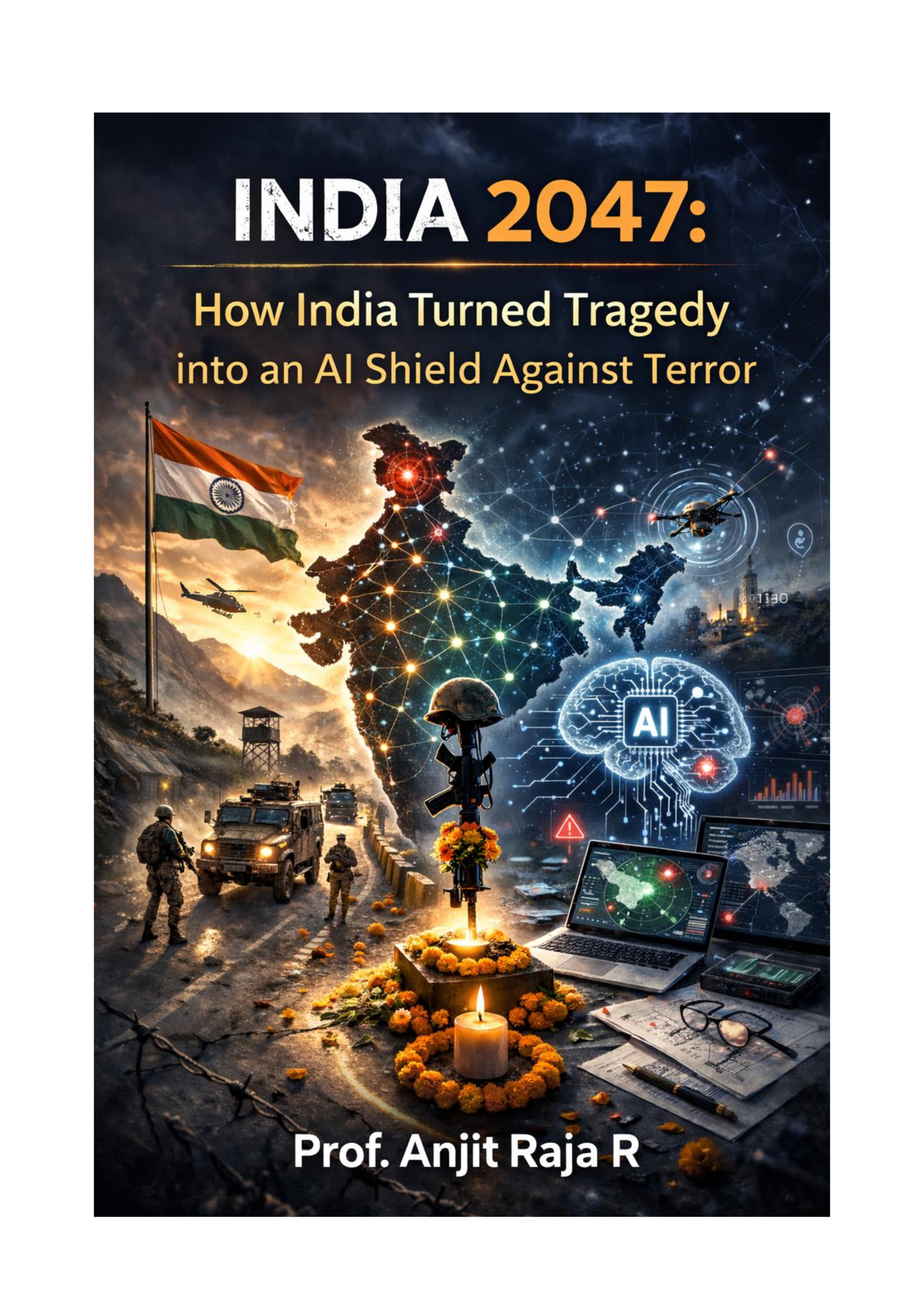

INDIA 2047 The Predictive Nation ━━━━━━━━━━━━━━━━━━━━━━━━━━━━━━━━ How India Transformed Tragedy into an AI Shield, Built a Sovereign Technology Ecosystem, and Emerged as the World's Responsible Superpower ━━━━━━━━━━━━━━━━━━━━━━━━━━━━━━━━ A FICTION-GROUNDED PREDICTIVE CHRONICLE Based on the India 2047 Magazine Series Prof. R. Anjit Raja Page 3 | India 2047: Vision, Strategy & Sovereignty
DEDICATION — In Memoriam — To the forty brave soldiers of the Central Reserve Police Force who gave their lives on 14 February 2019 in Pulwama, Jammu & Kashmir. Their sacrifice was not in vain. From the ashes of that February morning, India chose not to mourn endlessly - it chose to prepare relentlessly. "They did not die so we could grieve. They died so we would never have to grieve the same way again." - Prof. R. Anjit Raja This book is also dedicated to every scientist, coder, ethicist, soldier, teacher, and citizen who will build the India of 2047 - one that is secure, sovereign, and humane. — Jai Hind — Page 4 | India 2047: Vision, Strategy & Sovereignty
Foreword: A Letter from 2047 You are reading this in what we once called 'the present.' For me, writing these words from the vantage point of 2047, your world with its anxieties, its unrealised potential, it’s devastating tragedies is the past I grew up in. I was seven years old when the Pulwama attack happened. I remember my mother crying quietly in the kitchen and not understanding why. I remember the names scrolling on the television forty names, each one a universe of love and sacrifice. That morning planted a question in me that took two decades to answer: Can we do better? Can a nation of 1.4 billion people, ancient in wisdom and young in ambition, build systems capable of preventing such tragedies? The answer, as you will read in the pages ahead, is a cautious but definitive: Yes. "Technology does not make us safer. Responsibility does. Technology merely amplifies whatever values we choose to hold." India in 2047 is not perfect. No nation ever is. But it is prepared. And preparedness, we learned, is the highest form of patriotism. Read this book not as prophecy, but as possibility. Every figure in it is a projection. Every scenario is a simulation. But the questions are real, the stakes are real, and the choices belong to your generation. - Unknown India, August 15, 2047 Page 5 | India 2047: Vision, Strategy & Sovereignty
Contents Chapter 1 The Morning That Changed Everything - Pulwama 2019 Chapter 2 From Reaction to Prediction: India's Strategic Pivot Chapter 3 The AI Shield - Architecture of the 2047 Defense Grid Chapter 4 Highway Intercept 2046 - The Simulation That Proved the Theory Chapter 5 The Tech Stack Behind the Shield Chapter 6 Biological Frontiers - The New Dimension of Security Chapter 7 Security with Responsibility - Ethics in the Age of AI Chapter 8 Tech-Trained Nation - From Classroom to Command Centre Chapter 9 India's 2047 Technology Landscape - A Statistical Vision Chapter 10 Conclusion - Vision 2047: A Centenary Promise Appendix A Key Technologies of India's 2047 Defense Ecosystem Appendix B Timeline: India's AI & Security Milestones 2019 - 2047 Appendix C Statistical Projections for India 2047 Page 6 | India 2047: Vision, Strategy & Sovereignty
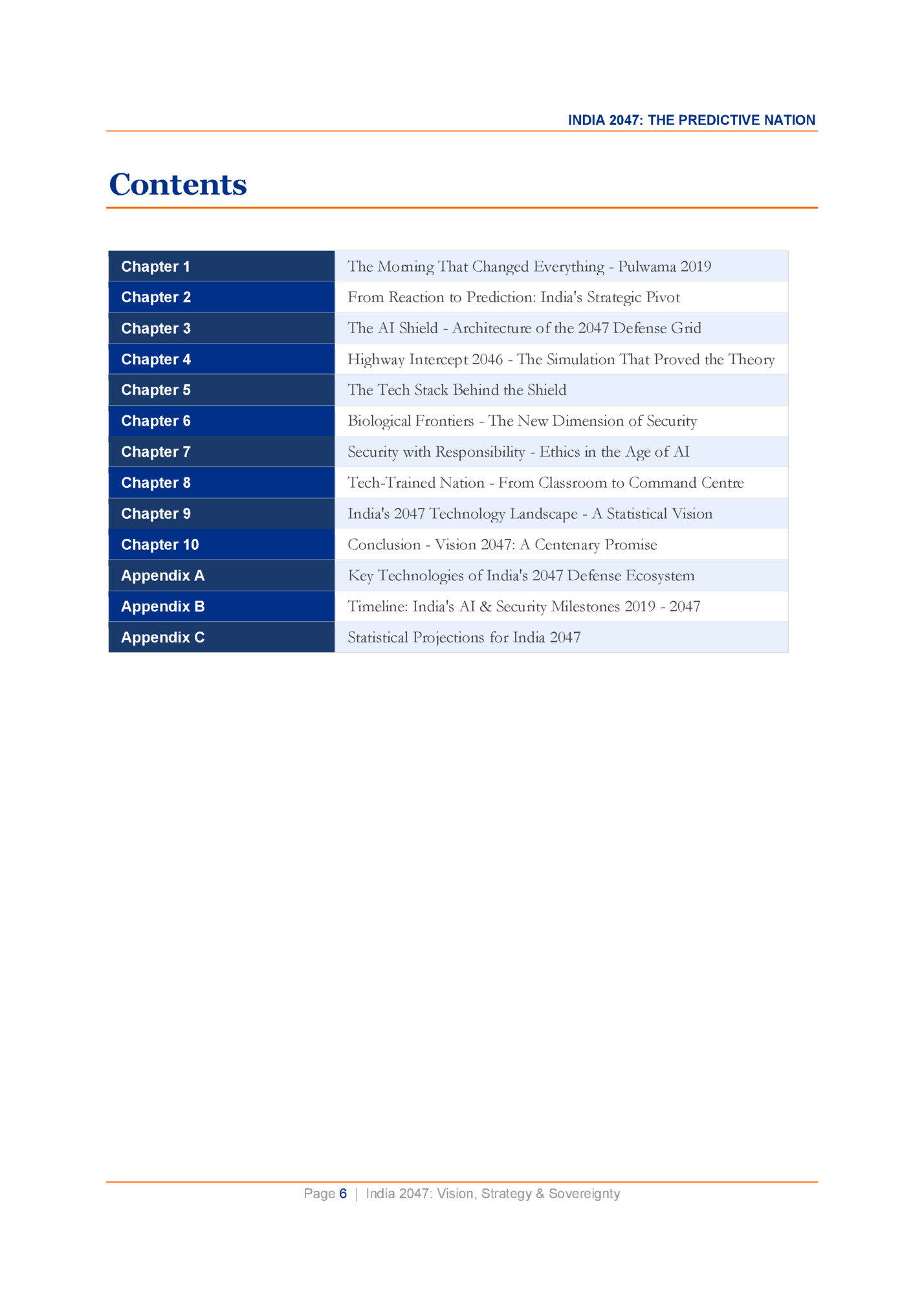
Chapter One The Morning That Changed Everything Figure 1.1 - The Pulwama Memorial: A Nation Remembers Its Forty Heroes (Artistic Rendering, 2047) 14 February 2019, 15:15 Hours - National Highway 44, Pulwama Page 7 | Chapter 1: The Morning That Changed Everything
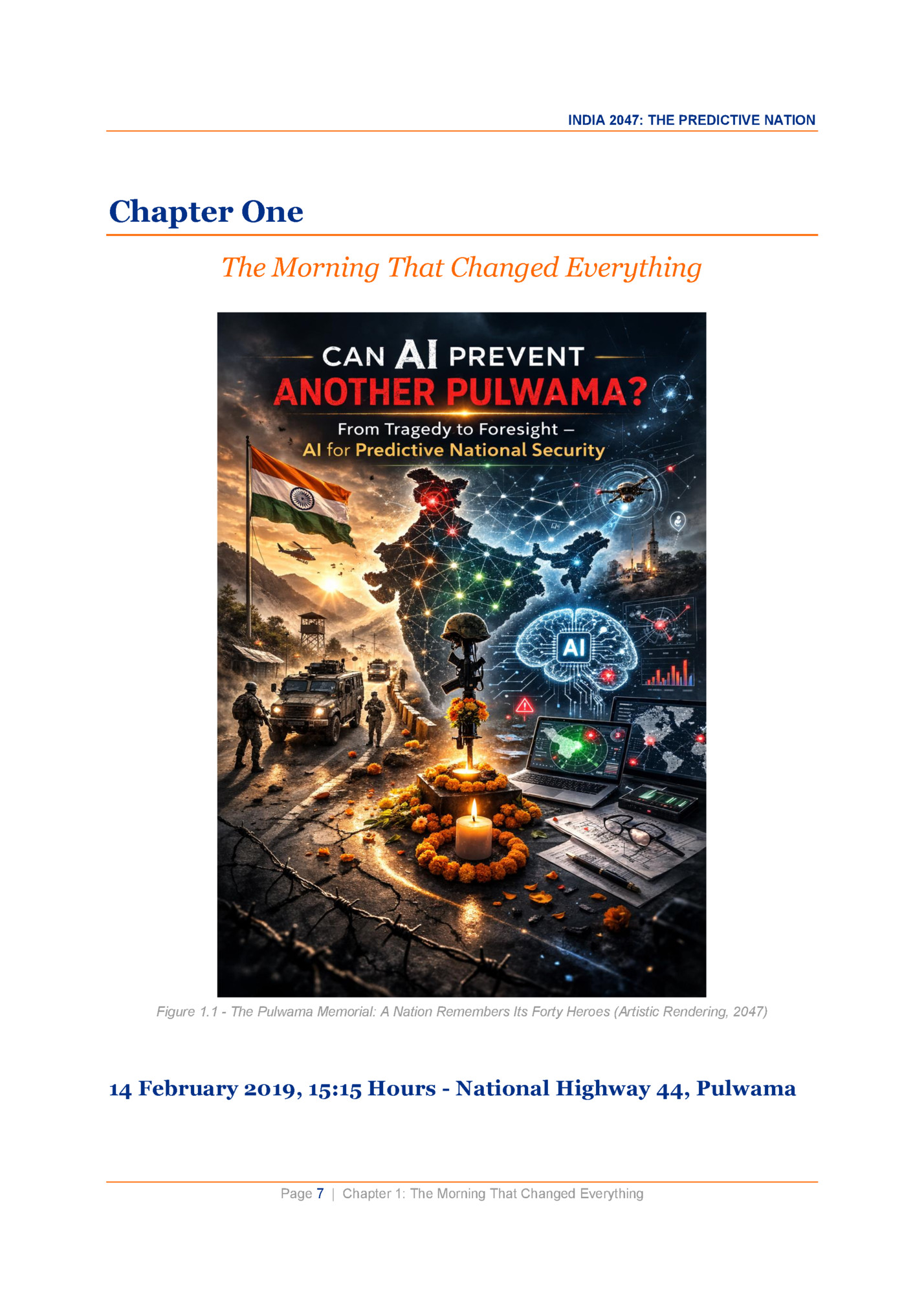
The convoy stretched for miles. Two thousand five hundred CRPF personnel. Seventy-eight vehicles. Routine movement from Jammu to Srinagar. For the men inside those armoured buses, it was just another transfer - uncomfortable, long, but unremarkable. Until it wasn't. At 15:15 hours, a vehicle loaded with over 300 kilograms of explosive material rammed into bus number 1151. The explosion that followed was not just physical - it tore through the consciousness of a nation. Forty men did not return home that evening. Forty families entered a darkness that never fully lifts. "The tragedy of Pulwama was not that intelligence failed. It was that intelligence was never designed to succeed in time." - Prof. R. Anjit Raja What the Investigation Revealed In the months that followed, parliamentary committees, intelligence reviews, and security analysts dissected what had gone wrong. The findings were uncomfortable - not because of negligence, but because of structural limitations that no amount of dedication could overcome in real time. Fragments of relevant information had existed. Movement signals, behavioural anomalies, procurement patterns, communication bursts - scattered across databases, agencies, and jurisdictions that did not speak to each other in a unified language. The system was not blind. It was fragmented. And in security, fragmentation kills. Date of Attack 14 February 2019 Location Lethapora, Pulwama, Jammu & Kashmir, NH-44 Target CRPF Convoy — 78 Vehicles, 2,500 Personnel Method Vehicle-borne IED (Improvised Explosive Device) Casualties 40 CRPF Personnel Killed Page 8 | Chapter 1: The Morning That Changed Everything
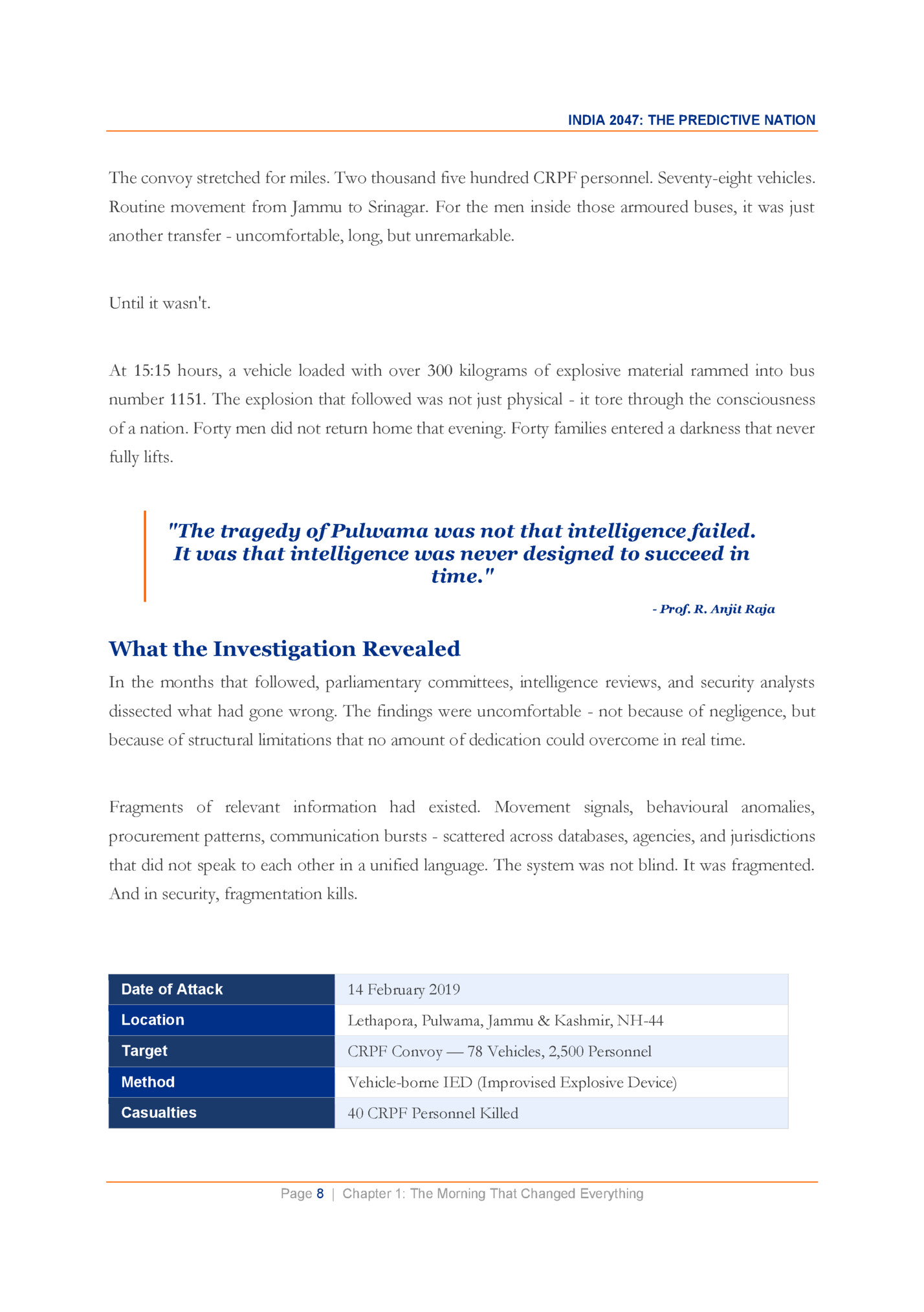
Intelligence Gaps Fragmented data, siloed agencies, no predictive fusion platform Perpetrating Group Jaish-e-Mohammed (JeM), Pakistan-based terrorist organisation National Response Operation Bandar (Balakot Air Strikes, 26 Feb 2019) Policy Outcome Major push for intelligence modernisation and AI integration The Questions That Refused to Die What if the satellite imagery had been cross-referenced with vehicle movement logs in real time? What if communication pattern anomalies had triggered an automated alert forty-eight hours before the convoy departed? What if a predictive risk model had flagged National Highway 44 as elevated threat on that particular morning? These are not rhetorical questions. They became the architecture of India's next twenty-eight years of security evolution. They became the blueprint of the AI Shield of 2047. "In the language of data science, every tragedy is a labelled training event. The question is whether we have the courage to learn from it." - Prof. R. Anjit Raja Pulwama did not merely expose a tactical failure. It exposed the philosophical gap between India's intelligence doctrine and the technological tools available to modern nation-states. The country that had given the world Aryabhatta, Ramanujan and the digital revolution of the 1990s had not yet applied its computational genius to its most urgent existential challenge. That was about to change. Page 9 | Chapter 1: The Morning That Changed Everything
Fleepit Digital © 2021