ON LAND sustainablegoals15
CONTENTS 1 AMAZING FACTS ABOUT LIFE ON LAND (SDG 15) 2 PROTECTING LIFE ON LAND: A VOICE FROM THE FIELD 3 THE VOICE OF NATURE: THE WISDOM OF MAHATMA GANDHI 4 THE PHILIPPINES: A BIODIVERSITY HOTSPOT 5 THE PHILIPPINE EAGLE: A NATIONAL SYMBOL 6 TAMARAW: THE FIERCE DWARF BUFFALO OF MINDORO 7 FARMING FRIENDS OF PHILIPPINES FOREST 8 GREEN ROOTS RISING: BCU CBA'S TREE WARRIORS WEED THE WAY TO SDG 15 GLORYNESIA 9 FLOWCHART 10 CROSSWORD PUZZLE 11 CONTRIBUTORS 12 REFERENCES
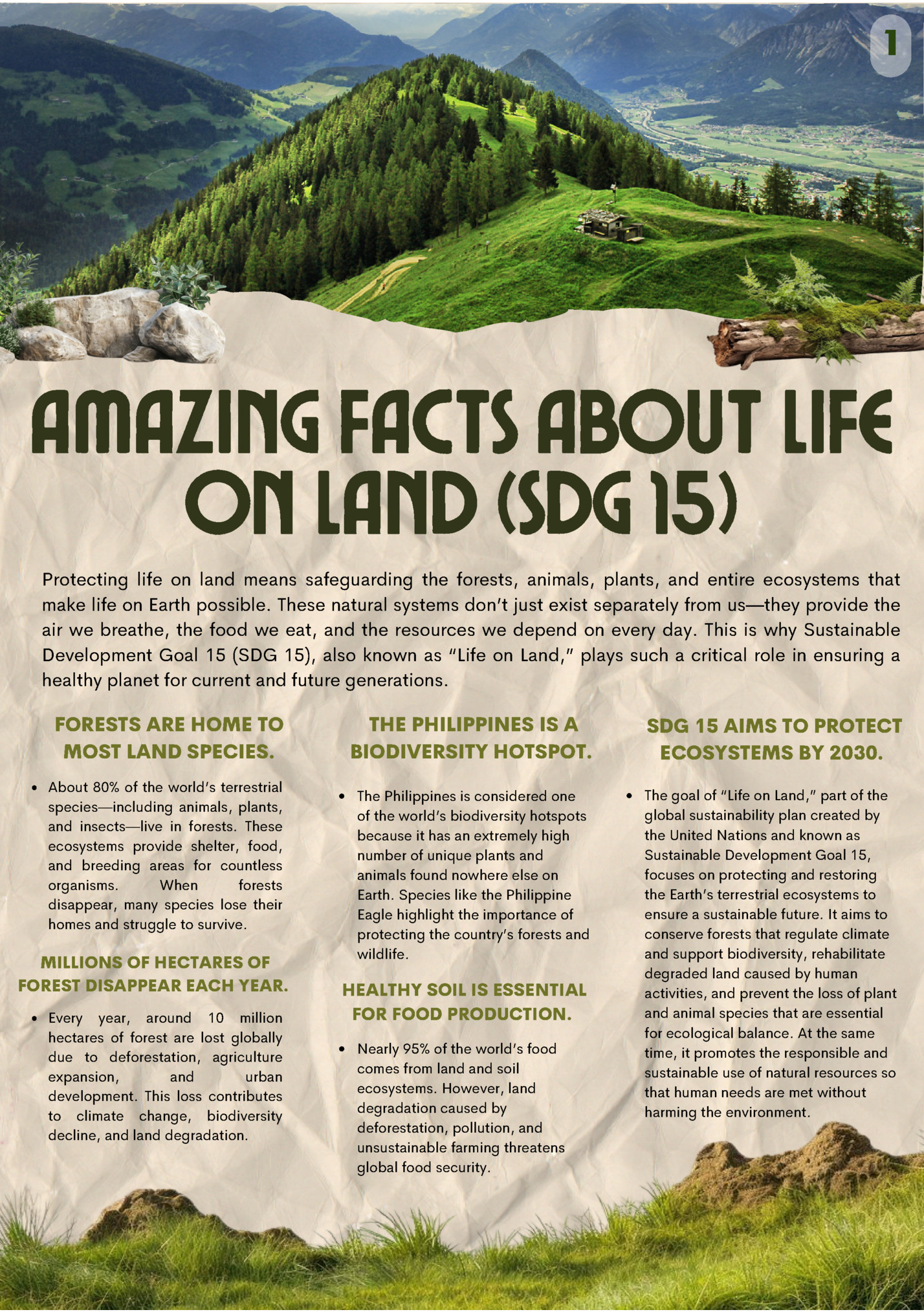
Amazing Facts About Life oN LAND (SDG 15) Protecting life on land means safeguarding the forests, animals, plants, and entire ecosystems that make life on Earth possible. These natural systems don’t just exist separately from us—they provide the air we breathe, the food we eat, and the resources we depend on every day. This is why Sustainable Development Goal 15 (SDG 15), also known as “Life on Land,” plays such a critical role in ensuring a healthy planet for current and future generations. FORESTS ARE HOME TO MOST LAND SPECIES. About 80% of the world’s terrestrial species—including animals, plants, and insects—live in forests. These ecosystems provide shelter, food, and breeding areas for countless organisms. When forests disappear, many species lose their homes and struggle to survive. MILLIONS OF HECTARES OF FOREST DISAPPEAR EACH YEAR. Every year, around 10 million hectares of forest are lost globally due to deforestation, agriculture expansion, and urban development. This loss contributes to climate change, biodiversity decline, and land degradation. THE PHILIPPINES IS A BIODIVERSITY HOTSPOT. SDG 15 AIMS TO PROTECT ECOSYSTEMS BY 2030. The Philippines is considered one of the world’s biodiversity hotspots because it has an extremely high number of unique plants and animals found nowhere else on Earth. Species like the Philippine Eagle highlight the importance of protecting the country’s forests and wildlife. The goal of “Life on Land,” part of the global sustainability plan created by the United Nations and known as Sustainable Development Goal 15, focuses on protecting and restoring the Earth’s terrestrial ecosystems to ensure a sustainable future. It aims to conserve forests that regulate climate and support biodiversity, rehabilitate degraded land caused by human activities, and prevent the loss of plant and animal species that are essential for ecological balance. At the same time, it promotes the responsible and sustainable use of natural resources so that human needs are met without harming the environment. HEALTHY SOIL IS ESSENTIAL FOR FOOD PRODUCTION. Nearly 95% of the world’s food comes from land and soil ecosystems. However, land degradation caused by deforestation, pollution, and unsustainable farming threatens global food security.
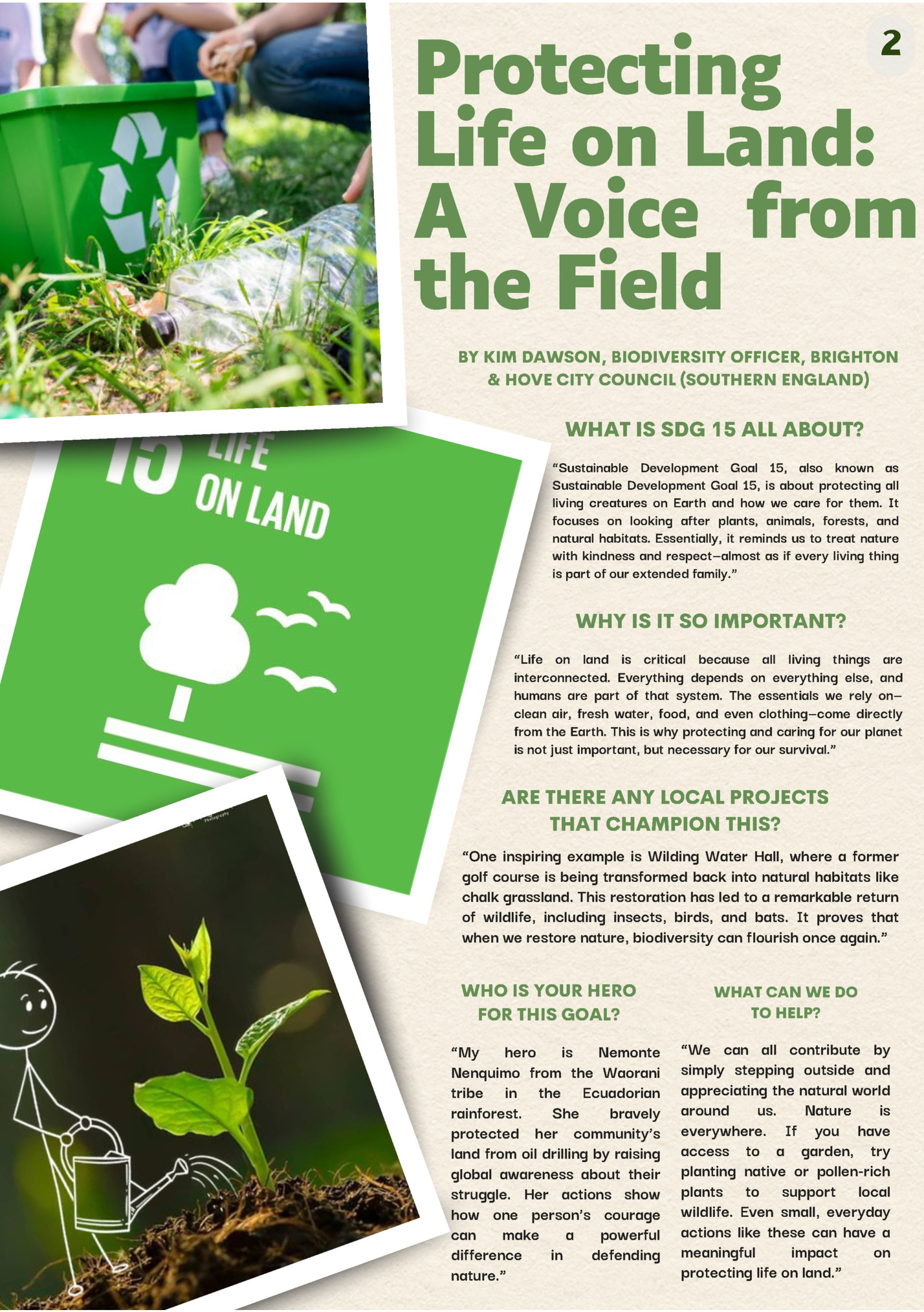
Protecting Life on Land: A Voice from the Field BY KIM DAWSON, BIODIVERSITY OFFICER, BRIGHTON & HOVE CITY COUNCIL (SOUTHERN ENGLAND) WHAT IS SDG 15 ALL ABOUT? “Sustainable Development Goal 15, also known as Sustainable Development Goal 15, is about protecting all living creatures on Earth and how we care for them. It focuses on looking after plants, animals, forests, and natural habitats. Essentially, it reminds us to treat nature with kindness and respect—almost as if every living thing is part of our extended family.” WHY IS IT SO IMPORTANT? “Life on land is critical because all living things are interconnected. Everything depends on everything else, and humans are part of that system. The essentials we rely on— clean air, fresh water, food, and even clothing—come directly from the Earth. This is why protecting and caring for our planet is not just important, but necessary for our survival.” ARE THERE ANY LOCAL PROJECTS THAT CHAMPION THIS? “One inspiring example is Wilding Water Hall, where a former golf course is being transformed back into natural habitats like chalk grassland. This restoration has led to a remarkable return of wildlife, including insects, birds, and bats. It proves that when we restore nature, biodiversity can flourish once again.” WHO IS YOUR HERO FOR THIS GOAL? “My hero is Nemonte Nenquimo from the Waorani tribe in the Ecuadorian rainforest. She bravely protected her community’s land from oil drilling by raising global awareness about their struggle. Her actions show how one person’s courage can make a powerful difference in defending nature.” WHAT CAN WE DO TO HELP? “We can all contribute by simply stepping outside and appreciating the natural world around us. Nature is everywhere. If you have access to a garden, try planting native or pollen-rich plants to support local wildlife. Even small, everyday actions like these can have a meaningful impact on protecting life on land.”
THE VOICE OF NATURE: THE WISDOM OF MAHATMA GANDHI Long before the world began talking about climate change, sustainability, and the Sustainable Development Goals, Mahatma Gandhi was already sharing ideas about living simply and respecting nature. Known as the leader of India’s nonviolent movement for independence, Gandhi also believed that humans must live in harmony with the environment. His words continue to inspire environmental movements and sustainability efforts around the world today. Born in 1869 in India, Gandhi became famous for leading peaceful protests against British colonial rule. However, his philosophy went beyond politics. He strongly believed in simple living and responsible consumption. Gandhi encouraged people to avoid excessive use of resources and to live in ways that would not harm others or the environment. One of his most powerful ideas about nature is reflected in his statement: “What we are doing to the forests of the world is a mirror of what we are doing to ourselves.” This quote highlights the deep connection between human life and the natural environment. When forests are destroyed, ecosystems collapse, biodiversity disappears, and communities lose important natural resources. Today, Gandhi’s message closely relates to Sustainable Development Goal 15: Life on Land, an initiative led by the United Nations. This goal focuses on protecting forests, restoring degraded land, and stopping biodiversity loss. Gandhi believed that nature provides enough resources for everyone if people use them responsibly. His well-known idea, “The Earth provides enough to satisfy every man’s needs, but not every man’s greed,” reminds us that environmental problems often arise from overconsumption and unsustainable practices. In modern times, deforestation, wildlife extinction, and land degradation are major global challenges. Gandhi’s teachings encourage societies to rethink how resources are used and to adopt sustainable lifestyles that protect ecosystems. Many environmental advocates today continue to draw inspiration from Gandhi’s philosophy. His emphasis on ethical responsibility, simplicity, and respect for life aligns closely with global sustainability movements. for students and young people, Gandhi’s message remains powerful: protecting nature is not only the responsibility of governments or organizations—it is a responsibility shared by every individual. As the world works toward achieving sustainability goals by 2030, Gandhi’s ideas remind us that environmental protection begins with our daily choices. Conserving resources, respecting wildlife, and protecting forests are actions that help preserve life on Earth. More than a century after his birth, the voice of Mahatma Gandhi still echoes in global conversations about sustainability. His message is simple yet powerful: caring for the planet means caring for ourselves and future generations.
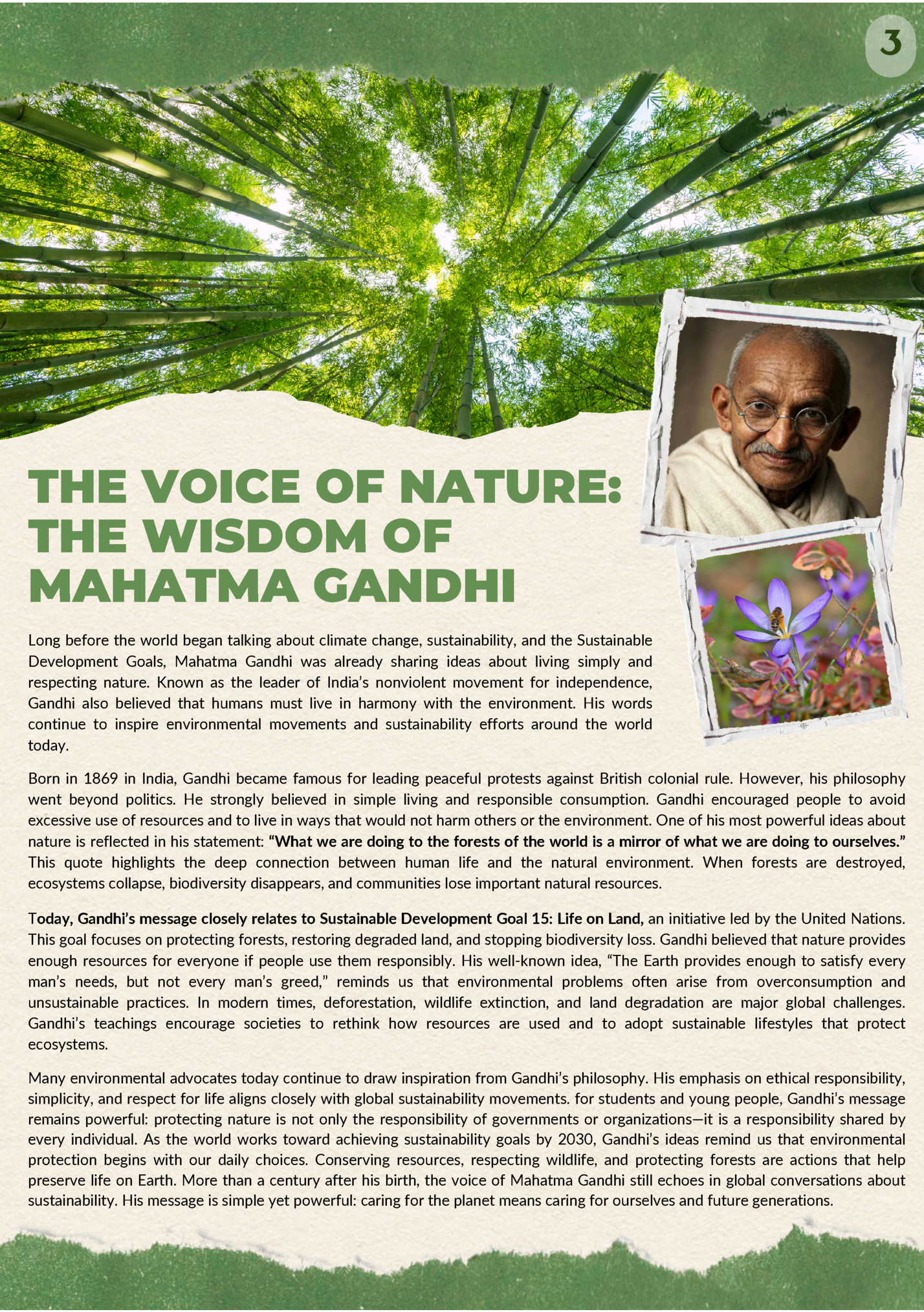
A BIODIVERSITY HOTSPOT 4 The Philippines is known as one of the world’s richest areas for biodiversity, home to many unique plants and animals found nowhere else on Earth. With more than 52,177 described species—about half of which are endemic—the country stands among the world’s megadiverse nations. This richness is largely due to its geography, with over 7,600 islands that allow species to evolve in isolation through the process of Speciation. Over time, this has led to an extraordinary variety of life, including hundreds of endemic birds, mammals, amphibians, and reptiles. The country’s marine ecosystems are just as impressive, with thousands of fish species thriving in areas like the Verde Island Passage, widely recognized as the “center of the center” of marine biodiversity due to its unmatched concentration of marine life. However, many of these species are now endangered due to habitat loss, deforestation, and illegal hunting. Island ecosystems are especially vulnerable because of their limited space and fragile balance, making it difficult for species to survive when their habitats are disturbed. Animals such as the Philippine eagle are rapidly losing their forest homes, while ecosystems like Lake Lanao have been severely affected by the introduction of non-native species. Smaller and isolated populations, including the Tamaraw, are also more susceptible to disease and environmental changes. Protecting wildlife is a vital part of Sustainable Development Goal 15, which focuses on conserving ecosystems, restoring natural habitats, and preventing biodiversity loss. Strengthening conservation laws, promoting sustainable practices, and increasing public awareness are crucial steps to ensure that these unique and irreplaceable species continue to thrive for future generations.
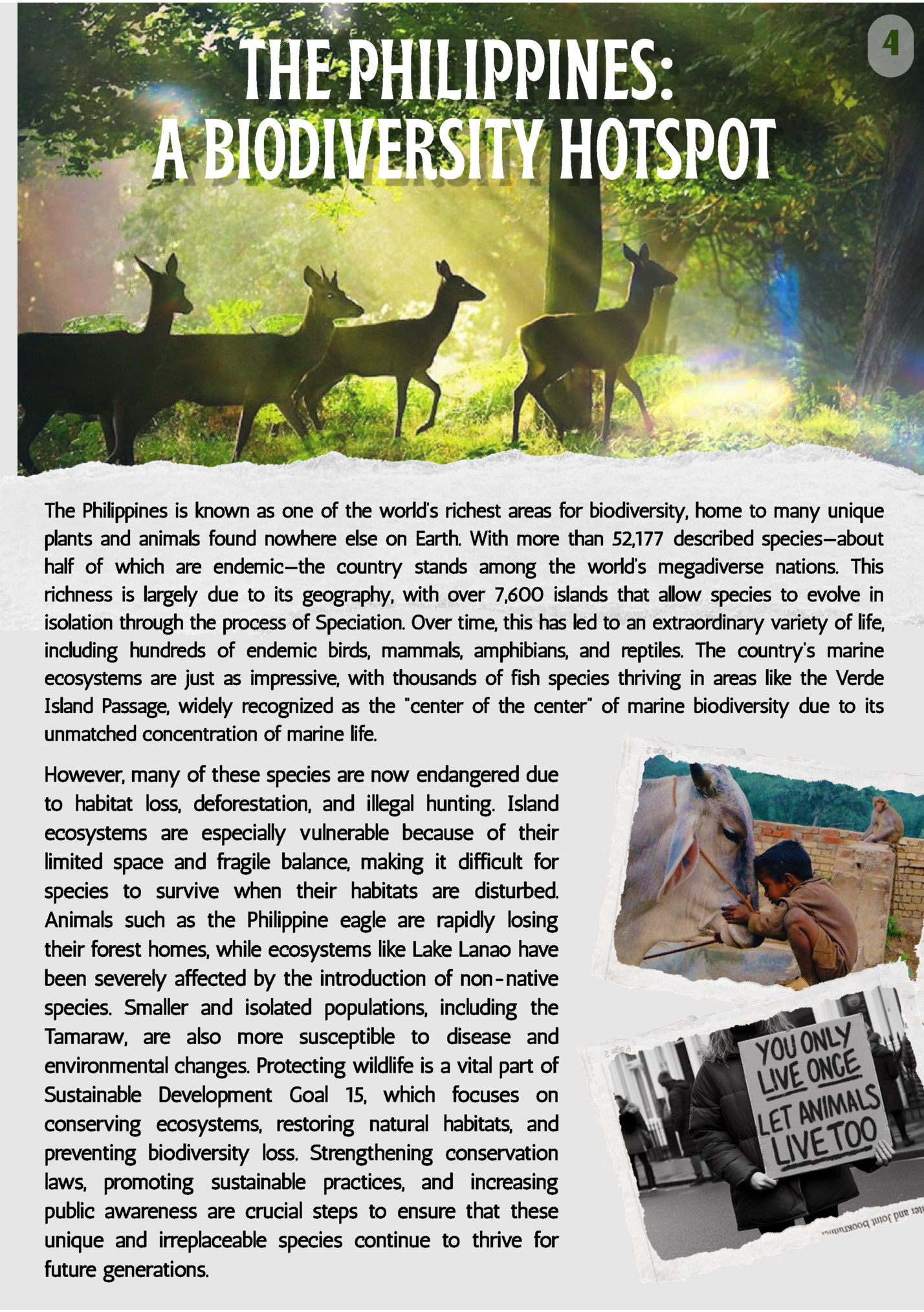
THE PHILIPPINE EAGLE: A NATIONAL SYMBOL The Philippine eagle is the king of our rainforests. It became our national bird in 1995. But now it is in big danger. Fewer than 400 pairs live in the wild, says the Philippine Eagle Foundation. This giant bird stands 3 feet tall with 7-foot wings—one of the world's largest eagles. A fluffy crest crowns its head like royalty. Its blue-gray eyes see eight times better than ours. The hooked beak turns dark at the tip, and yellow legs have 3-inch claws. Eagles mate for life and need huge forests of 4,000 to 11,000 hectares. They nest in tall lauan trees and eat mostly flying lemurs—up to 90% of their food—plus rats, civets, and snakes. Endemic only to the Philippines, it lives in four islands: Luzon, Samar, Leyte, and Mindanao. Forests shrink fast from logging and farms. Only 32% of good lands are safe. Hunters shoot eagles—one dies yearly, four from guns in 2024 alone. Rescue teams saved five since 2020. Eagles lay just one egg every two years, so numbers grow very slow. When forests vanish, eagles hunt near villages. Traps catch them, pets spread sickness, and loud machines stop nesting. As top hunters, they control monkeys, snakes, and birds to keep forests healthy. The IUCN lists them as critically endangered since 2010. Each lost eagle hurts the whole web of forest life. Help comes from the Philippine Eagle Foundation's center, raising 29 babies since 1992. A new 13-hectare sanctuary in Davao City will make 1-2 eaglets yearly with perfect height and plants. Lumad people guard nests through "Bantay Bukid." They plan three million narra and lauan trees in key spots. Laws ban hunting and protect forests, but we need more funding. Adopted globally as a symbol by the Wildlife Conservation Society, saving it means saving our unique forests.
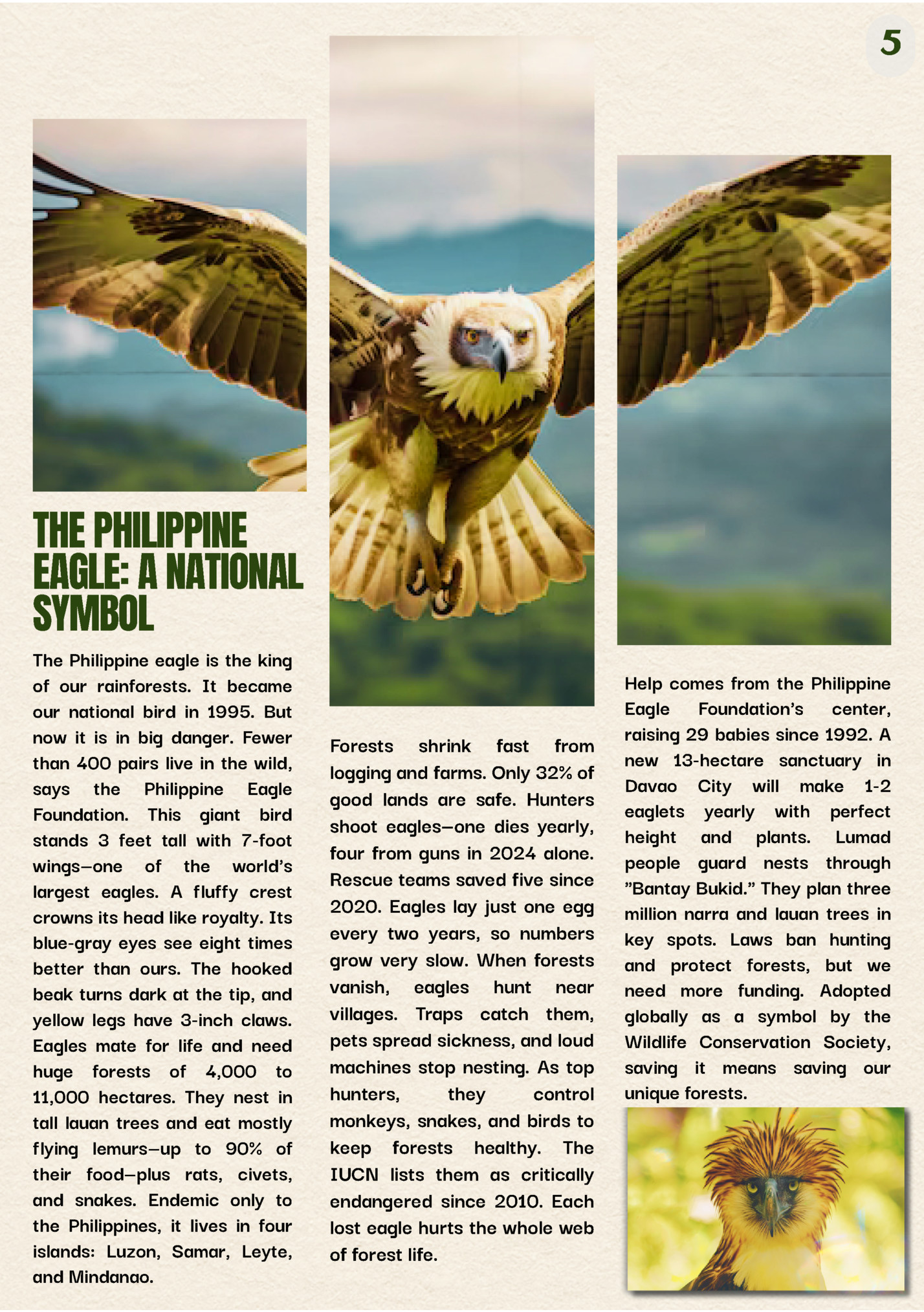
Mindoro Island in the mountains. This small, strong dwarf buffalo stands just over one meter tall at the shoulder. In the early 1900s, about 10,000 tamaraws roamed free. Now only 480 remain, says Re:wild—they are critically endangered. Tamaraws like to live alone, not like big water buffalos. Adult males stay by themselves and can be very aggressive. Mothers stay with babies of different ages. They eat mostly grasses like cogon grass and wild sugarcane. They love mud baths to stay cool and keep bugs away. Now they hide in highland forests, thick bushes near open glades, and grassy plains by water. They move at night to avoid people. Young tamaraws play in small groups to learn who is boss, while adults keep apart. They once walked all over Mindoro, from sea level to 2,000-meter peaks. Big threats hurt tamaraws. A cow disease called rinderpest killed thousands in the 1930s from farm animals. Today farms, logging, houses, and cattle ranches take their grasslands and forests. Slash-and-burn farming splits their groups. Hunters kill them for meat or sport. Cows and buffalos bring new sickness. Human homes limit their space. But help works! Mt. Iglit-Baco National Park protects 80% of all tamaraws. The Tamaraw Conservation Program started by Presidential Order in 1979. Numbers grew from 154 in 2000 to 480 today. DENR rangers guard mountains from poachers. New calves appear in Upper Amanay and AruyanMalate too. Mangyan people help through partnership. The National Plan aims for thriving tamaraws by 2050 with good habitats. Save the tamaraw—save Mindoro's wild home! Tamaraw: The Fierce Dwarf Buffalo of Mindoro 6
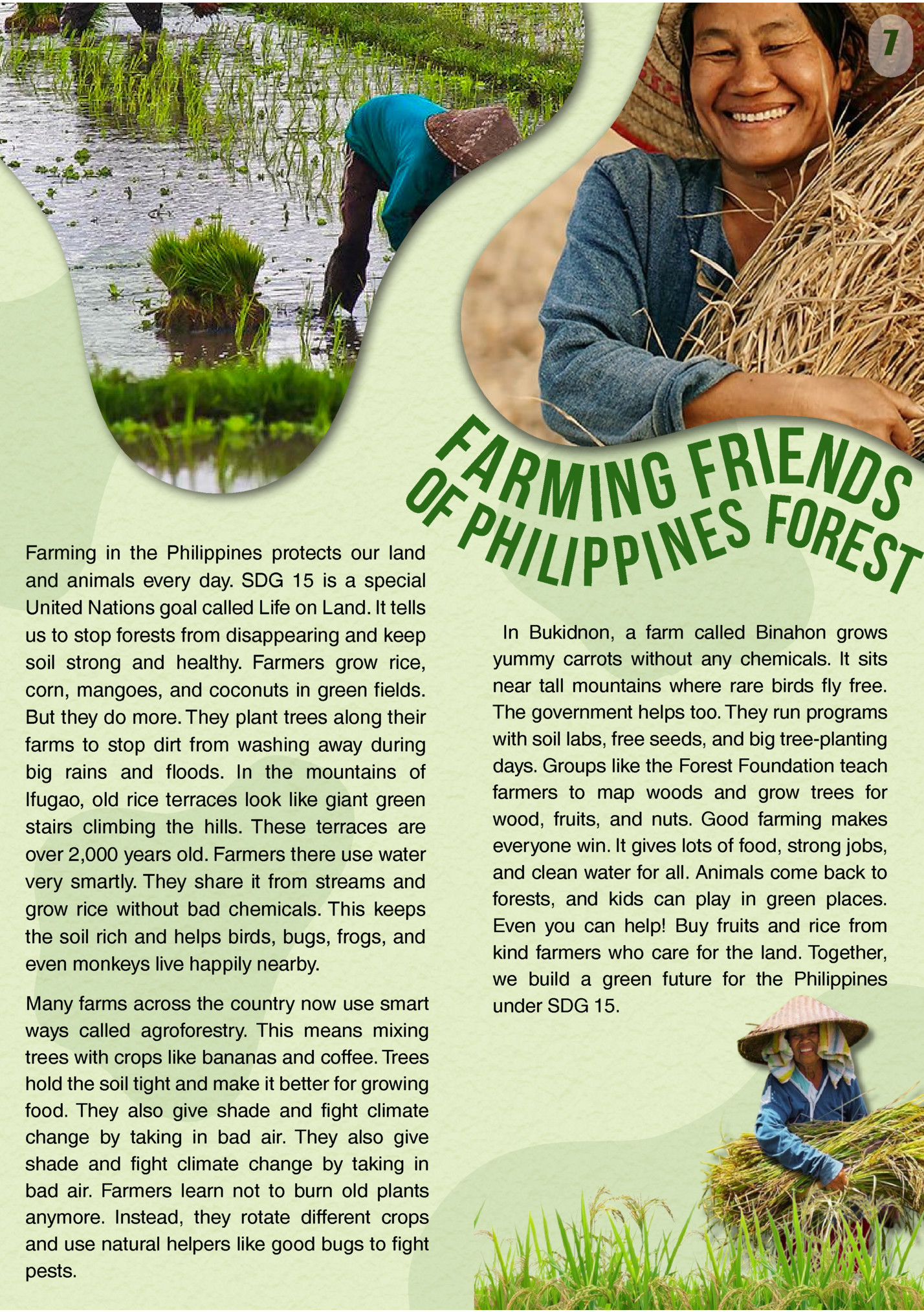
FA OF R M I N G F R IEND S F O PH I L S R E EST N IPPI Farming in the Philippines protects our land and animals every day. SDG 15 is a special United Nations goal called Life on Land. It tells us to stop forests from disappearing and keep soil strong and healthy. Farmers grow rice, corn, mangoes, and coconuts in green fields. But they do more. They plant trees along their farms to stop dirt from washing away during big rains and floods. In the mountains of Ifugao, old rice terraces look like giant green stairs climbing the hills. These terraces are over 2,000 years old. Farmers there use water very smartly. They share it from streams and grow rice without bad chemicals. This keeps the soil rich and helps birds, bugs, frogs, and even monkeys live happily nearby. Many farms across the country now use smart ways called agroforestry. This means mixing trees with crops like bananas and coffee. Trees hold the soil tight and make it better for growing food. They also give shade and fight climate change by taking in bad air. They also give shade and fight climate change by taking in bad air. Farmers learn not to burn old plants anymore. Instead, they rotate different crops and use natural helpers like good bugs to fight pests. In Bukidnon, a farm called Binahon grows yummy carrots without any chemicals. It sits near tall mountains where rare birds fly free. The government helps too. They run programs with soil labs, free seeds, and big tree-planting days. Groups like the Forest Foundation teach farmers to map woods and grow trees for wood, fruits, and nuts. Good farming makes everyone win. It gives lots of food, strong jobs, and clean water for all. Animals come back to forests, and kids can play in green places. Even you can help! Buy fruits and rice from kind farmers who care for the land. Together, we build a green future for the Philippines under SDG 15.
Fleepit Digital © 2021