India This Week~August 29, 2025
India This Week~August 29, 2025
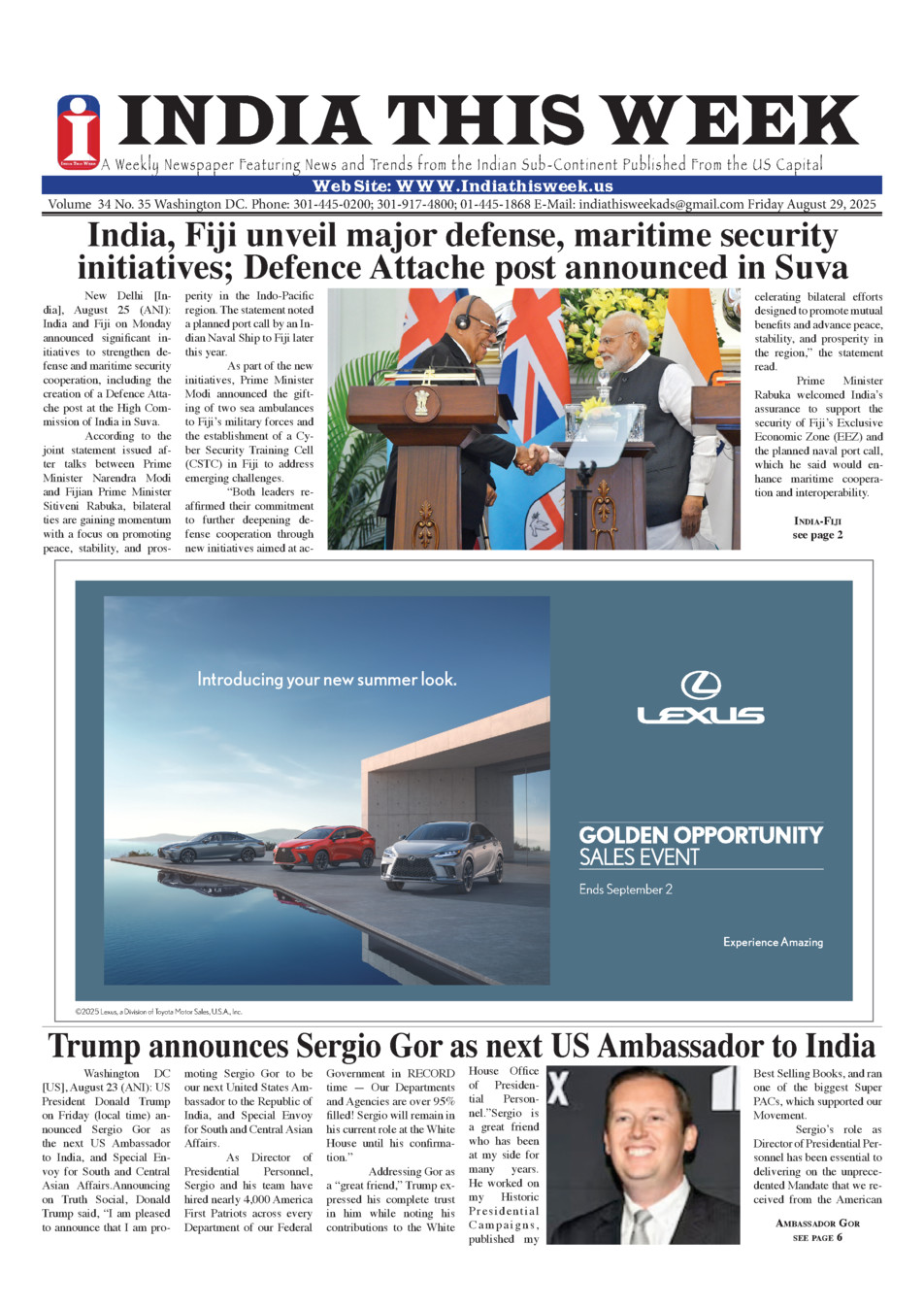
India This Week – Highlights for August 29, 2025
Overview of key developments in a rapidly changing regional landscape
The August 29, 2025 edition of India This Week offers a comprehensive snapshot of how India is engaging with partners across the Indo-Pacific, balancing security, diplomacy, and cultural exchange while highlighting the resilience of the region in the face of natural disasters and shifting geopolitical currents. The issue threads together defense partnerships, strategic appointments, cultural showcases, and on-the-ground humanitarian responses to illustrate a nation actively shaping its role on multiple fronts—military, diplomatic, economic, and sociocultural. The convergence of these themes underlines India’s effort to cultivate stability, expand influence through capable governance, and sustain momentum in regional collaborations with friends and allies far beyond its borders. (Page 1)
Strengthening Indo-Pacific security through India-Fiji collaboration
A centerpiece of this week’s reporting is the deepening defense and maritime security partnership between India and Fiji. Following discussions between Prime Minister Modi and Fijian Prime Minister Sitiveni Rabuka, the two nations outlined concrete steps aimed at enhancing bilateral security cooperation. Notable measures include inaugurating a Defense Attache post at the Indian High Commission in Suva, planning a forthcoming Indian Naval Ship port call to Fiji, and expanding information sharing and joint response capabilities to coastal and maritime challenges. The statement framed these moves as a shared commitment to peace, stability, and prosperity in the Indo-Pacific, with both sides signaling a readiness to elevate interoperability across training, maritime security, and security governance. (Page 2)
In a broader scope, Modi pledged to gift two sea ambulances to Fiji’s military and to establish a Cyber Security Training Cell (CSTC) designed to counter evolving cyber threats. These gestures are presented not only as humanitarian and security support, but also as practical infrastructure for modern defense cooperation. The joint communiqué underscored mutual trust and a willingness to pursue innovative mechanisms—such as training exchanges, disaster-response coordination, and maritime domain awareness—as pillars of a more robust partnership. Rabuka’s government welcomed the assurances, emphasizing how enhanced security collaboration would improve maritime interoperability and regional readiness. (Page 2)
Officials from both governments also highlighted cooperation in United Nations peacekeeping, military medicine, and maritime information exchange, signaling a comprehensive approach to security beyond traditional defense postures. The emphasis on capacity-building and port-level collaboration reflects a recognition that regional security in the Pacific hinges on practical, on-the-ground capabilities, including disaster management when storms and floods disrupt coastal infrastructure. The overarching aim is to translate political goodwill into sustained operational gains—better-trained personnel, shared intelligence, and a security framework capable of responding to natural and man-made crises alike. (Page 2)
US-India diplomacy through the lens of Sergio Gor’s nomination
In Washington’s diplomatic arena, the nomination of Sergio Gor as the United States Ambassador to India and Special Envoy for South and Central Asia represents a notable inflection point. The announcement, circulated via Truth Social, frames Gor as a trusted insider whose career has centered on assembling teams, delivering policy outcomes, and navigating high-stakes organizational dynamics. Proponents argue that Gor’s proven ability to staff the federal workforce rapidly and effectively translates into the kind of decisive, results-driven diplomacy required to advance a wide-ranging US-India agenda—from security and defense technology to trade and economic reform. (Page 6)
The piece situates Gor within a lineage of influential U.S. ambassadors whose strength lay less in ceremonial stature and more in access, trust, and pragmatic problem-solving. Drawing historical parallels with figures known for bridging policy and practice, the author suggests Gor could bring an operational mindset to New Delhi—one that couples tight coordination with the capacity to mobilize diverse actors across government, industry, and civil society. In an era when the Indo-Pacific balance hinges on tangible deliverables—such as resilient supply chains, technology transfer, and joint defense initiatives—Gor’s background in coordinating large teams and complex personnel decisions is presented as an asset for advancing bilateral objectives. (Page 6)
Business and regional expansion: BK Franchise ties with Ten Thousand and L’AMI Bakery; India-Japan ties on a fast track
The issue also highlights a corporate wave of franchise expansion led by BK Franchise, the franchise-focused arm of a major Asian supermarket chain, as it broadens its U.S. footprint through collaborations with niche brands Ten Thousand Coffee and L’AMI Bakery. The strategic alliance aims to accelerate growth across key markets, including New York, New Jersey, California, Texas, and Illinois, with a notable launch inside a flagship H Mart location in Great Neck, New York. Ten Thousand Coffee is positioned as a premium, scalable coffee brand with a robust operating framework designed to attract franchise partners seeking a stable return on investment. L’AMI Bakery, meanwhile, reimagines Korean bakery flavors with contemporary desserts, expanding in-shop and standalone formats to meet evolving consumer tastes. (Page 2)
Beyond North American expansion, Ten Thousand already maintains a footprint in Australia, Taiwan, and Vietnam, and has recently sealed a master franchise agreement in the Philippines to accelerate cross-border development. L’AMI’s global vision anticipates similar momentum through dual operating models and a clear emphasis on brand storytelling that resonates with American consumers seeking new cultural experiences. Both brands emphasize a holistic approach to franchising—combining brand identity, consumer appeal, and operational rigor to scale globally. The article also provides practical contact points for prospective franchisees, signaling a poised momentum in cross-cultural retail entrepreneurship. (Page 2)
Separately, reporting on India-Japan ties underscores a high-priority trajectory in which Modi’s forthcoming visit to Japan is framed as a landmark opportunity to deepen collaboration across multiple dimensions. Foreign Secretary Vikram Misri outlined an expansive partnership that spans trade, investment, defense, science and technology, and people-to-people exchanges, with a focus on launching new initiatives and expanding intergovernmental and interregional engagement. The summit with Japanese Prime Minister Ishiba (and the broader agenda with prefectures and industry leaders) is described as a catalyst for resilience and shared prosperity in the Indo-Pacific, reinforcing the view that India and Japan are strategic partners whose cooperation extends into infrastructure, mobility, and technology collaboration. (Page 2)
Culture, cinema, and diaspora voices: DC South Asian Film Festival returns with a star-studded lineup
The DC South Asian Film Festival (DCSAFF) returns for its 14th edition, illuminating the dynamic storytelling emanating from South Asian communities and the broader diaspora. The festival blends in-person screenings in Rockville, Maryland (September 5–7) with a virtual program running from September 8–30, broadening access to audiences beyond the Greater DC area. Organized by the nonprofit DC South Asian Arts Council, the festival emphasizes a mosaic of languages, genres, and perspectives that highlight the diversity of South Asian cinema. (Page 3)
Among the programmatic highlights are a red-carpet opening featuring Nahin Hoon (I Am Not an Actor) by Aditya Kripalani, the screening of Loop Line, an animated short recognized by major film festivals, and appearances by leading actors and directors from India’s contemporary scene. The event also showcases a slate of master classes—ranging from Script to Screen to debates on the state of independent cinema in North and South Asia—along with panel discussions that probe the social impact of cinema on the diaspora and the broader cultural landscape. (Page 3)
A centerpiece moment of the festival is a restored, celebrated classic, Manthan (1976) by Shyam Benegal, which has earned standing ovations at international festivals after restoration. This screening, part of a broader retrospective, pays tribute to Benegal’s contribution to parallel cinema and to the historical evolution of Indian film culture. The closing night features Pyre, a contemporary feature that has earned international accolades and will be accompanied by a post-screening dialogue with the filmmakers. The festival’s breadth—encompassing 54 films from 12 countries and 14 languages—highlights the power of cinema to bridge communities, spark dialogue on social issues, and celebrate artistic excellence across borders. (Page 3-4)
Humanitarian resilience and climate-driven crises: Army rescue operation and weather alerts
In another major development, Indian Army Aviation conducted a daring rescue operation near Madhopur Headworks in Punjab to evacuate 22 Central Reserve Police Force personnel and three civilians stranded by rising floodwaters. Launching helicopters at dawn under adverse weather, the team succeeded in removing all evacuees to safety, an achievement underscored by reports of a nearby building collapsing soon after the evacuation. The incident illustrates the critical role of the armed forces in disaster response and the seamless coordination with civil authorities to avert potential tragedies. (Page 5)
The flood scenario in Punjab is part of broader weather dynamics affecting northern India, with heavy rainfall cascading through Himachal Pradesh and Jammu and Kashmir and swelling rivers across the region. Local authorities issued evacuation advisories and designated relief centers, while meteorological agencies warned of ongoing thunderstorm activity and severe convection. As communities brace for further weather volatility, official guidance emphasizes staying indoors during storms, avoiding waterlogged zones, and relying on official safety advisories to reduce risk. The episode underscores the importance of preparedness, timely communication, and interagency cooperation in safeguarding lives during extreme weather. (Page 5)
Analytical reflections on leadership and the US-India partnership
An opinion piece by Al Mason delves into the significance of Sergio Gor’s ambassadorial nomination within the evolving US-India relationship. The author argues that the appointment signals a practical, delivery-focused era in which trust, access to decision-makers, and the capacity to mobilize federal resources will matter as much as formal diplomacy. The piece situates Gor’s profile alongside a lineage of executive-focused figures who translated strategic intent into tangible results, particularly in complex, multi-stakeholder environments. Given India’s rising status as a global economic and strategic actor, the author contends that Gor’s combination of organizational discipline and diplomatic leverage could help accelerate initiatives across technology transfer, defense collaboration, and trade facilitation. (Page 6)
Literary reflections: A critical poem on power and masking intent
The issue also presents a poem titled A Sadist King, offering a piercing meditation on rulers who cloak cruelty with rhetoric and manipulate public perception to safeguard personal power. The piece uses stark metaphor and imagery to critique the dissonance between proclaimed virtue and actual governance, inviting readers to reflect on how language tools and narrative framing can sustain oppression while appearing virtuous. The poem’s exploration of power’s seductive logic complements the issue’s broader interrogation of leadership accountability, reminding readers that political theater can obscure harsh realities beneath a veneer of legitimacy. (Page 7)
Closing synthesis: a multi-faceted map of engagement and influence
Taken together, this edition paints a broad, interwoven map of contemporary dynamics shaping India’s regional and global footprint. It highlights how defense and maritime collaboration with partners like Fiji are part of a broader strategy to stabilize the Indo-Pacific; how senior diplomacy in Washington is being recalibrated around trusted leadership and execution-focused governance; how business and cultural diplomacy—through franchises and film festivals—translate soft power into tangible people-to-people connections; and how crisis readiness and climate resilience remain central to the country’s ability to protect lives while expanding its international presence. The blend of strategic security, high-profile diplomacy, entrepreneurial vitality, and cultural expression underlines a country that seeks to combine strength with inclusion, innovation with tradition, and regional leadership with global collaboration. (Page 7)