The Ultimate IETM Q&A Guide: Standards, Levels, and Implementation.
The Ultimate IETM Q&A Guide: Standards, Levels, and Implementation.
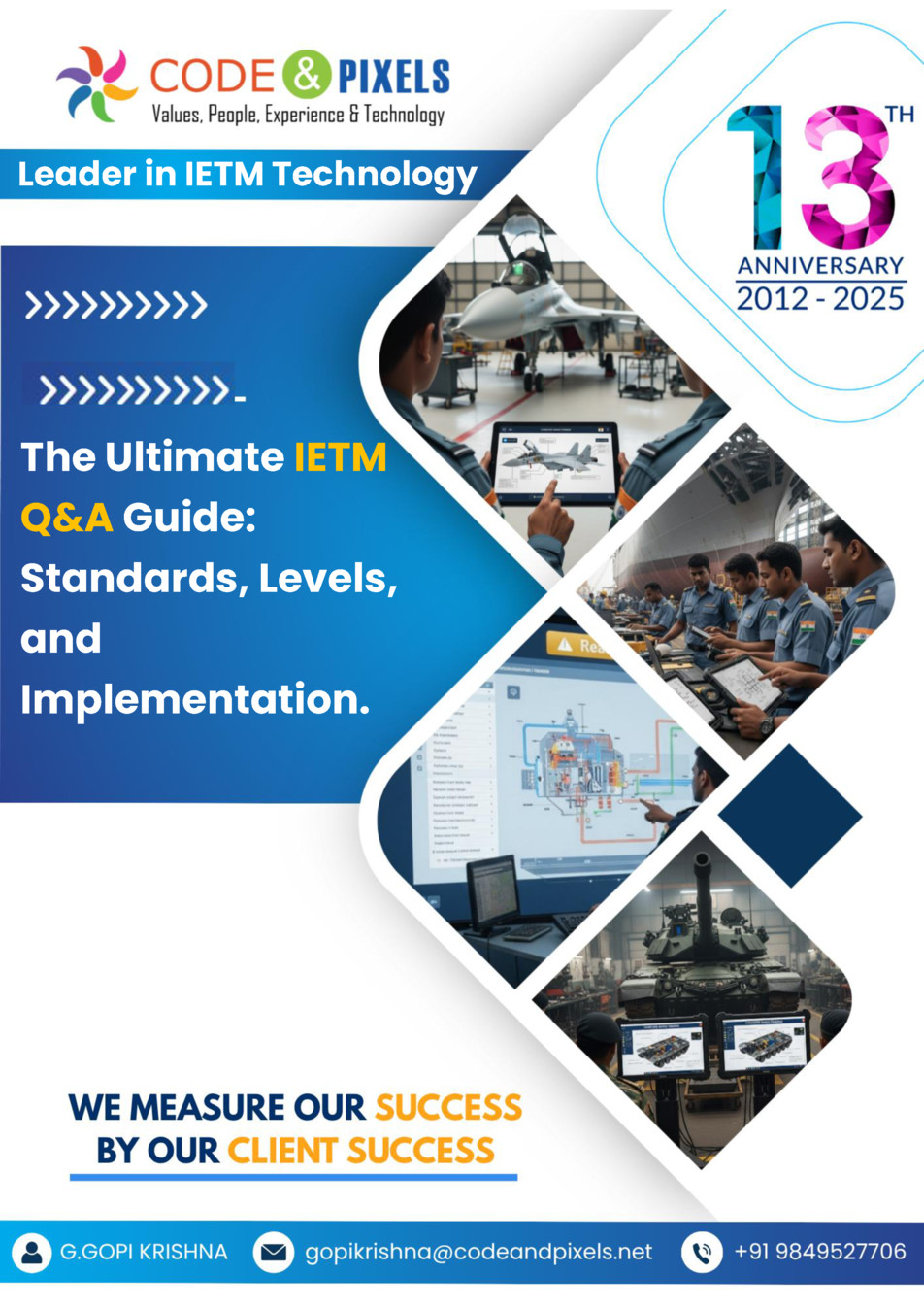
The Ultimate IETM Q&A Guide — Standards, Levels, and Implementation for Defence, Aerospace, and Complex Engineering Programs
Basics / Definitions
An Interactive Electronic Technical Manual, or IETM, is best described as a digital, database-driven workspace for technical documentation. It consolidates procedures, drawings, parts data, troubleshooting steps, and multimedia into a single platform that enables interactive access rather than forcing engineers to flip through static pages. The design emphasizes structured content, rapid searchability, and the ability to tailor views to different roles, so technicians, maintainers, and inspectors can quickly reach the information they need without wading through irrelevant material. (Page 2)
Where traditional manuals rely on fixed sequences, an IETM supports non-linear navigation, cross-references, and interactive elements. While a PDF or scanned document remains a fixed snapshot, an IETM organizes knowledge in modular topics and links them to procedures, parts catalogs, and diagnostics. This shift improves accuracy, reduces time to locate information, and supports offline access in constrained environments such as battlefield or shipboard settings. (Page 2)
Historically, IETMs were described by Levels 1 through 4, indicating progression from simple digitized pages to fully queryable, database-backed systems. The modern view often replaces these labels with a functionality matrix that specifies the precise features required—search, cross-links, multimedia, and interactive diagnostics—so contractors and buyers can clearly evaluate capability without relying on outdated level terminology. (Page 2)
A functionality matrix serves as a more precise contract for what an IETM must deliver. It translates the concept of levels into concrete features, clarifying expectations around how information is accessed, how interactions work, and how integrated tools such as diagnostics and data exchange with other systems should function. (Page 2)
Standards & Compliance
Standards guide the development and procurement of IETMs. In the Indian context, JSG-0852 is commonly adopted, setting mandatory requirements for functionality, security, performance, and usability in defense-related documentation. While European standard S1000D exists, it is not universally applied in India and is often discouraged for defence projects there. (Page 3)
Industry practice shows a preference for Indian standards on domestic contracts, with some exceptions. For instance, certain aerospace players like Hindustan Aeronautics Limited have shown interest in S1000D, but most shipyards and defence programs request IETMs aligned with Indian standards rather than S1000D. This distinction influences tender preparation and content management. (Page 3)
Choosing a standard hinges on project scope and governance. For Indian defence initiatives, JSG-0852 is typically the reference point, ensuring consistent requirements across platforms. S1000D remains aligned with European aviation contexts and may appear in niche collaborations; however, its practical utility in the Indian defence ecosystem is limited. (Page 3)
In tender documents, IETMs are usually specified through a Functionality Matrix rather than a blanket 'Level' claim. This approach communicates the expected capabilities—such as search depth, multimedia support, security posture, and integration readiness—without tying the deliverable to a historical level that may not reflect current technology. (Page 3)
Implementation & Architecture
Implementation choices often favor web-based IETMs for broad accessibility, with offline deployments possible on secure devices when connectivity is restricted. This balance supports real-time collaboration and updates while complying with security constraints in defence and other sensitive environments. (Page 4)
Key architectural elements of an IETM include an authoring tool, an administrative cockpit for governance, and a viewer or playback engine that presents content to users. Together, these components enable the life cycle of documentation—from creation to distribution—while maintaining control over who can access what. (Page 4)
Content is organized as modular topics—distinct procedures, descriptions, fault explanations, and parts data—rather than mere page-by-page documents. This modularization supports reusability, easier updates, and more precise linking between the steps, diagnostics, and parts involved in maintenance tasks. (Page 4)
A broad set of file types can be incorporated into an IETM. Text, raster and vector graphics, PDFs, multimedia elements such as videos and animations, and even 3D models may be integrated, enabling an interactive, visually rich experience that helps technicians understand complex systems. (Page 4)
Migrating legacy manuals into an IETM typically starts with data extraction and restructuring. Information is tagged and linked in a central database, so content can be cross-referenced and surfaced through the search and navigation features. The process also includes validating the quality of migrated data. (Page 5)
Authoring & Conversion
Authoring and conversion rely on purpose-built tools. For example, Quantum Tech Docs is highlighted as a widely used IETM authoring platform across major defence programs, supporting the creation and management of content for missiles, ships, and other sophisticated systems. (Page 5)
Even with automation, human oversight remains essential. Optical character recognition can accelerate the conversion of scanned materials, but errors creep in if the source documents are not in good condition or if scans are degraded. Where OCR fails, meticulous manual transcription and validation are needed. (Page 5)
AI features can enhance IETMs, particularly for large, complex systems, but they are not universally required. When used, AI typically demands high-end hardware and careful configuration to avoid introducing risk into critical maintenance procedures. (Page 6)
Typical workflows for delivering an IETM follow a structured sequence: authoring content, undergoing peer and QA reviews, publishing a released version, obtaining formal acceptance, and finally deploying to the target environment. This workflow supports traceability and accountability across the development lifecycle. (Page 6)
Functionality & Features
Functionality and features matter just as much as content. A robust IETM supports advanced search capabilities, hyperlinks, multimedia, role-based views, bookmarking, and annotation tools, enabling technicians to navigate efficiently and to annotate or mark critical information for later reference. (Page 6)
Parts lookup is typically delivered through interactive catalogs that are linked to drawings and step-by-step procedures. This integration ensures that a user can locate components, confirm compatibility, and obtain the associated maintenance actions in one coherent workflow. (Page 6)
Multimedia embedding—such as training videos, step-by-step animations, and 3D visualizations—enhances comprehension and supports on-the-job training, turning static content into an immersive learning experience within the IETM. (Page 6)
Version control is a core practice: every release carries a distinct version name and a clear date, enabling engineers to track changes, revert when necessary, and maintain audit trails across updates. (Page 6)
Offline capability is a common requirement in defence contexts, where robust field environments demand access to critical procedures even without a live network connection. (Page 6)
Levels & Classification (Practical)
Distinguishing Level 3 from Level 4 shows differences: Level 3 emphasizes structured navigation, while Level 4 includes full interactivity, database-driven logic, and decision-based flows. (Page 7)
Are levels still relevant in practice? In many programs, the emphasis has shifted toward a Functionality Matrix that captures the complete range of capabilities rather than relying on historical level labels. (Page 7)
What does Level-4 mean today? It generally denotes a fully interactive, cross-referenced, media-rich, and database-backed system capable of guiding users through complex decision processes based on data. (Page 7)
Integration & Systems
Integration with computer-based training (CBT) content is feasible when the CBT materials are browser-based, enabling a seamless blend of reference materials and training in a single platform. (Page 7)
Video content can also be integrated into the IETM’s digital library, supporting training and reference workflows alongside textual procedures and diagrams. (Page 7)
Overall, modern IETM implementations aim to unify content creation, maintenance, and training within a flexible platform that aligns with defence, aerospace, shipbuilding, and other complex engineering programs while respecting applicable standards and tender requirements. (Page 7)
The Ultimate IETM Q&A Guide: Standards, Levels, and Implementation. - Flipbook by Fleepit