jj
jj
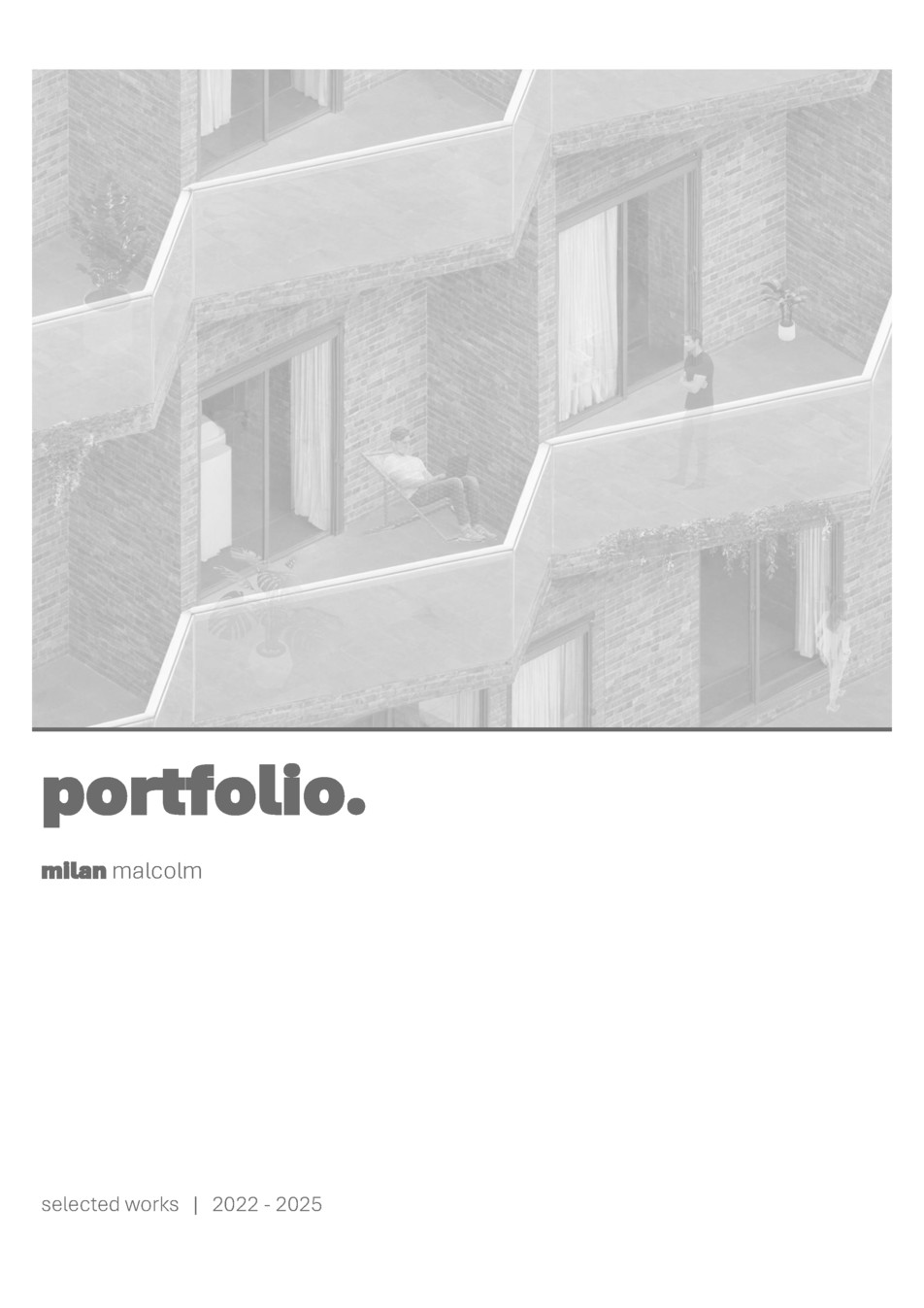
JJ Portfolio: Milan Malcolm Selected Works (2022–2025) — Architectural Design Portfolio and Studies
Overview
This collection presents a curated arc of architectural thinking and practice spanning 2022 to 2025, organized to reveal how design choices evolve from initial concept through detailing and presentation. The compilation unfolds across distinct categories—architectural design, collective dwelling, building design, additional works, and a design sketchbook—each chosen to illustrate a continuity of inquiry and a range of scales and programs. The body of work foregrounds the dynamic between place, program, and user experience, showing how space can shape social life, cultural production, and everyday routines. (Page 01)
Contents and Scope
Within the portfolio, five principal sections structure the narrative: architectural design, collective dwelling, building design, additional works, and design sketchbook. These sections are populated by projects such as The Castle Atelier, the Creekside Apartments, a harbour sports complex, and a broader set of detailing studies and experimental sketches. The organization emphasizes a workflow from concept to representation, with a focus on how ideas translate into built form and visual communication. (Page 01)
The Featured Projects
The accompanying projects showcase a spectrum of spatial typologies, including a mixed program centered on artist residency and public engagement, as well as residential and recreational facilities. Each project is explored through plans, elevations, and sections designed to convey spatial relationships, material choices, and the experiential quality of interiors and exteriors. The entries collectively highlight how architecture serves both private life and public activity, sustaining environments where creativity can flourish while remaining legible within its urban context. (Page 02)
Spring 2025: Software and Methodology
In the Spring 2025 phase, digital tools are employed to develop and refine design propositions, with the use of Adobe Photoshop for image composition, Adobe Illustrator for diagrams and presentation graphics, AutoCAD for precise drafting, and SketchUp Pro supported by VRay for SketchUp to translate concepts into immersive renderings. The project cluster is located in Canterbury, Kent, integrating a sense of historical context with contemporary design practice, and underscoring how technology supports rigorous visualization and iterative refinement. (Page 02)
The Castle Atelier: Context and Concept
The Castle Atelier project situates a creative production hub adjacent to Canterbury Castle, with deliberate sightlines toward the cathedral to frame a dialogue between heritage and modern artistic life. The design aims to be a space where making, exhibiting, and learning are interwoven, enabling artists to work and reside while inviting the public to participate in the rhythms of cultural labor through regular exhibitions and workshops. The setting invites a reciprocal relationship between old fabric and new activity, positioning architecture as both venue and catalyst for ongoing creative exchange. (Page 03)
Programmatic Configuration
The project narrative maps a sequence of program blocks that articulate a holistic living and working environment. These include an arts and crafts shop, a café and restaurant, service zones, a mixed-use studio area, and a dedicated sequence of artist studios and gallery spaces. Additional spaces such as a viewing gallery, exhibition areas, and a resident kitchen and lounge contribute to a layered program that supports both private rehearsals of craft and public display of work. The arrangement is designed to optimize circulation, accessibility, and social interaction, while maintaining clear distinctions between public, semi-public, and private realms. (Page 03)
Spatial Logic and Circulation
Architectural planning emphasizes how light, volume, and circulation interlock to create legible, expressive interiors. Orthographic drawings illustrate the building’s massing and its interaction with surrounding historic fabric, with attention to how public functions link with private dwellings. The layout supports a natural progression from entry to studio spaces, gallery areas, and residencies, while preserving intimate zones for conversation, study, and retreat. The careful layering of zones fosters a sense of place where visitors can move through different atmospheres and experiences. (Page 04)
Materiality and Architectural Language
The Castle Atelier foregrounds a material palette that engages both industrial and traditional forms. The exterior employs a combination of steel corten and reclaimed brick to resonate with Canterbury’s historic streetscape while signaling modern durability and texture. This material strategy helps to knit the new structure into its urban context and to articulate a tactile, enduring presence that respects the surrounding fabric while expressing contemporary craft and form. (Page 04)
Light, Volume, and Experience
Through elevations and sections, the project demonstrates how daylight is choreographed to enliven studio environments and gallery spaces. The design harnesses vertical and horizontal openings to frame cathedral and city views, balancing transparency with enclosure to create varied atmospheres across the day. The spatial energy is produced by the interplay of bright public zones and more contemplative private rooms, each receiving treated daylight that enhances material textures and tactile details. (Page 05)
Environmental Strategy and Sustainability
Environmental considerations inform passive design and energy efficiency. The design advocates rainwater management, bioswales, and permeable paving to sustain urban hydrology and reduce runoff. A green roof contributes to thermal regulation, and the building’s thermal mass helps stabilize interior temperatures. A combination of single-sided and stack ventilation, aided by skylights, supports natural ventilation while minimizing artificial cooling and heating demands. Large, triple-glazed windows maximize natural light while limiting energy loss. (Page 05)
Construction Detailing and Structural Craft
A detailed visualization of construction logic is provided through exploded axonometric views and physical sections at 1:20 scale. The specification emphasizes layers that protect against moisture and temperature changes, such as insulation, vapor barriers, and air barriers. The structure integrates CLT (cross-laminated timber) panels with glulam columns, complemented by corten steel elements, to achieve a robust yet refined composition that respects the building’s mass and legibility. (Page 06)
Materials, Substrates, and Layering
The detailing sequence includes multiple layers of enclosure and finish, from recycled materials and brick to advanced timber assemblies. The descriptions reference a multi-layered approach: a base structural system, insulation and vapor control, a timber façade assembly, and cladding or finishing layers that respond to climate and acoustic needs. This careful stack ensures performance while preserving the desired aesthetic of texture and tactility. (Page 07)
Fabrication Details and Technical Diagrams
Technical drawings accompany the narrative, showing the synergy between architectural intent and constructive feasibility. The documentation includes notes on substrate preparation, insulation thicknesses, air and vapor barriers, CLT and GLulam components, and integrations with metal and brick finishes. Such diagrams communicate how the building is meant to be assembled, tested, and inhabited, anchoring design ideas in practical realities. (Page 07)
Additional Works and Sketchbook
The portfolio also highlights supplementary sketches and experimental studies that illuminate the evolution of ideas beyond finished plans. These pages capture iterative explorations—diagrammatic investigations, rhythm studies, and process-oriented experiments—that contribute to a richer understanding of how the main projects were conceived and refined. The design sketchbook acts as a record of thinking, not just a record of outcomes. (Page 08)
Methodology, Tools, and Process
Across the studies, digital tools and hands-on modeling converge to support a rigorous design workflow. The use of image editing, vector diagramming, precise drafting, and three-dimensional modeling enables clear communication of concept, spatial logic, and material intent. Rendered perspectives and technical drawings work together to convey both the experiential qualities of spaces and the structural realities underpinning them. (Page 08)
Cultural Context and Ambition
The overarching aim of the Castle Atelier and related works is to fuse Canterbury’s historical identity with contemporary artistic practice. The project seeks to create spaces that nurture creative production while inviting public participation, thereby forging a living dialogue between heritage, craft, and modern culture. In doing so, the work aspires to contribute to a vibrant urban fabric where architecture serves as both guardian of memory and propeller of new cultural life. (Page 09)
Digital Presence and Documentation
The portfolio is complemented by a digital footprint that situates the projects within a broader catalog of works—web-based galleries and catalogs that showcase magazines, portfolios, and case studies. These digital documents extend access to the designs and provide a platform for ongoing dialogue about architectural practice, representation, and pedagogy. (Page 09)