PREPARED BY Nourhan Mohmaed Salem Qamar 4231192 Shahd Ahmed Mohamed Bakoush 4231247 Mohamed Gamal Shaat 4231066 Mohamed Osama Taha 4231143 Ezz El-Din Karim Moussa 4231151 SUPERVISED BY Dr. / Dina Saif Ragab Kazamel Prof. Dr. / Magdy Zakaria Rashad ARTIFICIAL INTELLIGENCE ASSISTANT
Faculty of Artificial Intelligence Lumo - The AI-Powered Child Assistant & Smart Learning System Prepared by Nourhan Mohammed Salem Shahd Ahmed Bakoush Mohammed Gamal Shaat Mohammed Osama Taha Ezz El-Din Karim Mousa 4231192 4231247 4231066 4231143 4231151 Submitted to Faculty of Artificial Intelligence Delta University for Science and Technology In Work based Professional Project in Computer Science Supervised by Prof. Dr. / Magdy Zakaria Rashad 2025 Dr. / Dina Saif Ragab Kazamel
We want to express our deepest gratitude to all those who contributed to the successful completion of this project. First and foremost, we extend our sincere appreciation to our supervisors, Prof. Dr. Magdy Zakaria Rashad and Dr. Dina Seif Ragab Kazamel, for their invaluable guidance, encouragement, and expertise throughout the research process. Their insightful feedback and unwavering support were instrumental in shaping the direction and outcome of this work. We are also profoundly grateful to Delta University for Science and Technology and the Faculty of Artificial Intelligence for providing the resources, facilities, and academic environment necessary to pursue this innovative endeavor. Special thanks go to our colleagues and peers for their constructive discussions, collaborative spirit, and moral support during the more challenging phases of the project. Lastly, we sincerely acknowledge the contributions of the participants in our clinical trials. Their willingness to engage with our system and share their experiences provided essential data and insights that were critical to our findings. Their resilience and cooperation served as a driving force behind our mission to enhance AI-Powered Child Assistant & Smart Learning System This project stands as a testament to the power of collaboration, and we are honored to have worked alongside such dedicated individuals.
PAGE NUMBER ACKNOWLEDGEMENTS 2 ABSTRACT 6 WORK RATIO DISTRIBUTION 7 CHAPTER 1: INTRODUCTION 8 1.1 GENERAL OVERVIEW 9 1.2 PROBLEM STATEMENT 10 1.3 PROJECT MOTIVATION 13 1.4 PROJECT OBJECTIVES 15 1.5 SCOPE OF THE PROJECT 18 1.6 METHODOLOGY OVERVIEW 22 1.7 REPORT ORGANIZATION 25 CHAPTER 2: BACKGROUND AND RELATED WORK 28 2.1 INTRODUCTION 29 2.2 LITERATURE REVIEW 30 2.3 THEORETICAL FRAMEWORK 33 2.4 EXISTING SYSTEMS ANALYSIS 37 2.5 COMPARATIVE ANALYSIS (LUMO VS. THE MARKET) 40 2.6 CONCLUSION 42 CHAPTER 3: PROBLEM ANALYSIS AND TECHNOLOGICAL FRAMEWORK 44 3.1 INTRODUCTION 45 3.2 SYSTEM REQUIREMENTS ANALYSIS 46 3.3 SYSTEM ARCHITECTURE 51 3.4 TECHNOLOGICAL STACK 54 3.5 DATABASE DESIGN 59 3.6 DETAILED MODULE DESIGN & ALGORITHM LOGIC 65
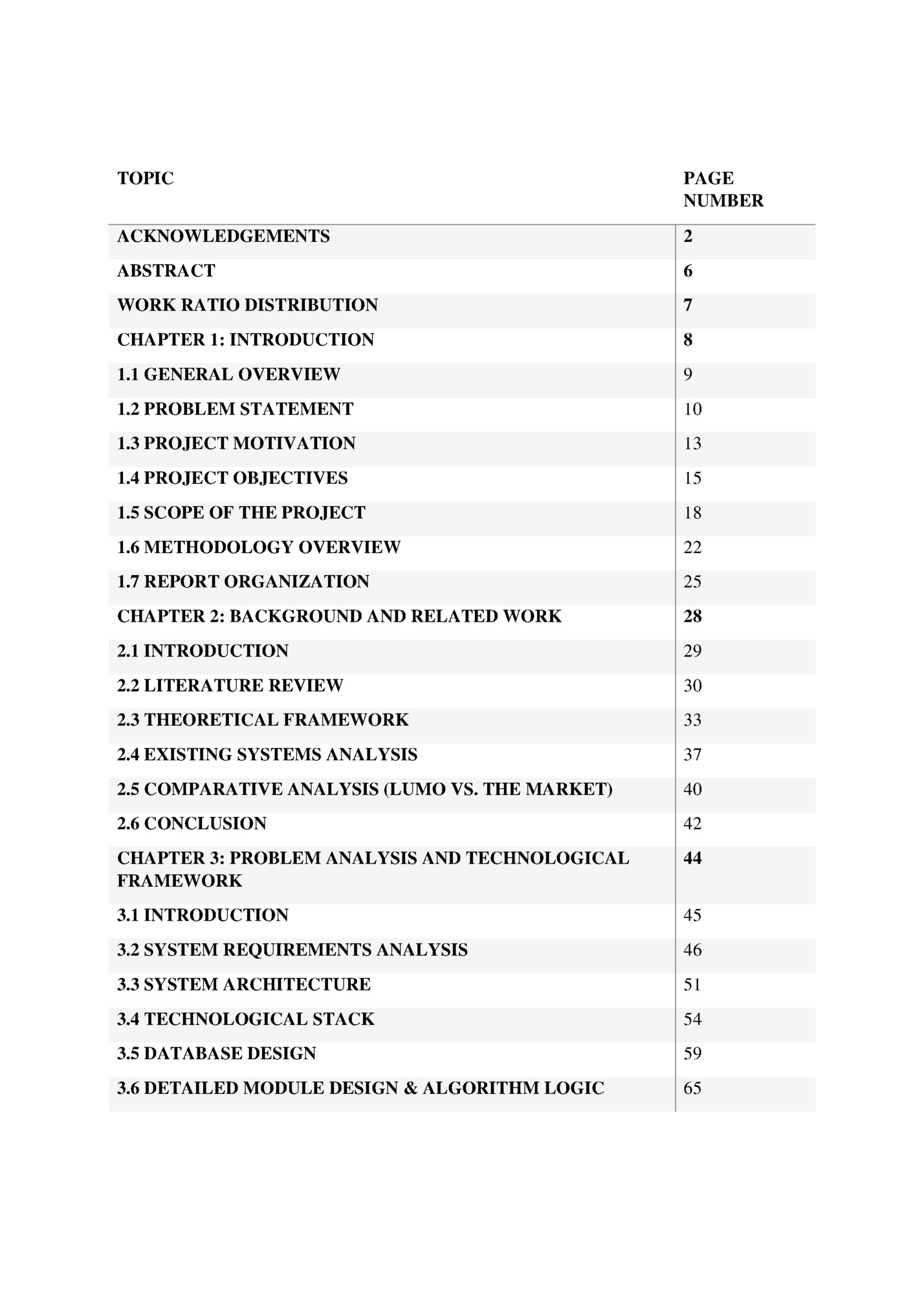
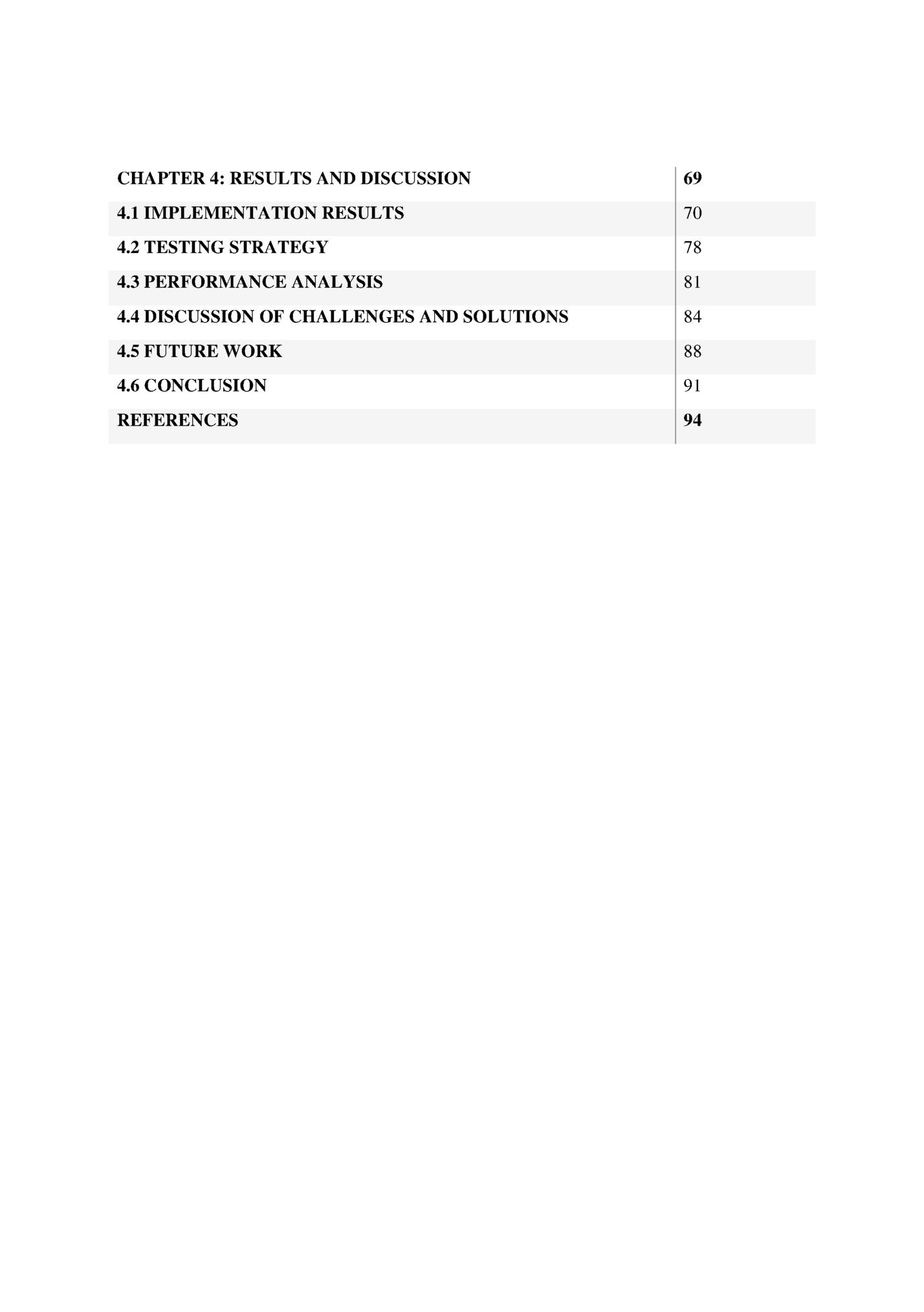
69 4.1 IMPLEMENTATION RESULTS 70 4.2 TESTING STRATEGY 78 4.3 PERFORMANCE ANALYSIS 81 4.4 DISCUSSION OF CHALLENGES AND SOLUTIONS 84 4.5 FUTURE WORK 88 4.6 CONCLUSION 91 REFERENCES 94
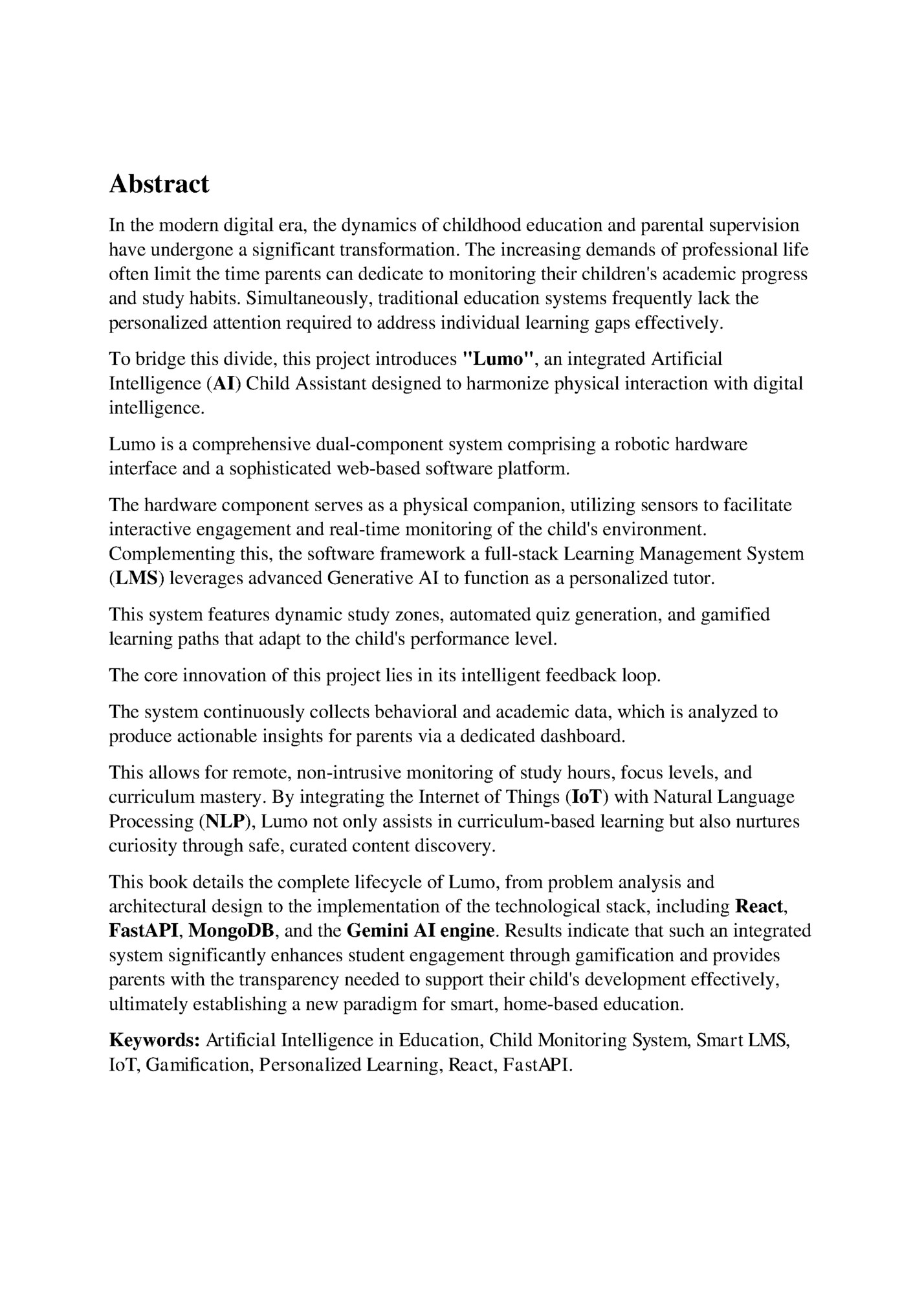
In the modern digital era, the dynamics of childhood education and parental supervision have undergone a significant transformation. The increasing demands of professional life often limit the time parents can dedicate to monitoring their children's academic progress and study habits. Simultaneously, traditional education systems frequently lack the personalized attention required to address individual learning gaps effectively. To bridge this divide, this project introduces "Lumo", an integrated Artificial Intelligence (AI) Child Assistant designed to harmonize physical interaction with digital intelligence. Lumo is a comprehensive dual-component system comprising a robotic hardware interface and a sophisticated web-based software platform. The hardware component serves as a physical companion, utilizing sensors to facilitate interactive engagement and real-time monitoring of the child's environment. Complementing this, the software framework a full-stack Learning Management System (LMS) leverages advanced Generative AI to function as a personalized tutor. This system features dynamic study zones, automated quiz generation, and gamified learning paths that adapt to the child's performance level. The core innovation of this project lies in its intelligent feedback loop. The system continuously collects behavioral and academic data, which is analyzed to produce actionable insights for parents via a dedicated dashboard. This allows for remote, non-intrusive monitoring of study hours, focus levels, and curriculum mastery. By integrating the Internet of Things (IoT) with Natural Language Processing (NLP), Lumo not only assists in curriculum-based learning but also nurtures curiosity through safe, curated content discovery. This book details the complete lifecycle of Lumo, from problem analysis and architectural design to the implementation of the technological stack, including React, FastAPI, MongoDB, and the Gemini AI engine. Results indicate that such an integrated system significantly enhances student engagement through gamification and provides parents with the transparency needed to support their child's development effectively, ultimately establishing a new paradigm for smart, home-based education. Keywords: Artificial Intelligence in Education, Child Monitoring System, Smart LMS, IoT, Gamification, Personalized Learning, React, FastAPI.
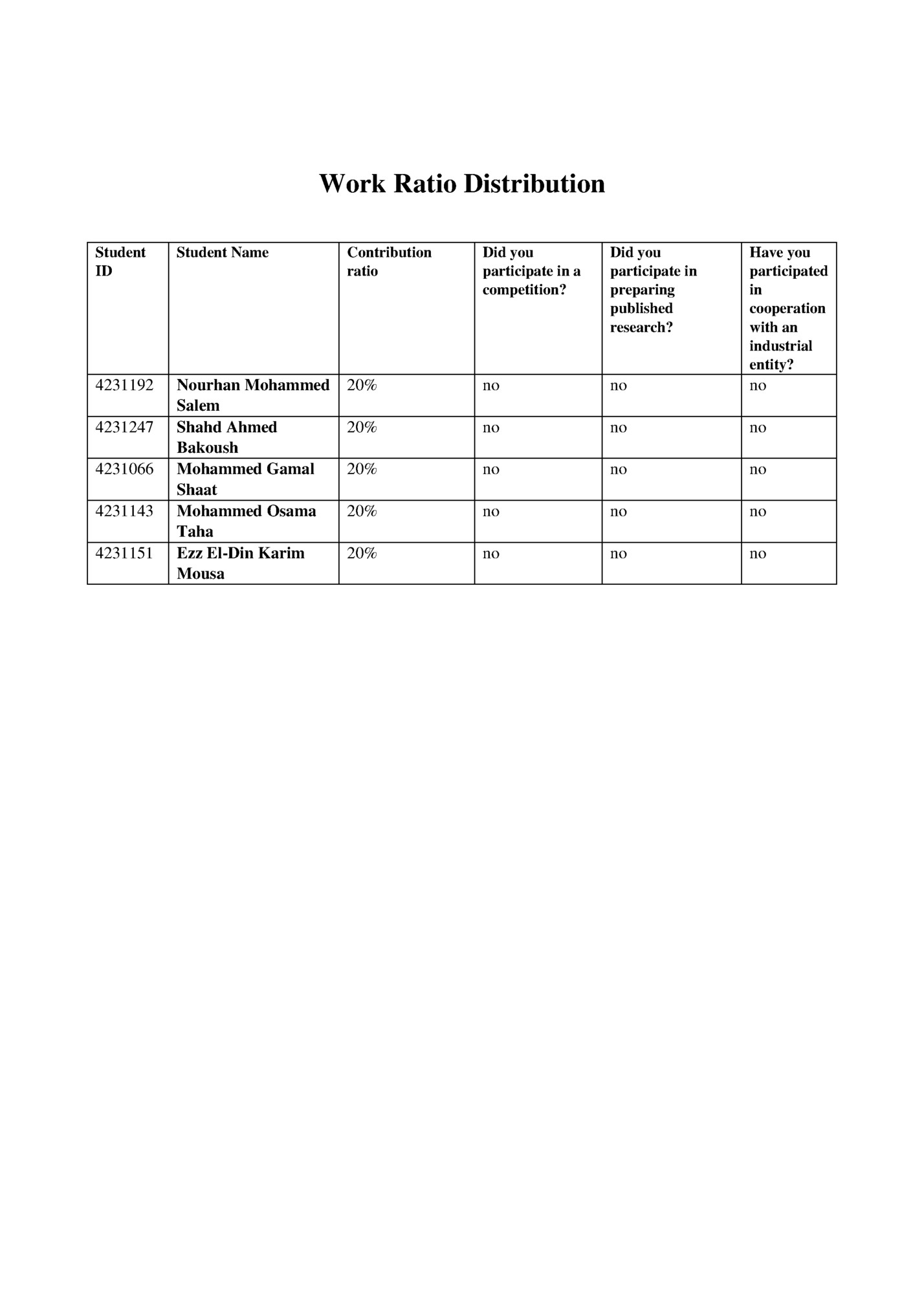
Student ID Student Name Contribution ratio Did you participate in a competition? Did you participate in preparing published research? Have you participated in cooperation with an industrial entity? 4231192 Nourhan Mohammed Salem Shahd Ahmed Bakoush Mohammed Gamal Shaat Mohammed Osama Taha Ezz El-Din Karim Mousa 20% no no no 20% no no no 20% no no no 20% no no no 20% no no no 4231247 4231066 4231143 4231151
Introduction

The landscape of childhood education and development has undergone a seismic shift in the 21st century. We are currently living in the era of "Education 4.0," a paradigm characterized by the integration of cyberphysical systems, the Internet of Things (IoT), and Artificial Intelligence (AI) into the learning environment. Traditionally, the primary sources of a child's education and moral guidance were the school and the home. However, the rapid digitalization of society has introduced a third dimension: the digital environment. While this digital realm offers boundless access to information, it also presents significant challenges regarding distraction, safety, and the quality of information consumed. Simultaneously, the socioeconomic fabric of the modern family has evolved. In many households, both parents are employed, leading to a significant reduction in the time available for direct supervision of their children's academic and behavioral progress. This "presence gap" often results in children navigating their educational journey with limited guidance, potentially leading to stagnation in learning curves, development of poor study habits, or exposure to inappropriate content. "Lumo" emerges as a technological intervention designed to address these contemporary challenges. It represents a convergence of hardware robotics and advanced software engineering, aiming to create a ubiquitous, intelligent presence in the child's life. Unlike passive monitoring tools like surveillance cameras, which offer observation without interaction, Lumo is designed as an active participant. It serves as a study companion, a tutor, and a guardian, leveraging the power of Generative AI to provide personalized education while simultaneously offering parents a transparent window into their child’s development through data-driven analytics. This project explores the design, development, and
Fleepit Digital © 2021