India This Week~May 29, 2026
India This Week~May 29, 2026
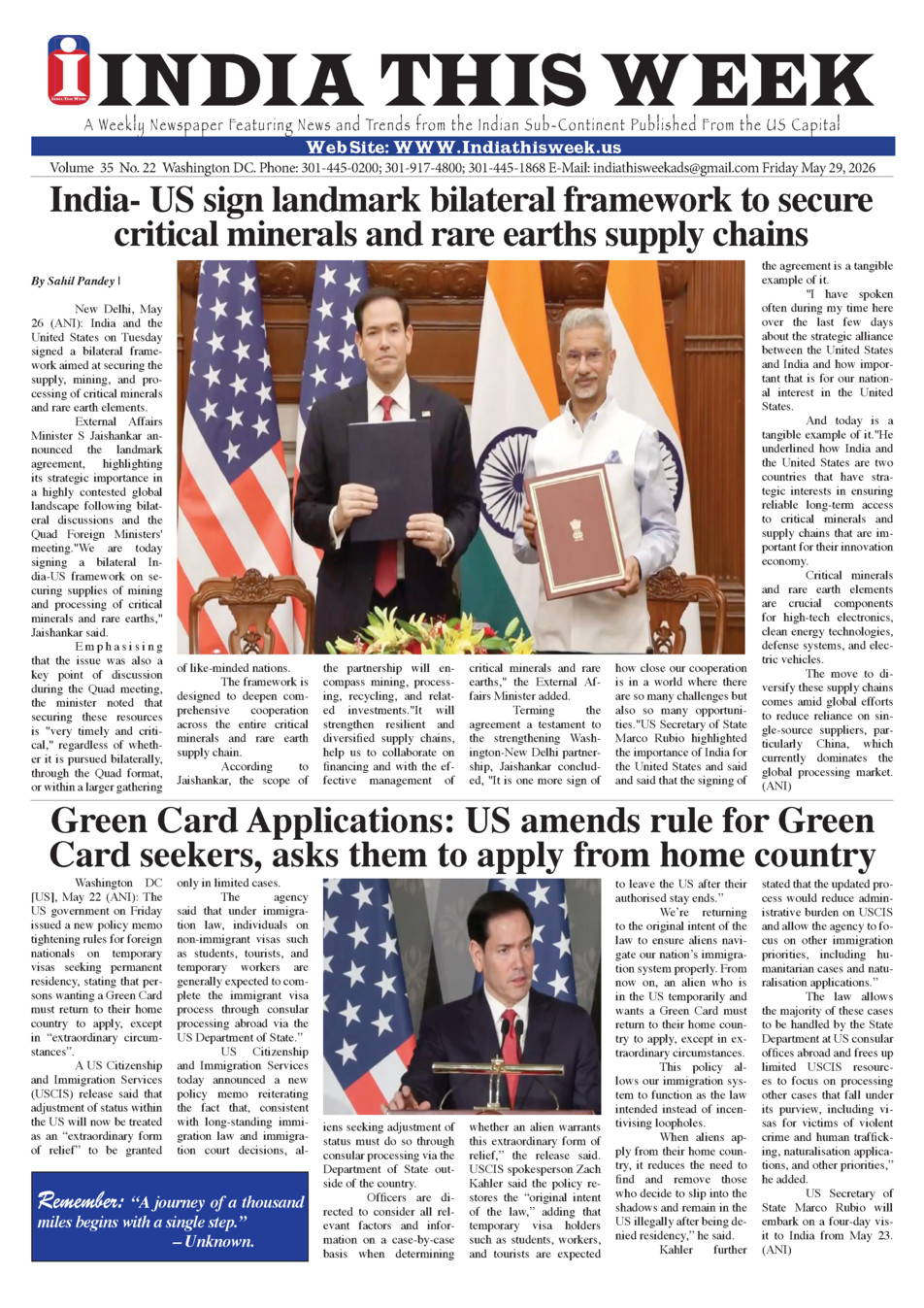
India This Week (May 29, 2026): A Comprehensive Look at US-India Critical Minerals Framework, Migration Policy Shifts, Political Developments, and Nuclear-Energy Collaboration
India‑US agreement to secure critical minerals and rare earths supply chains
The governments of India and the United States formalized a bilateral framework aimed at securing the entire lifecycle of essential minerals and rare earth elements, including exploration, extraction, processing, and recycling. This partnership is designed to build resilient, diversified supply chains by coordinating financing, technology transfer, and investments across public and private sectors, signaling a strategic emphasis on resource independence in a highly competitive global landscape. Officials described the accord as timely and critical, stressing that its relevance extends beyond a single transaction to broader cooperation in a context where advanced electronics, clean energy technologies, and defense systems depend on stable access to these materials. The agreement also aligns with ongoing Quad discussions and aims to strengthen collaboration in mining, processing, recycling, and related investments to create reliable networks capable of withstanding external pressures. (Page 1)
Observers note that diversifying supply chains for minerals and rare earths is seen as essential to reducing reliance on any one country for processing and manufacturing. By envisioning a comprehensive framework, New Delhi and Washington intend to foster not only steady supplies but also robust financing mechanisms and private-sector involvement to accelerate development across the entire supply chain. The ministers underscored that this collaboration will contribute to more resilient, diversified, and secure sources for critical components used in high-technology and energy applications, helping both nations strengthen their strategic autonomy. (Page 1)
In remarks tied to the broader regional context, officials highlighted that the initiative complements other multilateral efforts to promote trusted industrial partnerships and standards. The emphasis on critical minerals and rare earths reflects a shared objective to maintain leadership in innovation ecosystems while safeguarding national security and economic competitiveness. The framework is expected to catalyze joint research, investment, and regulatory cooperation that can scale to regional and global networks as demand for these resources continues to grow. (Page 1)
Migration policy updates in the United States: Green Card rules and global modernization
A recently issued policy memo from the U.S. government tightens rules for foreign nationals on temporary visas seeking permanent residency. Under the new guidance, most applicants must pursue immigrant status from their home country through consular channels, with limited exceptions for extraordinary circumstances. The adjustment of status inside the United States is now treated as an exceptional remedy and will be granted only after careful case-by-case consideration. This shift is framed as realigning the immigration process with its long-standing statutory intent and reducing administrative burdens on the agencies involved. (Page 1)
Officials emphasize that the core immigration pathway remains through consular processing abroad, and that the changes are intended to curb opportunities for procedural loopholes while maintaining due process for applicants. The intent is to ensure that individuals navigate the system in a way that reflects the original design of immigration law, while allowing authorities to focus resources on urgent humanitarian cases and naturalization efforts. (Page 1)
In parallel commentary, U.S. officials stressed that visa policy reforms are not targeted at any single country but are part of a broader modernization of the migration system that affects applicants worldwide. The administration notes that the United States continues to welcome lawful migration and values the contributions of international communities. The ongoing discussions also acknowledge the need to balance security concerns with economic and social benefits that come from skilled workers and students who enrich the U.S. economy. (Page 1)
Washington‑Delhi dialogue: statements on strategic partnership and migration reforms
A White House spokesperson reinforced the view that the U.S. administration seeks to elevate the bilateral relationship with India, pointing to high-level conversations and a recent exchange that featured a public display of camaraderie during a national celebration. The spokesperson framed Marco Rubio’s upcoming visit to India as a milestone in expanding bilateral cooperation on trade and national security, including the signing of a landmark framework on critical minerals. The message emphasized that strengthened ties between the two countries are aimed at delivering tangible gains in security, technology, and economic collaboration. (Page 2)
The administration’s public narrative also connects the minerals framework to broader initiatives launched earlier in the year under a forum dedicated to resource geostrategy. Officials said that government resources, in partnership with private capital, are being mobilized to support projects aligned with these goals, potentially unlocking vast amounts of private financing to accelerate development of critical mineral supply chains. The emphasis is on synchronized action across public institutions and the private sector to maximize impact. (Page 2)
During Rubio’s public engagements, he reiterated that reforms to migration policy are global in scope, not India‑specific, and are intended to modernize how the United States manages entry and residence. He highlighted the importance of Indian investment in the U.S. economy and stressed a continued interest in expanding this engagement while implementing improvements to the visa process. The remarks framed the reforms as a necessary step in aligning the system with contemporary realities and economic needs. (Page 2)
Gujarat’s natural farming success and Tamil Nadu’s farmer relief measures
In Gujarat’s Olpad taluka, Kalpesh Patel radically altered his farming approach after his father’s cancer diagnosis, abandoning chemical fertilisers in favor of natural farming methods. He now cultivates more than fifty varieties of bananas and attributes his improved yields to techniques learned through government training on preparing natural inputs. With around eight bighas of land and a shift toward value-added products, his income has increased substantially, illustrating how natural farming can reduce input costs and enhance soil health. The state supports these efforts through promotional programs and marketplace infrastructure that connect farmers directly with buyers. (Page 3)
Kalpesh’s experience has drawn national attention, with officials and ministers from the central government acknowledging his success. The model aligns with broader state initiatives to promote sustainable agriculture, reduce chemical dependency, and expand market opportunities for farmers who adopt nature-based practices. By diversifying banana varieties and embracing post-harvest processing, Kalpesh demonstrates the potential for smallholders to achieve higher returns while contributing to environmental and health goals. (Page 3)
In Tamil Nadu, the state government announced a major crop-loan waiver targeting small and marginal farmers who borrowed from cooperative banks. Eligible borrowers with loans up to 50,000 rupees will have their entire debt forgiven, while larger borrowers receive relief on a sliding scale. The package is projected to reach more than a million farmers and carries a significant fiscal outlay. Officials cited RBI guidelines to frame the disbursement timeline, indicating that the waiver covers loans issued between May 1, 2025 and February 28, 2026, with structured relief designed to ensure timely implementation. (Page 3)
The government emphasized transparency and procedural compliance, detailing how different loan brackets are treated and noting the importance of timely execution for beneficiaries. The policy mirrors broader electoral commitments and aims to alleviate financial stress among farmers while maintaining fiscal discipline in line with national monetary guidance. (Page 3)
Constituency vacancies in Tamil Nadu amid party reshuffles
Following a split within AIADMK, three assembly seats—Madurantakam, Dharapuram, and Perundurai—were declared vacant after resignations submitted by MLAs and accepted by the assembly Speaker. The resignations were processed in accordance with established procedures, and officials indicated that the changes would have immediate electoral implications. Opposition leaders criticized the move as hurried and politically opportunistic, while supporters argued that it reflected ongoing realignments within alliances. The public discourse highlighted tensions over party loyalties, governance priorities, and the strategic calculations behind such resignations. (Page 4)
The head of the DMK party and other critics used social media to accuse the opposing coalition of “horse trading,” contrasting it with their own positions on alliance ties and governance. The exchange underscored how internal party dynamics can quickly translate into formal shifts in representation, with consequences for legislative stability and upcoming electoral contests. Commentators also pointed to broader questions about coalition discipline, public accountability, and the public perception of political ethics in a rapidly evolving political landscape. (Page 4)
US‑ISPF/Nuclear Energy Institute mission to India and the SHANTI Act
A four‑day executive delegation organized by the U.S.‑India Strategic Partnership Forum (USISPF) and the Nuclear Energy Institute (NEI) brought together a diverse group of industry players spanning reactor developers, engineering and construction firms, fuel cycle participants, component suppliers, and service providers. The delegation engaged with senior Indian officials and regulators in New Delhi and Mumbai to explore deeper collaboration across the nuclear sector, including project development, supply chains, and local manufacturing partnerships. Meetings with key ministers and regulators underscored India’s commitment to expanding its nuclear capacity and integrating U.S. technology and resources into its energy ecosystem. (Page 5)
The accompanying briefing materials highlighted the role of U.S. energy leadership and private-sector capabilities in helping India pursue its nuclear ambitions. Industry leaders emphasized the importance of stable regulatory frameworks, safe operation standards, and scalable partnerships that can support a multi‑decade program. The discussions also covered how state governments can facilitate manufacturing collaborations and how national programs can combine with private investment to deliver reliable, clean energy to India’s growing economy. (Page 5)
As part of the event, the significance of reforms under India’s SHANTI Act—seen as the most consequential overhaul of the nuclear policy framework in decades—was highlighted. By replacing earlier regulations with a market‑oriented environment, the act aims to attract private participation and expand international partnerships. Advocates argue that such reforms can unlock large‑scale projects and supply chains necessary to reach India’s long‑term goal of around 100 gigawatts of nuclear capacity by 2047, a target that would require substantial manufacturing, investment, and technology transfer from global partners. (Page 5)
Industry leaders also pointed to India’s rapidly expanding digital footprint—home to hundreds of millions of internet users and an increasingly data‑driven economy—as a major driver for reliable, large‑scale power. The growth of data centers and digital infrastructure underscores the strategic rationale for a robust nuclear energy program as a cornerstone of energy security, industrial competitiveness, and innovation ecosystems across sectors. (Page 5)
Senior executives stressed that U.S. firms bring advanced technology, global safety standards, and global operating experience, while India offers manufacturing scale and a strong track record in nuclear expertise. They framed the collaboration as a mutually beneficial pathway to modernize energy systems, diversify supply chains, and stimulate long‑term economic growth through technology transfer and joint ventures that bridge both markets. (Page 5)
In closing remarks, industry leaders cited Modi’s government as having created an opening for a transformative future in India’s nuclear energy landscape. They argued that the combination of policy reforms, private investment, and international partnerships could accelerate the delivery of clean power, stabilize electricity availability for data centers and industrial zones, and position both nations as leaders in next‑generation energy solutions. (Page 5)
A closing reflection in the issue—presented as a poem by Rajan George—offers a moral meditation on power, responsibility, and public service. It cautions leaders to act with integrity, to avoid personal gain at the expense of the common good, and to depart positions of authority with grace when the time comes. The piece reinforces the idea that sustainable leadership depends on humility, accountability, and a lasting commitment to the people served. (Page 6)
As the issue wraps, the compilation underscores the broader theme of international cooperation—particularly between the United States and India—in addressing critical challenges and opportunities in technology, energy, migration, and governance. The narrative points to a future in which joint actions, shared standards, and principled leadership can yield durable benefits for both nations and their citizens, even as they navigate complex policy environments and evolving geopolitical dynamics. (Page 6)