India This Week~April 17, 2026
India This Week~April 17, 2026
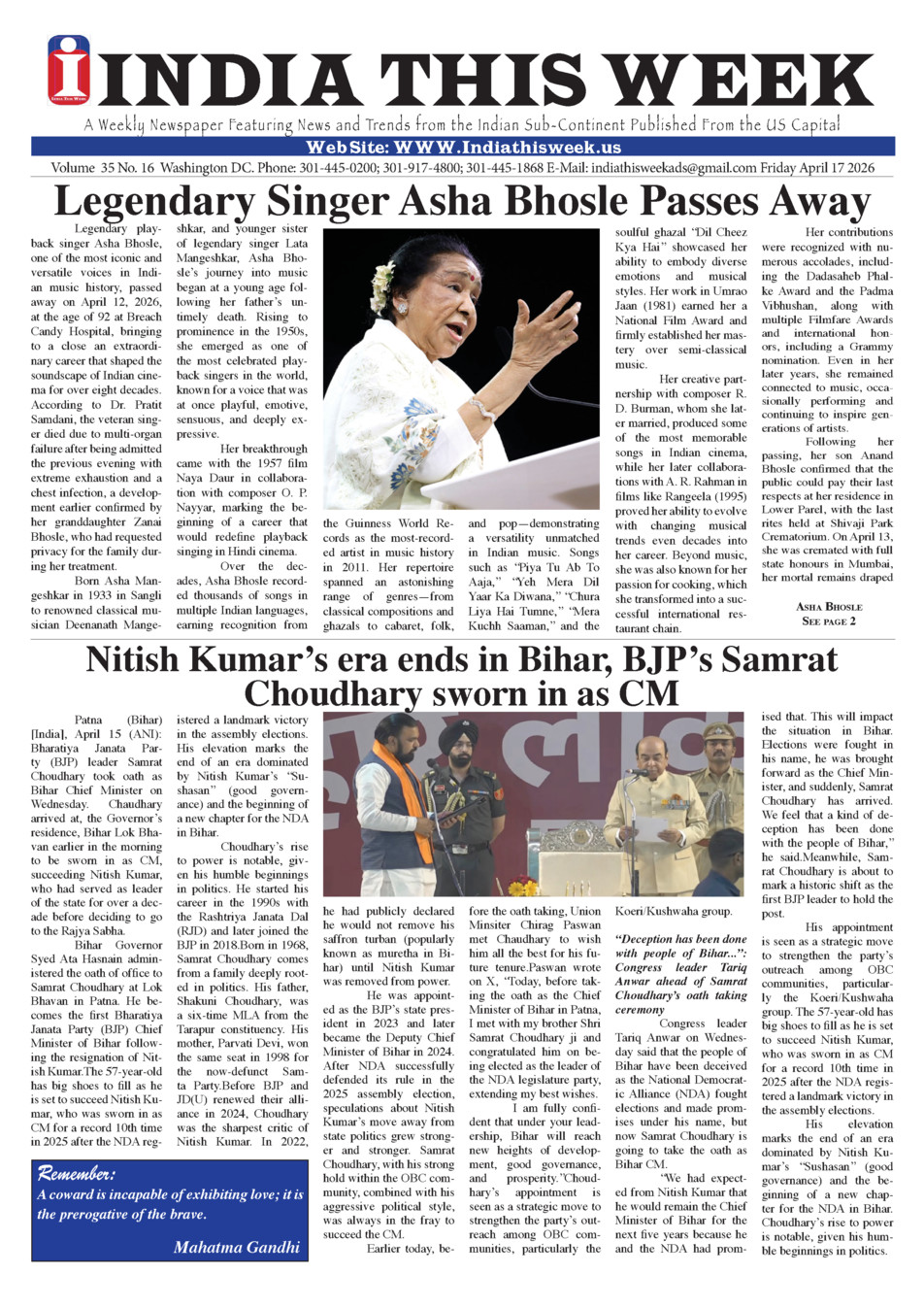
India This Week (Apr 17, 2026): Asha Bhosle’s Passing, Bihar Power Shift, West Asia Evacuations, Delimitation Debates, and Refugee Tragedy
Asha Bhosle’s Departure: A Legendary Voice Ends a Storied Era
India’s cultural landscape was marked by the sudden passing of legendary playback singer Asha Bhosle, who died on April 12, 2026 at the age of 92 after a long and influential career that helped shape Indian cinema’s sound for eight decades. Her family confirmed that the cause of death was multi-organ failure following a period of extreme exhaustion and a chest infection, with her passing mourned across the nation. (Page 1)
Born Asha Mangeshkar in 1933 in Sangli, she belonged to a family steeped in musical tradition and was the younger sister of the renowned Lata Mangeshkar. Her early life saw tragedy with the loss of her father, yet it also laid the groundwork for a remarkable musical journey that would blossom in the decades that followed. (Page 1)
Her ascent in the 1950s culminated in a breakout moment with the 1957 film Naya Daur, where her collaboration with composer O. P. Nayyar showcased a fresh, expressive voice that would redefine Hindi playback singing. This breakthrough opened doors to a prolific career that would see her recording thousands of songs across multiple Indian languages. (Page 1)
Over the years, Asha Bhosle demonstrated extraordinary flexibility, traversing genres from classical pieces and ghazals to cabaret, folk, and modern pop. Her ability to inhabit diverse emotions—playful, sensuous, wistful, or deeply energetic—made her one of the most versatile artists in Indian music history. (Page 2)
Her enduring collaboration with music legend RD Burman, whom she later married, produced some of the era’s most memorable songs, while later partnerships with composers like A. R. Rahman in films such as Rangeela highlighted her continued evolution with changing trends. Her repertoire underscored not just technical prowess but a remarkable emotional range. (Page 2)
Asha Bhosle’s influence extended beyond cinema. She earned recognition from the Guinness World Records as the most-recorded artist in music history in 2011, a testament to her prolific output and global appeal. Her work earned numerous accolades, including prestigious national and international honors, and she remained a public figure who inspired generations long after her peak years. (Page 2)
Her legacy is defined not only by iconic numbers but by the breadth of her artistry—ranging from devotional and classical pieces to popular film songs—along with performances that could instantly evoke a mood or memory. Her presence in Umrao Jaan (1981) exemplified her mastery of semi-classical music, while collaborations with RD Burman and later AR Rahman illustrated her capacity to stay current across decades. (Page 2)
In life off the stage, Bhosle was known for warmth and generosity, and she also embraced entrepreneurship, notably building a restaurant venture that reflected her passion for cooking. Her achievements earned her the Dadasaheb Phalke Award, the Padma Vibhushan, multiple Filmfare Awards, and even a Grammy nomination, marking her as a global ambassador for Indian music. (Page 2)
Her public farewell was marked by state honors and widespread tributes from the film industry and political leadership alike. Her son Anand Bhosle confirmed that fans could pay their respects at her Mumbai residence, and her funeral at Shivaji Park Crematorium was attended by prominent figures who celebrated a life devoted to musical excellence. (Page 2)
Political Shift in Bihar: Samrat Choudhary Becomes Chief Minister
In Patna, a major shift in state leadership unfolded as Samrat Choudhary, a senior BJP figure, took oath as Bihar’s Chief Minister, marking the end of Nitish Kumar’s long tenure. The oath ceremony occurred at the Governor’s residence with the provincial governor administering the formal swearing-in. This transition signals a new chapter for the NDA alliance in Bihar, where Kumar previously governed for more than a decade. (Page 3)
Choudhary’s ascent is notable given his journey from early political work with the Rashtriya Janata Dal to his 2018 switch to the BJP and subsequent roles, including a stint as deputy CM in 2024. Born in 1968 and hailing from a family with deep political roots, his rise reflects a strategic shift in Bihar’s political landscape, especially as the NDA ended a major era under Kumar after their 2025 electoral victory. (Page 3)
Observers describe his leadership as a test for governance and development in Bihar, with expectations of continuing the NDA’s agenda while expanding the party’s outreach among the state’s OBC communities. Meanwhile, opposition voices, including Congress leaders, voiced skepticism about the move, suggesting it signals a broader realignment rather than a routine leadership transition. (Page 3)
Support for Choudhary’s elevation came from various quarters, including remarks from national and regional leaders who stressed the need for stable governance and continued development projects. Commentary emphasized that while the change represents continuity for the NDA, it could also shift regional political dynamics and the balance of power within the state’s legislative landscape. (Page 3)
West Asia Crisis: India Mobilizes to Safeguard Citizens
With the West Asia crisis intensifying, India activated a comprehensive diplomatic and logistical operation to protect its citizens abroad. Under the leadership of External Affairs Minister S. Jaishankar, the government coordinated direct outreach with counterparts in Kuwait, Israel, Singapore, and Australia to navigate the evolving regional security situation. (Page 3)
MEA briefings noted that since late February, nearly a million Indian nationals had been repatriated or moved to safer locations, even as airspace restrictions complicated travel. Missions across Gulf states and West Asia operated on a crisis footing, offering consular services and round-the-clock helplines to assist communities, including seafarers who faced unique challenges in maritime corridors. (Page 3)
India maintained ongoing communication with state governments and union territories to share information and coordinate evacuation efforts. By leveraging alternative flight corridors and land routes, officials ensured a steady flow of evacuees, while advisories emphasized adherence to local guidelines and close contact with embassies for those remaining in the region. (Page 3)
Officials highlighted specific movements, such as pathways through Armenia and Azerbaijan for those traveling from Iran, and continued operations from airports in the UAE, Qatar, Oman, and nearby transit points. The priority remained the safety and welfare of Indian nationals, including vulnerable groups like fishermen and crew members on vessels. (Page 3)
Delimitation Debates and Women’s Reservation: Voices and Contestations
The political debate around the 131st Constitutional Amendment Bill, which ties into the delimitation exercise and the expansion of Lok Sabha seats, sparked sharp criticism from key voices in the Congress. A senior Congress leader characterized the proposed delimitation as mischievous and potentially harmful to southern states’ representation, arguing that any population-based reallocation should be fair and proportional. (Page 4)
Proponents of the change have proposed increasing the Lok Sabha’s total seats to 850, with 815 allocated to states and 35 to union territories, a framework that provokes concern about regional balance, particularly for Tamil Nadu and other southern states whose relative share could be reduced after delimitation. Critics warned that this process could be used to tilt political power without a corresponding census-based recalibration. (Page 4)
Amid these debates, the government connected the timing of delimitation to the Nari Shakti Vandan Adhiniyam, 2023, which seeks to reserve 33% of seats for women in the Lok Sabha by 2029. Opposition voices argued that while female representation is a worthy goal, the manner in which delimitation is proposed could undermine regional parity and rational policy making. (Page 4)
Senior lawmakers from the INDIA bloc, including Mallikarjun Kharge and Rahul Gandhi, asserted a unified stance: they supported women’s reservation in principle but insisted that delimitation should not be rushed or manipulated to alter state representation or constitutional balance. They stressed the need to base any changes on a robust census and clear constitutional safeguards. (Page 4)
Regional Perspectives on Delimitation and Political Reactions
Several regional leaders underscored the potential consequences of delimitation for southern states and neighboring regions. KT Rama Rao, a key BRS figure, warned that a flawed delimitation exercise could trigger widespread public protests if it reduces states’ voice in Parliament. He urged the central government to consider the ground realities of the south while revisiting the approach to seat redistribution. (Page 4)
In Tamil Nadu, Chief Minister MK Stalin publicly pressed for a cautious approach, signaling that the state would mobilize MPs and allies if its interests faced harm. He argued the central plan to push through a constitutional amendment during an ongoing electoral period was inappropriate and could threaten state-level political dynamics. Additional voices from other southern states echoed similar concerns about proportional representation in a future Lok Sabha. (Page 5)
Meanwhile, political commentary reflected the broader national debate on how to reconcile women’s representation with the mechanics of delimitation. The discussion highlighted a tension between advancing gender equity and preserving federal balance, a theme that has animated parliamentary strategizing in the lead-up to the upcoming budget session. (Page 5)
Delhi Incident: Acid Attack near a Bride’s Mehendi Ceremony
In Delhi, a disturbing assault occurred when a 21-year-old woman was critically injured in an acid attack in Indira Vihar, just days before her planned wedding. The attacker has been identified and arrested, and a case under relevant criminal provisions has been registered. A forensic team collected evidence as investigators work to determine the motive and timeline of the attack. (Page 5)
The victim, who was preparing for her mehendi ceremony, belongs to a large family, with neighbors describing her as a bright student. The case has stunned the local community and authorities are urging swift and decisive action against the perpetrator. Separate but related violence in nearby Gurugram, involving a different case of acid attack, underscores the broader concern about violence against women in the region and the emphasis on safeguarding survivors. (Page 5)
Andaman Sea Tragedy: Refugee Boat Capsizes, Dozens Missing
A tragic incident in the Andaman Sea drew international attention as a crowded boat carrying Rohingya refugees and Bangladeshi nationals capsized, leaving an estimated 250 people missing or dead. The IOM issued a formal statement expressing deep sorrow and calling for sustained humanitarian support to refugees in Bangladesh, as well as to host communities facing the burden of displacement. (Page 5)
The disaster is understood to have occurred during a perilous sea crossing amid adverse weather, highlighting the dangerous journeys undertaken by refugees seeking safety and livelihood opportunities. The statement stressed that such accidents reflect the urgency of addressing the root causes of displacement in Myanmar and ensuring safe, voluntary returns when conditions permit. (Page 5)
The international community was urged to mobilize resources to fund lifesaving aid and to safeguard vulnerable populations who remain at sea or in precarious camps. The incident also underscored ongoing concerns about people-smuggling networks that exploit desperate circumstances, and it called for collective action to prevent further tragedies. (Page 6)
The Poetic Pen: A Mother’s Courage set against Predatory Threats
The publication includes a short verse titled The Emu and the Komodo Dragon, which, though presented as poetry, conveys a narrative about a mother emu defending her offspring from a predator. The poem portrays a fierce, protective resolve that transcends mere instinct, turning maternal love into a force capable of repelling danger. (Page 6)
The central moment of the piece—when the mother stands between her chicks and harm—serves as a meditation on the power of care and the moral courage that arises when survival and protection intersect. The animal world in the poem becomes a mirror for human concerns about family and the lengths one will go to safeguard young lives. (Page 6)
Interwoven with themes of mortality and struggle, the poem also hints at a broader commentary on resilience in the face of violence, implying that love can be a transformative, even radical, form of defense against threats. The final image leaves readers with a sense of reverence for the unyielding strength found in maternal devotion. (Page 6)
Reflections on Refugees and Humanitarian Crises
Beyond the immediate news items, the issue spotlights the ongoing Rohingya crisis stemming from violence in Myanmar’s Rakhine State. The text emphasizes the precarious conditions facing refugees in Bangladesh and the need for durable, voluntary pathways home, underscoring that displacement remains a driving force behind dangerous sea journeys. (Page 6)
Experts and aid organizations stress that reduced access to education and livelihoods, along with shrinking humanitarian support, contribute to people risking perilous travel in search of safety and opportunity. They call for sustained international solidarity and funding to supplement lifesaving assistance and to support the communities hosting refugees. (Page 6)
Closing Notes: A Week of Diplomatic and Domestic Currents
As the week closes, the publication underscores the intertwined currents of global diplomacy and domestic politics shaping India’s trajectory. From high-profile cultural legacies to shifts in state leadership, and from crisis-driven evacuations to delibitation debates that could redefine parliamentary representation, the issue captures a broad spectrum of urgent national and international concerns. (Page 7)
Readers are reminded that India This Week continues to document ongoing developments in diplomacy, governance, and social issues, inviting engagement and dialogue around the challenges and possibilities that lie ahead for the country and its people. The issue also notes contact details for readers seeking to engage with the publication or share information related to its reporting. (Page 7)
Key Takeaways and How to Read This Week’s Narrative
In this edition, the dominant threads include the passing of a cultural icon whose musical influence spanned generations, a consequential political transition in a major Indian state, a sweeping diplomatic effort to safeguard citizens amid regional turmoil, and a shaping debate over how to rebalance representation in Parliament through delimitation while advancing women’s participation. The reporting stitches together human stories—from celebrated art and public service to personal tragedy—and situates them within larger questions about governance, regional equity, and humanitarian responsibility. (Page 7)