100 Creek Rd, Mitcham VIC 3132- 15-05-2025
100 Creek Rd, Mitcham VIC 3132- 15-05-2025
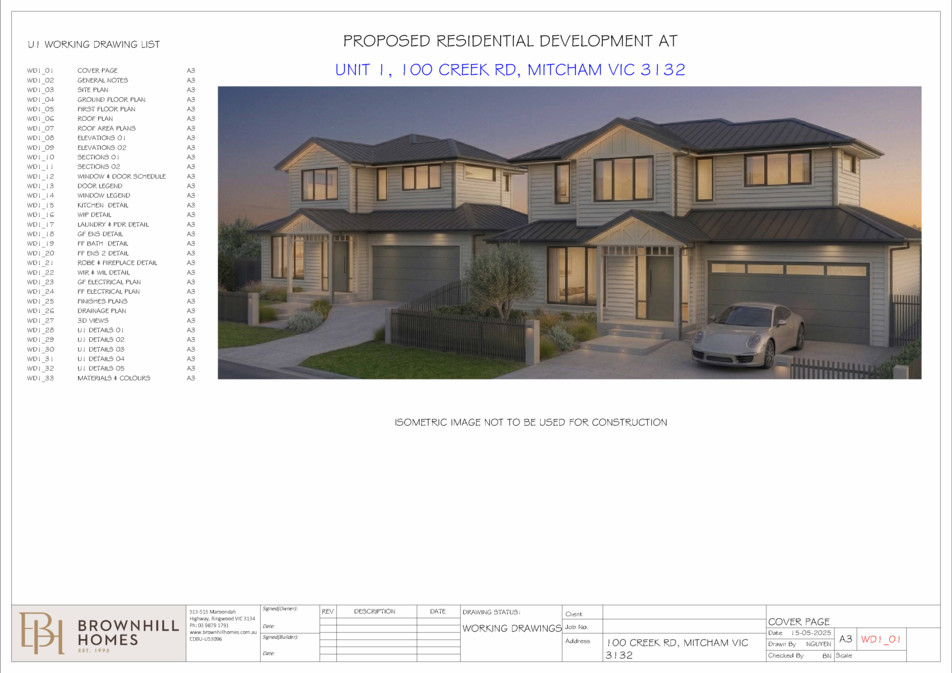
Proposed Residential Development at 100 Creek Rd, Mitcham VIC 3132 — Comprehensive Working Drawings and Compliance Notes
Executive Summary and Key Details
The document outlines a proposed residential development for a single dwelling at 100 Creek Road in Mitcham, Victoria. It consolidates a complete suite of working drawings and associated data, organized across multiple sheets labeled WD1_01 through WD1_11 (and extending beyond in the original set). The package includes cover and index pages, general notes, site plan, ground and first floor plans, roof plans, roof area breakdowns, elevations, sections, window and door schedules, detailing for kitchens, laundries, wardrobes, bathrooms and ensuites, and a range of service and finish plans. It also features 3D views and unit-specific details (notably Unit 1) along with materials and color references for the project identified as Unit 1, 100 Creek Rd, Mitcham. The project is aligned with the NCC 2019 Building Code of Australia, Vol 2, and is prepared for a construction permit, with coordination anticipated from structural and mechanical consultants. (Page WD1_01)
The architectural package is prepared under the aegis of Brownhill Homes, with ownership details and sign-offs indicating the client and builder, and the date of preparation set to May 15, 2025. The drawings are intended to be read in conjunction with other specialist reports and written instructions issued during the contract period. They establish the framework for site measurements, construction sequencing, and compliance checks across a range of disciplines, including durability requirements for materials, waterproofing standards for wet areas, and specific guidelines for glazing, stairs, and barrier heights. The specimen notes emphasize the need to secure a building permit before work commences and to obtain approval from the relevant building surveyor for any performance solutions. (Page WD1_02)
The site plan presents the context of the project and the proposed layout, including the relocation or provision of crossovers, driveway arrangements, fencing, and retaining features. It documents the positions of existing and proposed elements such as trees to remain or be removed, access pathways, service pits, and drainage lines, with attention to setbacks and overall site coverage. The plan is prepared to scale and uses metres for site dimensions with millimetre precision for built details. It also notes alignment markers and utility locations, ensuring that stormwater management and access arrangements comply with local authority requirements. (Page WD1_03)
The ground floor planning focuses on the principal living envelope, incorporating an open-plan living/dining area, kitchen, and essential service zones. Public and private zones are distinguished through spatial adjacencies, with bedrooms and bathrooms arranged to optimize circulation and day-to-day use. External entries, porches, and the attached garage integrate with the internal layout while ensuring appropriate vertical and horizontal clearances. The design anticipates practical needs such as guest lodging, a master suite with a wardrobe and ensuite, and a utility room adjacent to the entry sequence. It also references plant and service locations (gas, electrical, water) and discusses compliance with slip resistance, waterproofing, and ventilation expectations for wet areas. (Page WD1_04)
The first-floor plan expands the living footprint vertically, detailing the arrangement of additional bedrooms and the master suite, including an ensuite and walk-in robe. The plan emphasizes family-oriented spaces with a potential for a secondary living area or lounge, and it situates private rooms to minimize cross-traffic with living spaces below. The layout considers privacy, daylight access, and egress requirements, while noting the alignment of internal doors, stairs, and storage provisions. The presence of a secondary circulation spine and potential balcony or veranda edge is acknowledged, with attention to headroom, stairs integrity, and the interface with the ground level. (Page WD1_05)
The roof plan conveys the architectural envelope and its cladding strategy, indicating a tiled roof finished in a slate-grey palette. It shows the roof’s primary pitch and the arrangement of gutters and fascias around the perimeter, as well as scale references for roof ridges and eave lines. The plan aligns with the overall massing of the dwelling, ensuring adequate shelter and weather protection while supporting provisions for roof penetrations such as vents and exhaust outlets. The notes address roofing compliance with applicable Australian standards and emphasize coordination with wall assemblies and water management strategies. (Page WD1_06)
The roof area plans provide a more granular breakdown of roof components, dividing the upper and lower roof surfaces into discrete areas and quantifying each segment. This segmentation assists with structural and waterproofing detailing, as well as the integration of any skylights, vents, or roof-mounted equipment. The plan tabulates the area of each zone (Area 1, Area 2, etc.) and identifies both lower and upper roof areas, helping designers and builders verify coverage and drainage paths across the entire roof assembly. (Page WD1_07)
The interior detailing sections (KITCHEN DETAIL and WIP DETAIL) reflect the cabinetry, fit-out strategies, and interior finishes that define the dwelling’s character. These pages illustrate the arrangement and dimensions of built-in units, storage solutions, and specific fittings within main living zones, such as the kitchen and wardrobe assemblies. They also reference ancillary elements like a rainwater tank and a gas-fired or electric heating appliance, while noting that some details may be labeled as work-in-progress. The documentation supports a clear understanding of how interior components interface with structural elements and with external spaces, ensuring consistency with the broader floor plan logic. (Page WD1_08)
Exterior elevations and related notes capture the appearance and structural articulation of the façade, including window and door openings, wall finishes, and alignment with roof edges. The pages discuss nominal window sizes and flashing requirements, and they acknowledge that actual product dimensions may vary depending on supplier manufacture. The elevations serve to communicate the external expression of the dwelling while ensuring compatibility with weatherproofing, termite protection, and overall durability expectations. The documentation also mentions the need to coordinate with the location of other fittings, such as light fittings and ceiling-mounted components. (Page WD1_09)
The interior detailing extends to casework layouts and room-specific elevations, highlighting relationships between entry sequences, living zones, dining areas, and bedrooms. The pages present cross references to cabinetry heights, storage locations, and access routes, as well as the interplay between timber finishes and other material selections. There is particular attention to alignment with structural elements and to the integration of fixtures such as wardrobes, beds, desks, and seating arrangements, all of which contribute to the dwelling’s functional flow. (Page WD1_10)
The area schedule consolidates quantitative assessments of the site and internal floor space. It enumerates the gross floor areas of living spaces, bedrooms, and ancillary rooms, along with the total site area and the proportion of site coverage. The schedule includes notes on external spaces such as pergolas and porches, and identifies service components like rainwater tanks, meters, and pits. This page provides a concise accounting framework for planning approvals, cost estimation, and verification of the completed dwelling’s footprint and massing relative to site constraints. (Page WD1_11)
100 Creek Rd, Mitcham VIC 3132- 15-05-2025 - Flipbook by Fleepit