India This Week~January 9, 2026

India This Week~January 9, 2026

Prix simple. Outils puissants. Annulation à tout moment.

India This Week – Highlights and Analysis (January 9, 2026)

Summary of India This Week – January 9, 2026

Section 1 — Maryland homicide involving an Indian national and the ensuing investigation

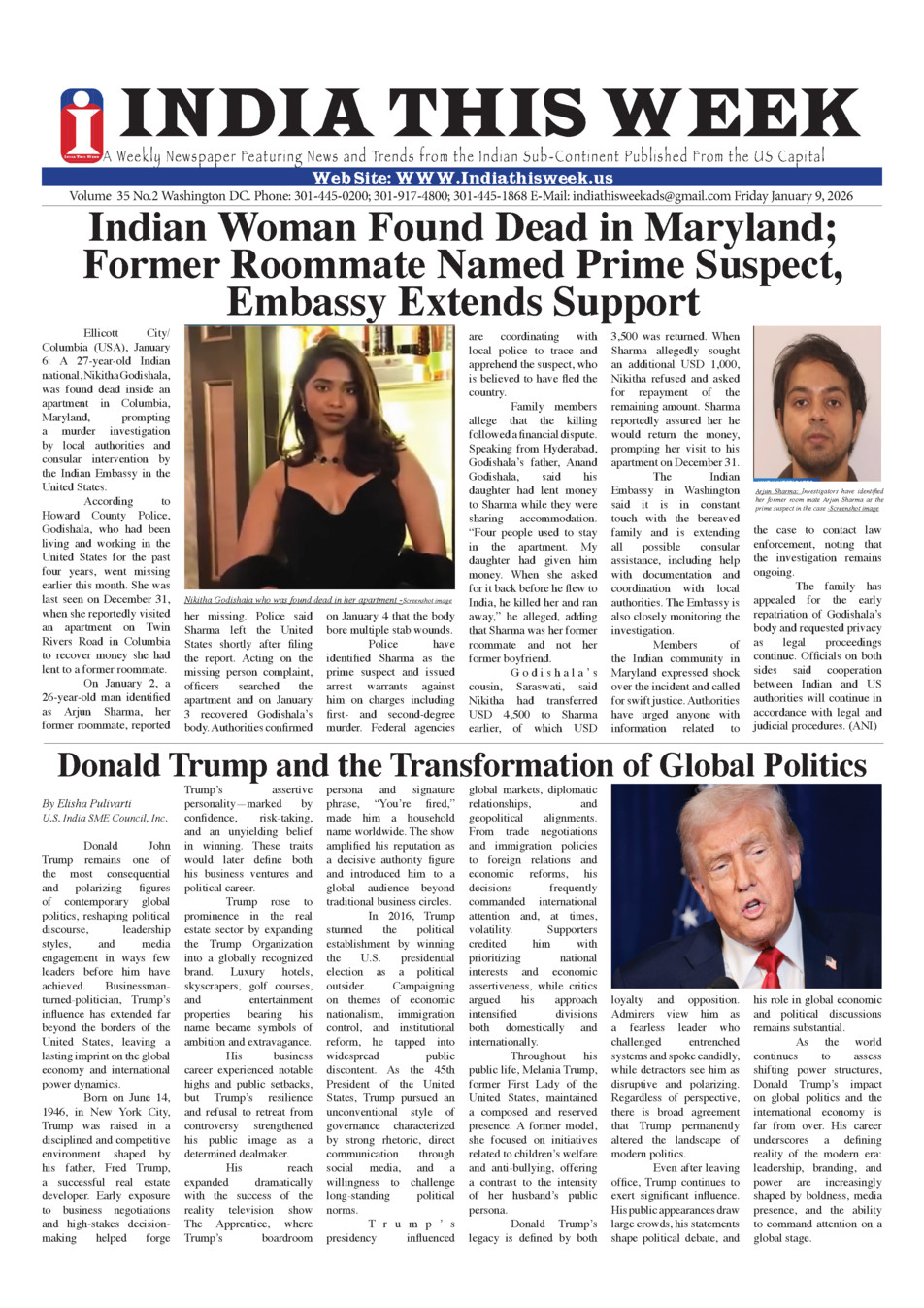
In early January 2026, authorities in Maryland opened a murder investigation after a 27-year-old Indian national was found dead inside an apartment in the Columbia area. The local police reported that the woman had been living and working in the United States for several years, and her death prompted a thorough inquiry that included tracing her movements in the weeks leading up to the discovery and coordinating with consular officials. (Page 1)

The investigation quickly identified a former roommate as a key suspect, and investigators recovered the body after responding to a missing-person report. The discovery of stab wounds suggested foul play, which intensified the search for those responsible. Police indicated that the suspect had left the country soon after the initial report, complicating efforts to arrest him domestically. (Page 1)

Authorities said the case involved a complex mix of personal and financial factors, with investigators probing whether a dispute over money may have escalated into violence. The family described a tense financial arrangement, while officials stressed that the motive remained under scrutiny as the investigation continues. (Page 1)

The incident drew attention from the Indian Embassy in Washington, which said it was in frequent contact with the bereaved family and was offering consular assistance and coordination with local authorities. Members of the Indian community in Maryland expressed shock and urged a swift and transparent justice process. (Page 1)

Section 2 — Donald Trump’s enduring impact on global politics and economic discourse

The article presents a portrait of Donald Trump as a figure whose career straddles business and politics, revealing how his approach to leadership, branding, and media engagement reshaped public discourse around power and governance. The narrative emphasizes his transformation from a prominent real estate developer to a political actor whose style disrupted traditional norms. (Page 1)

Trump’s ascent was propelled by a combination of high-profile branding, risk-taking, and a relentless media presence that widened his reach beyond conventional business circles. His foray into reality television amplified his image as a decisive, no-nonsense leader whose rhetoric and decisions drew global attention. The piece traces how this blend of branding and governance helped redefine expectations for leaders in the 21st century. (Page 1)

As the 2016 presidential campaign unfolded, his outsider status and policy prescriptions—from economic nationalism to immigration controls—altered political arithmetic in the United States and resonated with supporters worldwide. The analysis notes both the support he earned for challenging established elites and the intense opposition he encountered from critics who warned of polarization and instability. (Page 1)

Section 3 — Supreme Court bail rulings in the Delhi riots case and their legal significance

The Supreme Court’s bail decision in the Delhi riots matter centers on the adjudication of seven accused individuals under the Unlawful Activities Prevention Act (UAPA). The Court refused bail for Umar Khalid and Sharjeel Imam, citing material on record that, on its face, indicates a central and formative role in planning and directing the alleged conspiracy beyond isolated or local actions. The ruling underscores the court’s view that the statutory threshold under the UAPA is engaged in such circumstances. (Page 2)

In parallel, the Court granted bail to five other co-accused with conditions designed to safeguard the integrity of the trial. The judges required personal bonds, residency constraints within the National Capital Territory of Delhi, passport surrender or equivalent affidavits, and regular attendance at designated police and court offices. These measures illustrate a careful balance between individual liberty and public order. (Page 2)

The Court emphasized that liberty is not absolute and that the state may impose strict conditions to ensure the trial proceeds without undue delay. It also stressed the need to protect witnesses and maintain the security of the judicial process, signaling that any violation of conditions could lead to bail cancellation. The decision refrains from a guilt finding and frames bail as a calibrated exercise in constitutional discretion. (Page 2)

Authorities highlighted the broader context of the 2020 Delhi riots, including the scale of violence, casualties, and the substantial number of FIRs registered. The Court’s approach reflects a nuanced attempt to reconcile civil liberties with national security considerations during a highly charged political crisis. (Page 2)

Legal arguments in the case noted that prosecutors maintain a view of the conspiracy that extends beyond local disturbances, and the court’s ruling invites the trial court to move forward with expeditious proceedings, including the orderly examination of prosecution and protected witnesses. The judiciary signaled that timely resolution remains central to upholding justice in such complex matters. (Page 2)

Section 4 — Uttar Pradesh draft electoral rolls and the Special Intensive Revision process

The UP Chief Electoral Officer released figures detailing the ongoing Special Intensive Revision of electoral rolls, a process designed to cleanse and update the voter list ahead of forthcoming elections. The statewide revision activity highlighted significant deletions in several districts, with Lucknow reporting the highest deletion rate at about 30 percent. (Page 3)

Official data show that the total number of electors in Uttar Pradesh stood at roughly 125.5 million, down from around 155.8 million earlier in the enumeration cycle. The reductions are attributed to a combination of deceased individuals, relocated residents, and duplicate registrations discovered during verification. (Page 3)

The state administration explained that the enumeration phase, conducted over a defined period, involved house-to-house verification and the collection of forms to ensure accuracy. The publication of the draft rolls and the availability of a booth-wise list aimed to enable parties to verify and contest entries as needed. (Page 3)

Officials noted that more than 12.5 crore enumeration forms were submitted, with tens of millions of voters identified as deceased or migrated, and 2.47 million entries marked as duplicates. They stressed that a window for Form 6 submissions would remain open to include eligible voters and rectify the roll, while also inviting objections for deletions where appropriate. (Page 3)

The draft rolls were released publicly on January 6, and copies were provided to recognized political parties. The period for claims and objections runs from January 6 to February 6, with disposal of applications expected by February 27. The process involves a large network of EROs, AEROs, BLOs, and political party volunteers to ensure broad participation and transparency. (Page 3)

Section 5 — US-India defence cooperation notes and tariff considerations amid Russia-Ukraine dynamics

During a recent appearance at a GOP retreat, former President Trump highlighted what he described as growing defence cooperation between India and the United States, drawing attention to an India-ordered fleet of Apache attack helicopters and asserting that delivery delays were being tackled at the highest levels of government. He framed the issue as one of practical, bilateral collaboration. (Page 2)

The former president reiterated his relationship with Prime Minister Narendra Modi, while suggesting that ongoing tariff friction—stemming largely from concerns about Russia’s oil imports—crept into the broader trade relationship. He claimed that the United States had made moves to relieve some of these tariff pressures, framing it as progress in a long-standing effort to align U.S. and Indian economic priorities. (Page 2)

Trump also positioned himself as a potential mediator in the broader Russia-Ukraine conflict, signaling willingness to engage with both Moscow and Kyiv to advance a political settlement. Although he did not announce a breakthrough, the remarks underscored his intent to foreground security and energy considerations as shared pillars of the India-U.S. relationship. (Page 2)

Section 6 — Weather extremes in Rajasthan and India’s move toward drone-enabled warfare

Describing a harsh cold wave sweeping parts of northern India, the report notes that Jaipur was enveloped in dense fog, producing remarkably low visibility and prompting motorists to use headlights for safety. The episode coincided with deteriorating air quality as measured by the CPCB, which placed Jaipur’s air index in the poor category at the start of the day. Nearby cities like Ajmer exhibited less severe conditions, while other towns in the state also faced foggy conditions and travel disruptions. (Page 5)

The coverage emphasizes the broader pattern of winter weather across the region, with Delhi and other urban centers seeing shifts in air quality indices and occasional spikes in fog-related hazards. Officials advised caution to travelers and residents as conditions evolved through the morning hours. (Page 5)

In a separate development tied to national security, the Indian Army is accelerating its drone warfare capabilities by creating multiple Shaktibaan regiments within the artillery framework. These units will employ swarm drones, loitering munitions, and long-range unmanned platforms to target adversaries across substantial distances. (Page 7)

Officials indicate that an initial procurement of hundreds of loitering munitions and launchers will be conducted through a fast-track process, with domestic Indian firms lined up to supply the equipment within the next two years. The effort underscores a broader push to build indigenous defense capabilities, leveraging partnerships with companies such as Solar Defence and Adani Defence. (Page 7)

As part of the broader modernization plan, the Army is also expanding the Regiment of Artillery’s capabilities with additional Divyastra batteries and integrating new units like Ashmi platoons for infantry modernization, alongside a newly formed Bharav special force designed to enhance special operations at the corps level. Past operations, including the use of drones in Operation Sindoor, illustrate how these systems may be employed in future conflicts. (Page 7)

Overall, the January 9, 2026 issue of India This Week presents a kaleidoscope of domestic political developments, international diplomacy, and forward-looking defense modernization, reflecting how India navigates security, governance, and economic relations in a rapidly evolving global landscape. (Page 7)

India This Week~January 9, 2026 - Flipbook by Fleepit
© 2021 Fleepit Digital.
This site is protected by reCAPTCHA and the Google Privacy Policy and Terms of Service apply.