India This Week~September 12, 2025

India This Week~September 12, 2025

Prix simple. Outils puissants. Annulation à tout moment.

India This Week — Vice Presidency, GST Reforms, Elections, and International Ties (Sept 12, 2025)

Summary

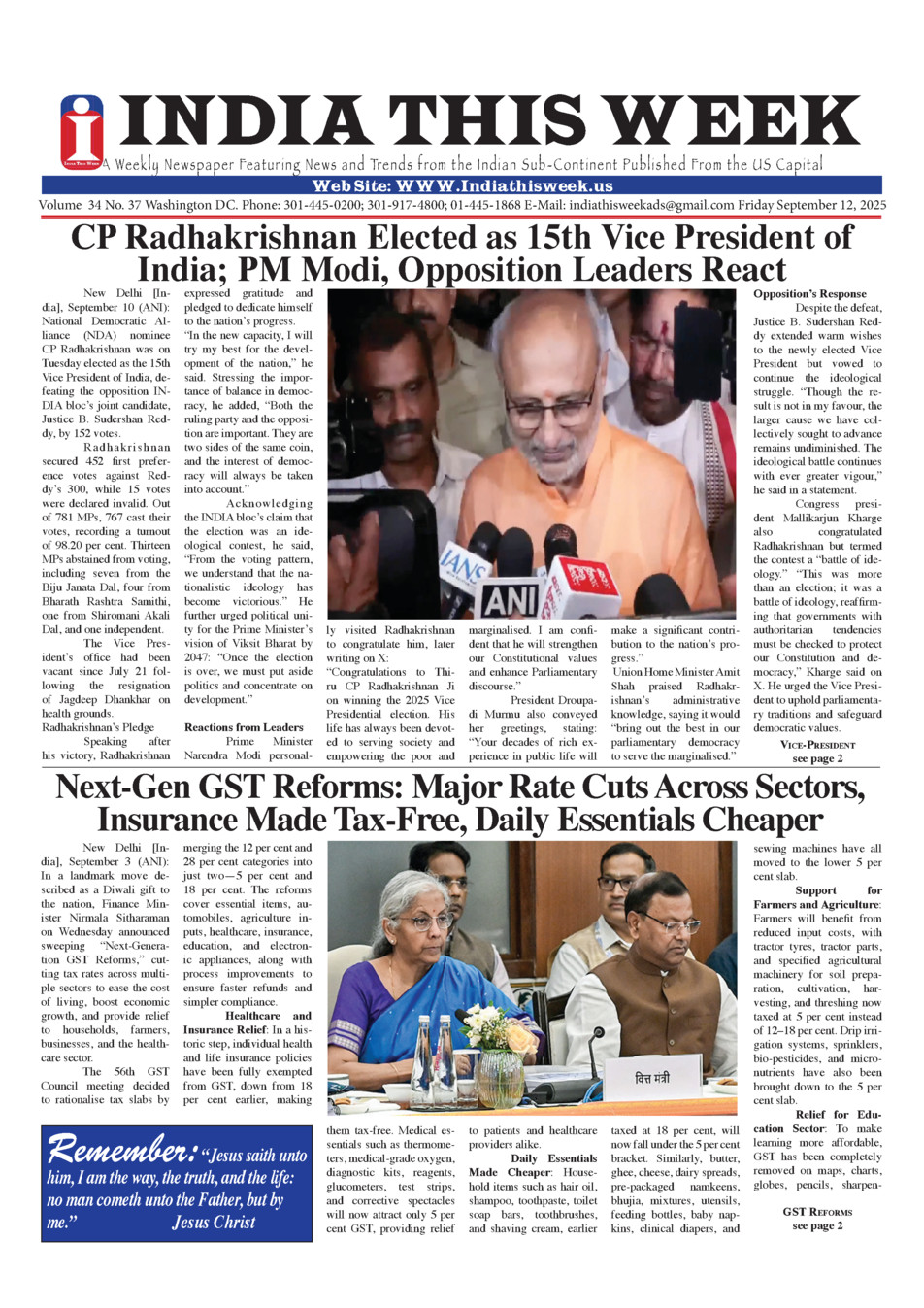
India This Week’s September 12, 2025 issue compiles a broad set of headlines spanning Indian politics, economic policy, electoral processes, and international relations, with a focus on how policy shifts and leadership changes may influence everyday life for citizens and the Indian diaspora. It surveys developments in New Delhi, Delhi’s federal interactions, and bilateral collaborations that shape both domestic governance and global economic ties. (Page 1)

CP Radhakrishnan has been elected as the 15th Vice President of India, edging out the INDIA bloc’s joint candidate with a comfortable margin amid a high parliamentary turnout. The result leaves the post vacated since July and underscores the upcoming phase of parliamentary engagement under a new constitutional officeholder. Radhakrishnan's remarks emphasized gratitude and a commitment to national development, while underscoring the importance of democratic balance between governing parties and opposition. (Page 1)

In a landmark policy move, Finance Minister Nirmala Sitharaman announced sweeping reforms to the Goods and Services Tax system, streamlining rates into two slabs of 5% and 18% to ease consumer costs, accelerate growth, and simplify compliance. The package also makes health and life insurance policies GST-free and extends relief to daily essentials, farming inputs, education materials, and medical supplies, while introducing faster refunds and easier registrations. (Page 2)

Industry bodies and industry leaders greeted the GST rationalization as a milestone, with government officials and the prime minister framing it as tangible relief for households and small businesses. The policy has drawn praise for reducing inverted duties in certain sectors and for its potential to stimulate demand, while critics and opposition voices emphasize the broader ideological contest around fiscal policy. (Page 2)

Meanwhile, Congressman Raja Krishnamoorthi has launched a campaign to succeed retiring Senator Durbin, presenting his personal journey from India to the U.S. political landscape as a foundation for reform-minded leadership. He entered the race with a strong fundraising lead and notable early advertising, aiming to broaden representation and advance immigration reform, small-business support, and economic opportunity. Polls and fundraising data suggest a favorable position relative to other Democratic contenders, though the field remains crowded. (Page 3)

The Election Commission held a conference of Chief Electoral Officers to evaluate nationwide Special Intensive Revision (SIR) of electoral rolls, detailing strategies for uniform implementation, the status of digitization, mapping of electors, and the rationalization of polling stations to ensure no station exceeds 1,200 voters. The CEOs discussed documentation to prevent eligible citizens from being excluded and to avoid ineligible individuals being included, along with training for DEOs, EROs, AEROs, BLOs, and BLAs. (Page 3)

In bilateral economic news, Israel and India signed a Bilateral Investment Agreement to deepen reciprocal investments and expand cooperation in finance, trade, infrastructure, and digital commerce. The signing, led by Israel’s Finance Minister Bezalel Smotrich and India’s Nirmala Sitharaman, marks a milestone as India engages with an OECD member on a strategic investment treaty, replacing a prior 1996 pact terminated in 2017. The agreement anticipates a more robust financial protocol and potential institutional ties, including Israel’s representation in India. (Page 4)

A literary insert titled The Poetic Pen features verse that challenges leadership accountability, urging integrity and the responsible use of influence to serve communities rather than personal ambitions. Authored by Rajan George, the piece reflects on the moral obligations of public figures and the dangers of power without accountability. (Page 4)

Prime Minister Narendra Modi announced a Rs 1,500 crore aid package for flood-hit Himachal Pradesh after an aerial survey, comprising advance SDRF funding, support for PM-Kisan beneficiaries, ex-gratia payments to the families of those lost, compensation for the seriously injured, and a multi-pronged plan to rebuild homes, roads, schools, and infrastructure. The relief package also includes water harvesting initiatives and targeted aid for farmers without electricity connections, with inter-ministerial teams deployed to assess damage and guide further assistance. (Page 4)

The edition closes with notes on the broader public-discourse context, including religious and moral references interwoven into the reportage, and a reminder of the publication’s editorial and community-focused mission. The issue provides contact details and publication information for readers seeking further coverage or to engage with India This Week’s content. (Page 4)

India This Week~September 12, 2025 - Flipbook by Fleepit
© 2021 Fleepit Digital.
This site is protected by reCAPTCHA and the Google Privacy Policy and Terms of Service apply.