India This Week~August 22, 2025
India This Week~August 22, 2025
Meta Title: India This Week – August 22, 2025 — A comprehensive digest of floods, political moves, diplomacy, and business partnerships shaping India’s week
Section 1 — Maharashtra floods, monsoon impacts, and related public safety measures (Page 1–2)
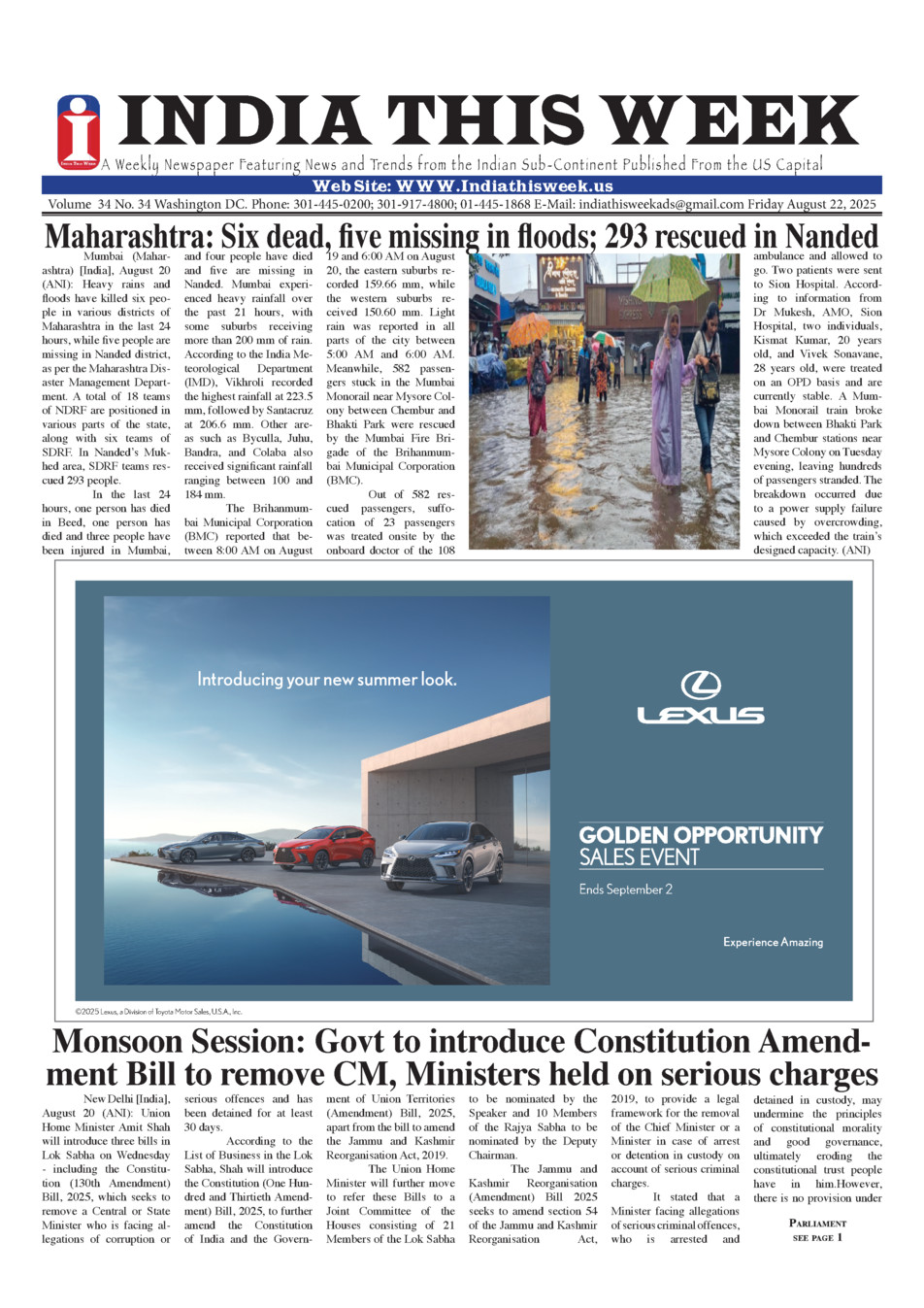
Across Maharashtra, intense monsoon rains triggered widespread flooding across several districts, leading to a number of fatalities and several people reported as missing. The state disaster management authorities indicated that as many as six residents had lost their lives while five remained unaccounted for in the Nanded district alone, with rescue teams deployed from multiple agencies to respond to developing emergencies. In the prior 24 hours, rescue operations and emergency responses were active in various areas, including beeds and Mumbai, as authorities worked to locate missing individuals and protect affected communities. (Page 1–2)
In Nanded’s Mukhed area, coordinated relief efforts under the SDRF managed to evacuate hundreds of residents, underscoring the scale of the flooding and the necessity of rapid response to protect vulnerable populations. Mumbai, in particular, faced significant rainfall, with several suburbs surpassing the 200‑millimeter mark as data from the India Meteorological Department (IMD) underscored the breadth of the deluge. The highest recorded rainfall in the city’s suburbs included values around 223.5 mm in Vikhroli and 206.6 mm in Santacruz, with other neighborhoods logging substantial precipitation that challenged drainage systems and infrastructure. (Page 1–2)
The weather‑driven emergencies also strained urban transit, with a Mumbai Monorail service breakdown near Mysore Colony triggering a large-scale passenger evacuation. The breakdown—attributed to a power‑supply failure linked to overcrowding—left hundreds temporarily stranded, and the Brihanmumbai Municipal Corporation (BMC) and municipal responders conducted rescue operations. In hospital contexts, some patients were transported for care, with reports confirming the transfer of two individuals to Sion Hospital in addition to ambulatory treatment for others at medical facilities. (Page 1–2)
As the monsoon activity persisted, emergency services tracked rainfall distributions across the city’s eastern and western suburbs, noting that about 582 passengers who had been stuck in the monorail system received assistance from the Mumbai Fire Brigade. The rescue effort also included on‑scene medical attention for a subset of passengers, demonstrating the city’s readiness to manage large‑scale public safety incidents during the monsoon season. (Page 1–2)
In a broader policy context, the government signaled ongoing attention to flood management and disaster readiness as part of the annual monsoon cycle, with continued monitoring of rainfall trends and the deployment of specialized teams to high‑risk zones. This update sits alongside upcoming parliamentary deliberations about constitutional amendments linked to governance during periods of political and legal scrutiny. (Page 1–2)
Section 2 — International diplomacy, domestic reform agenda, and business collaborations (Page 3–4)
In the external‑policy arena, China committed to addressing India’s prioritized concerns—specifically the availability of fertilizers, access to rare earth elements, and the supply of tunnel boring machines—during high‑level talks in New Delhi. Chinese Foreign Minister Wang Yi’s assurances to India’s External Affairs Minister S. Jaishankar highlighted a mutual interest in stabilizing trade and addressing critical supply needs, especially in sectors essential to India’s growth and infrastructure plans. Jaishankar emphasized that the two neighbors should manage their differences through dialogue and cooperation, rather than allowing disagreements to spill into broader conflicts. (Page 3–4)
Meanwhile, the retail sector in the United States saw H Mart announcing a new collaboration with NationsBenefits to broaden access to culturally aligned nutrition and wellness products. Eligible customers can use a NationsBenefits Flex Card at H Mart checkout to purchase fresh produce, specialty ingredients, and over‑the‑counter items that resonate with diverse culinary traditions. The partnership uses real‑time adjudication to simplify redemption at the point of sale, reinforcing preventive health approaches while preserving cultural food practices. (Page 3–4)
In the Indian political sphere, discussions and diplomacy also intersected with economic and administrative matters as the government advanced a constitutional framework aimed at expeditiously removing chief ministers or ministers who are detained on serious criminal charges. The government’s plan was to bring a trio of bills to Lok Sabha in the monsoon session, including the proposed 130th Amendment, which would define new procedural pathways for removing public officials under such circumstances, and would route these measures through a joint parliamentary committee for consideration. The underlying intent was to strengthen governance norms and maintain public trust by ensuring accountability at the highest levels of state and central administration. (Page 3–4)
As part of these broader constitutional discussions, Prime Minister Narendra Modi’s administration signaled a willingness to engage with opposition voices to reach broad consensus, while maintaining confidence that the proposed reforms would bolster democratic resilience. The language of these amendments has sparked debates about civil liberties and the balance between anti‑corruption aims and due process, a dynamic reflected in public discourse and media commentary as India navigates complex political terrain. (Page 3–4)
Section 3 — Political leadership profiles, endorsements, and procedural notes on the Vice Presidential bid (Page 5–6)
The NDA publicly welcomed the nomination of CP Radhakrishnan, the Governor of Maharashtra, as its candidate for the Vice Presidency, with senior leaders from the coalition lauding his long career in public service and his governance track record. The announcement, delivered after a Parliamentary Board meeting chaired by the party’s national president, underscored the NDA’s intent to field a seasoned administrator who has demonstrated leadership across multiple states and institutions. (Page 5–6)
The endorsement of CP Radhakrishnan drew congratulations from a number of senior figures, including government ministers and regional leaders. They highlighted his extensive public‑service résumé—from early political activism in the BJP’s forerunner organizations to his roles as a parliamentarian and, later, as governor in various states. Advocates noted his experience in administrative reform, public welfare initiatives, and international engagement, all of which were presented as assets for the Vice Presidential office. (Page 5–6)
A detailed biographical sketch provided by party speakers described Radhakrishnan’s journey from student activism through the Jan Sangh, his election to Parliament from Coimbatore in the late 1990s, leadership postings within the party in Tamil Nadu, and his tenure as the All India Coir Board chair, during which India’s coir exports reportedly reached new highs. The profile also chronicled his governance roles in Jharkhand, Telangana, Maharashtra, and Puducherry, along with his broader service in public life and belief in constitutional values. (Page 5–6)
In parallel, a political communication strategy unfolded as Defense Minister Rajnath Singh spoke with Congress President Mallikarjun Kharge to seek opposition backing for CP Radhakrishnan’s Vice Presidential bid. The NDA’s leadership signaled a desire for cross‑party consensus and hinted at ongoing efforts to secure broad support, including the possibility of an unopposed election if a workable accord could be reached. Party leaders stressed that dialogue would continue with opposition groups to build a mutually acceptable outcome. (Page 5–6)
Further commentary from party executives and parliamentary figures articulated the rationale behind presenting a candidate with decades of public stewardship and administrative competence, arguing that such a background would elevate the stature of the Rajya Sabha and reinforce governance ideals across the federation. The discussion also noted the procedural timeline for the Vice Presidential contest, with the election slated for September and the NDA pursuing a strategy designed to maximize cross‑party unity. (Page 5–6)
As the issue evolved, public coverage framed the appointments and endorsements as a test of political maturity and coalition solidarity, with critics cautioning against overreliance on a single candidate and urging inclusive dialogue. Supporters contended that CP Radhakrishnan’s proven leadership and administrative experience could help steer parliamentary debates toward stability and constitutional decorum during a period of geopolitical and domestic challenges. (Page 5–6)
Closing reflections in this section note that the Vice Presidential role is both ceremonial and influential, capable of shaping legislative discourse and the balance of power in a multipartite polity. The ongoing exchanges among political parties, along with the constitutional provisions under discussion, illustrate India’s continuing effort to align governance mechanisms with the principles of accountability, transparency, and responsible leadership. (Page 5–6)
Section 4 — Reflections, cultural notes, and closing cues (Page 7)
In a literary interlude, a poem attributed to a contemporary Indian writer offers a meditation on the responsibilities of public service, warning against the temptations of power and the manipulation of public opinion by those who pursue personal gain. The piece emphasizes integrity, accountability, and the importance of serving with humility rather than courting influence through wealth or donor interests. (Page 7)
A closing quotation from Christian scripture appears to remind readers that truth and liberty are entwined with adherence to genuine teachings. The excerpt frames truth as a pathway to freedom, serving as a thematic bookend to a week marked by debates over governance, transparency, and societal well‑being. (Page 7)
The issue concludes with a nod to a visual gallery of flipbook content and a reminder of the publication’s digital footprint, signaling ongoing access to the latest layouts, catalogs, and features through the publisher’s online platform. (Page 7)
Notes: The above synopsis reflects paraphrased synthesis of multiple report strands in the August 22, 2025 issue of India This Week, spanning natural‑disaster coverage, parliamentary business, international diplomacy, and leadership profiles. It aims to present the core developments in a cohesive narrative while preserving the original topics and sequence of the source material. (Page 1–7)