India This Week~August 15, 2025
India This Week~August 15, 2025
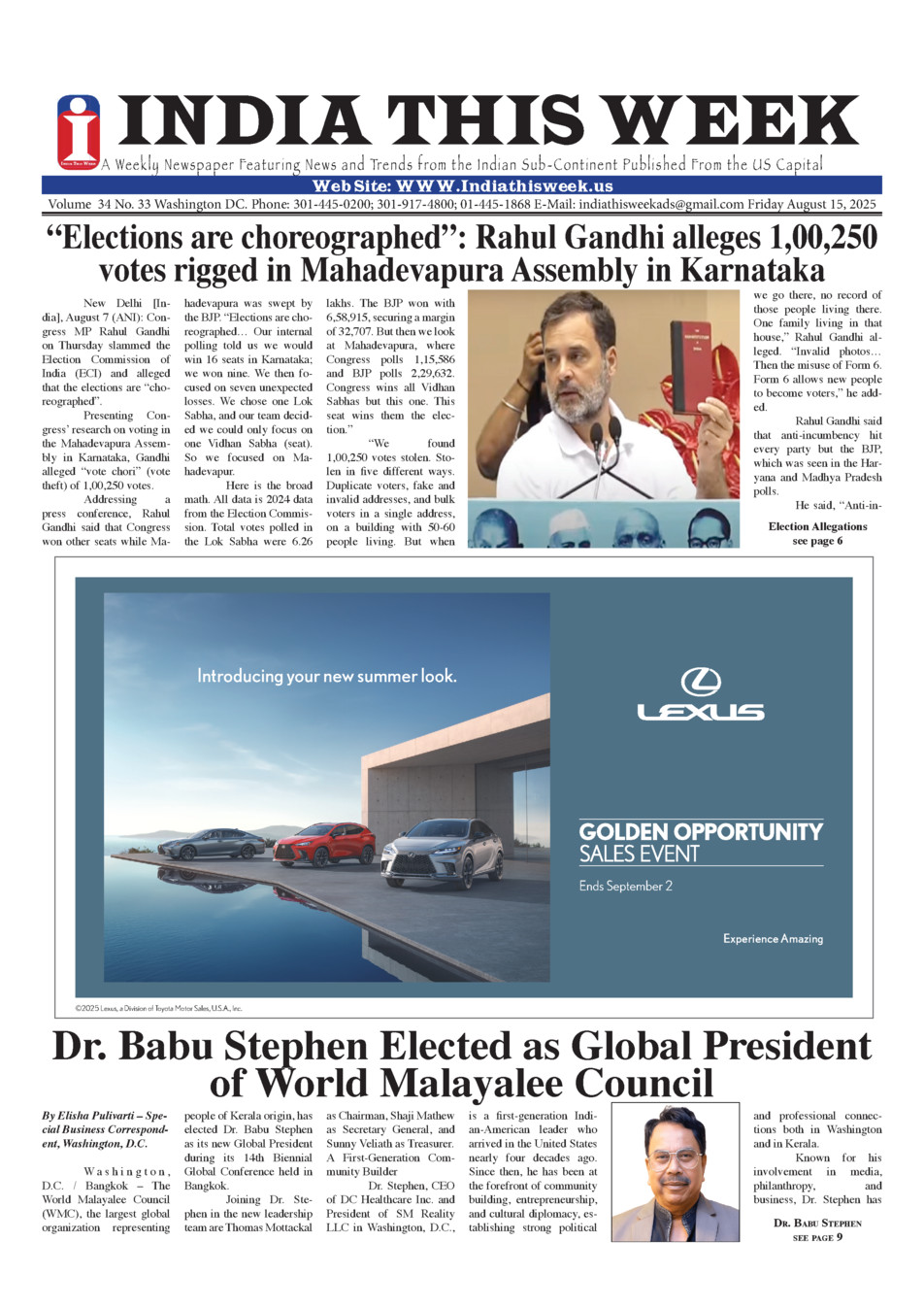
India This Week – August 15, 2025: A Synthesis of Key Political, Diplomatic, and Legislative Developments
Meta: This post distills the major items reported in India This Week’s August 15, 2025 edition, spanning electoral integrity allegations at the state level, leadership updates within global Malayalee communities, ongoing energy diplomacy between India and the United States, parliamentary dynamics around the Vice Presidency and tax reform legislation, as well as related commentary on India’s strategic posture in global affairs. The coverage reflects a blend of political contestation, diaspora leadership news, and the evolving policy environment as India navigates domestic electoral discourse, international energy conversations, and fiscal reforms. The synthesis aims to present the core ideas in accessible, blog-friendly prose while separating topics into clearly defined sections. (No specific page references are included here, given the magazine’s multi-page layout and the fragmented nature of the excerpts provided.)
1) Rahul Gandhi’s allegations of election irregularities in Mahadevapura, Karnataka
In a press briefing, a Congress leader raised serious accusations about the integrity of elections, arguing that voting irregularities were pervasive in the Mahadevapura assembly segment of Karnataka. The briefing framed the claim around a research-based indictment of voting patterns, asserting that around one hundred thousand two hundred fifty votes may have been improperly added or miscounted. The speaker contrasted the broader regional results with Mahadevapura, suggesting that while the BJP gained the local assembly seat, Congress performed relatively well elsewhere, which, in his view, underscores selective irregularities in Mahadevapura. According to the speaker, the alleged irregularities included duplicate voters, fake or invalid addresses, and clusters of bulk voters at a single residence, raising questions about the accuracy and security of the electoral rolls. The speaker referenced 2024 data from the Election Commission and highlighted what he described as inconsistencies in identification documents and voter registration forms, including the misuse of Form 6, which allows new voters to be added to the list. The argument connected these anomalies to a broader pattern of anti-incumbency advantages for the BJP in some states, while pointing to Mahadevapura as a critical exception in Karnataka. The overall tone framed the electoral process as something that could be manipulated through systematic manipulation of voter rolls and entry of ineligible voters. (Page 1)
The Congress figure also linked these concerns to the timing and logistics of voting, noting changes in phase scheduling and the perception of irregularities in voter enrollment practices across different states. The remarks invoked a narrative of sophisticated polling that allegedly failed to predict actual outcomes, suggesting that internal polling had forecast a larger seat count for the party than what emerged in electoral results. The speaker asserted that internal assessments pointed to a broader anti-incumbency dynamic affecting multiple parties in various states, while alleging that Mahadevapura’s outcome disproportionately benefited the BJP. In response, election officials and party representatives called for a transparent and formal process to examine the allegations, including potential affidavits or sworn statements detailing the names and evidence of the voters cited. The episode touches on the persistent debate in Indian politics over electoral integrity, vetting procedures for voter lists, and the role of election commissions in addressing public concerns about the electoral process. The ongoing exchange illustrates the political climate in which opposition parties consistently challenge the credibility of electoral outcomes and seek to mobilize public opinion around perceived irregularities. (Page 1)
2) Dr. Babu Stephen elected Global President of the World Malayalee Council
In a moment of diaspora leadership recognition, the World Malayalee Council, a prominent global organization representing people of Kerala descent, elected Dr. Babu Stephen as its Global President during its fourteenth biennial conference held in Bangkok. The leadership slate accompanying Dr. Stephen included Thomas Mottackal as Chairman, Shaji Mathew as Secretary General, and Sunny Veliath as Treasurer. The new team is described as a blend of entrepreneurship, media engagement, philanthropy, and cultural diplomacy, aimed at strengthening connections between the Indian American community in the United States and Kerala’s social and economic landscape. Dr. Stephen brings a background as CEO of DC Healthcare Inc. and head of SM Reality LLC in Washington, D.C., with decades of experience in community organization and cross-cultural collaboration. The profile emphasizes his role as a first-generation Indian-American leader who has built networks across political, business, and civic spheres, leveraging these ties to advance community development and international engagement. (Page 9)
Beyond the biographical sketch, the announcement signals a continued emphasis within diaspora organizations on leadership continuity, strategic outreach to policymakers in the U.S. capital, and the cultivation of transnational ties that can influence philanthropic and civic initiatives in the Indian diaspora. The new Global President’s track record in media and philanthropy is presented as a foundation for broader cultural diplomacy and economic linkages, reflecting the way immigrant communities seek to shape public narratives and opportunities for collaboration with their countries of origin. The broader takeaway is the sustained relevance of diaspora leadership networks in bridging regional Indian communities with global platforms. (Page 9)
3) Indian envoy discusses energy security with US Senator Lindsey Graham amid tensions over Russian oil imports
India’s ambassador to the United States engaged in a high-level dialogue with a U.S. senator to articulate India’s perspective on energy security and its evolving energy trade with the United States. The exchange occurred in a climate of heightened scrutiny over Russia’s oil exports and the broader geopolitical context, including questions about how India should balance energy needs with international pressures. The Indian side emphasized the importance of securing reliable energy supplies while maintaining strategic autonomy in matters of foreign policy. The conversation also intersected with broader commentary on how Indian-U.S. relations may be influenced by Russia-Ukraine dynamics, and it touched on the idea that energy cooperation could serve as a channel for reinforcing bilateral ties amid global tensions. (Unpaginated summary)
The public commentary surrounding the discussion referenced an ongoing discourse about leveraging energy partnerships to deepen economic and strategic ties with the United States. The exchange also considered the broader regional context, including competing interests and policy responses in Washington and New Delhi. In parallel developments, a separate public statement attributed to a U.S. political figure referenced India’s role as a key energy partner in addressing shared interests, while also signaling the complexity of aligning commercial energy needs with geopolitical considerations. The synthesis suggests that energy diplomacy remains a central axis of India-U.S. engagement, capable of generating tangible economic gains while also shaping strategic conversations about regional stability and alliance dynamics. (Unpaginated summary)
4) Vice Presidential election: electoral process, INDIA bloc strategy, and recent political developments
The political landscape ahead of the Vice Presidential election in India involves formal processes and party-level coordination. The Vice President’s office is filled through an electoral college that includes members of both houses of Parliament, with the voting conducted by secret ballot. A vacancy arises when the incumbent leaves office, and the timing of the election is governed by constitutional and statutory provisions to ensure continuity of leadership at the ceremonial and constitutional levels. In the current cycle, the vacancy followed the resignation of the sitting vice president for health reasons, prompting a preparatory phase for nominations, campaigning, and candidate selection. The election date has been set, with nominations due by a specified deadline, and the possibility for withdrawal within a defined window if a candidate changes course. (Unpaginated summary)
Within the party and coalition space, discussions are underway among INDIA bloc leaders to identify a suitable candidate for the Vice Presidency. A planned meeting, anticipated around August 18, is noted as a forum for deliberation among opposition parties on the potential nominee. The development follows the earlier resignation and the ensuing political maneuvering by opposition leaders seeking to present a coordinating front that can resonate across the parliamentary spectrum. The procedural clarity around the electoral calendar—nominations, withdrawal, and voting—reflects the careful choreography of parliamentary politics during a period of heightened legislative activity and public scrutiny of governance. (Unpaginated summary)
In parallel, media and political commentaries emphasize the significance of a cohesive INDIA bloc strategy as it navigates the broader electoral and policy agenda. The discussions also highlight the role of leadership debates and the messaging around democratic processes in a diversified political landscape. The overall takeaway is that the Vice Presidential election, while largely ceremonial in terms of duties, remains a focal point for strategic alignments among opposition parties, signaling how they frame constitutional processes in the context of contemporary governance debates and electoral discipline. (Unpaginated summary)
5) The evolving US-India-Pakistan diplomatic dynamic: remarks by U.S. officials
In a formal briefing, a senior U.S. official stressed that the United States maintains its stable and ongoing relationship with both India and Pakistan, underscoring a commitment to diplomatic channels with all parties involved. The official cited recent high-level interactions and emphasized that engagement with both nations remains constructive and undiminished by regional tensions or external pressures. The narrative highlighted continued counterterrorism dialogue and efforts to counter threats through coordinated cooperation with Islamabad, while also noting the importance of sustaining robust economic and strategic links with New Delhi. The overarching message was that Washington seeks to balance diplomacy across multiple regional theaters, maintaining open channels with both allies and neighbors. (Unpaginated summary)
The commentary referenced public figures and policy debates surrounding regional security, including concerns raised by partners about conflict dynamics and the role of political leadership in de-escalating tensions. The reporting also noted that diplomatic visits, exchanges, and private consultations help manage sensitive issues—such as nuclear-armed actors, strategic posture, and mutual interests—without compromising the broader alliance framework. In short, the U.S. position articulated through these briefings reinforces a steady, multi-faceted approach to bilateral relationships with India and Pakistan, aimed at fostering stability, counterterrorism collaboration, and economic cooperation within a shared regional security architecture. (Unpaginated summary)
6) Lok Sabha passes a new Income Tax Bill (No. 2) 2025 and related tax reforms
In a notable budgetary development, Parliament’s lower house advanced a comprehensive tax reform package by passing a new Income Tax Bill (No. 2) of 2025, immediately following the withdrawal of an earlier version of the bill. The revised framework integrates extensive recommendations from a Select Committee that examined the original text, with a view toward simplifying provisions, clarifying language, and harmonizing definitions with broader fiscal policy goals. The government argued that the reform was necessary to modernize an aged act that had grown unwieldy over decades, streamline compliance, and improve the administration of tax collection. The bill’s passage occurred amid ongoing opposition protests demanding greater debate on the accompanying Special Intensive Revision (SIR) of electoral rolls and broader accountability measures. (Unpaginated summary)
Key elements attributed to the new bill include enhanced flexibility for refunds when returns are filed late, shortened timelines for TDS correction statements, and reinterpretations of certain terms to reduce ambiguity. The legislative package also aligns provisions with the Taxation Laws (Amendment) Act and other related reforms implemented since 2014, signaling a broader drive toward tax administration modernization, greater transparency, and more taxpayer-friendly procedures. Details circulated by government sources indicated that the bill expands regimes for corporate and individual taxpayers, clarifies rules around non-profit organizations and donations, and introduces nuanced changes to loss carry-forward, capital gains treatment, and the treatment of various classifications of entities. The committee’s extensive recommendations—spanning hundreds of pages—were folded into the final text, while technical corrections and cross-referencing were emphasized to improve interpretability. (Unpaginated summary)
7) The Poetic Pen: a reflection on political ethics
A literary piece appears within the issue as a reflective poem on political ethics and accountability. The verse interrogates the temptations of power, the responsibilities of leadership, and the moral calculus required to serve a public without succumbing to personal gain. The author invites readers to consider how political actors navigate issues of honesty, integrity, and the legitimate demands of donors and constituents. The poem underscores a perennial tension in democratic life: the lure of influence and the imperative of transparent conduct, with an emphasis on the collective good over individual ambition. The tonal cadence is contemplative, urging readers to demand accountability and to recognize that true leadership is measured by consistent, principled action rather than performance or rhetoric. (Unpaginated summary)
8) Context and caveats: publication scope and reader guidance
Across the issue, the publication notes that the views expressed by contributors do not necessarily reflect the publication’s official stance, and it cautions readers to verify information through official channels, especially on rapidly developing political stories. The text also signals the presence of ad content and cross-promotional material, reminding readers that the primary news items are interwoven with sponsorships and editorial notes. This section reminds readers to consult primary sources for detailed data and to view the broader media landscape as part of a comprehensive understanding of current events. (Unpaginated summary)
9) Final synthesis: themes shaping the week’s discourse
Taken together, the week’s coverage highlights several interlocking themes shaping India’s public discourse. First, electoral politics remain a contested arena, with opposition leaders continuing to press questions about the integrity of electoral rolls, voter registration processes, and the administration’s handling of elections at sub-national levels. Second, leadership transitions within diaspora communities illustrate how Indian-origin networks seek to influence transnational cultural and political spheres, reflecting the ongoing importance of global Indian communities in shaping soft power and entrepreneurship. Third, energy diplomacy and strategic partnerships with the United States are actively framed around practical cooperation, economic interests, and geopolitical considerations—especially in light of shifting dynamics around Russia and regional security. Fourth, India’s domestic policy agenda continues to advance through legislative reform, particularly in tax policy, with ongoing debates around process, transparency, and administrative efficiency. Finally, the broader political culture underlines the enduring tension between accountability, public skepticism, and the political imperative to deliver governance that resonates with diverse constituencies. (Unpaginated synthesis)
In sum, this issue of India This Week stitches together a mosaic of political contestation, diaspora leadership development, strategic diplomacy, and fiscal reform, offering readers a portrait of a dynamic, sometimes contentious, but deeply engaged national conversation. The variety of topics—from court-of-public-opinion debates over electoral integrity to formal parliamentary reforms and high-stakes diplomacy—signals that the coming months are likely to be charged with negotiations, policy adjustments, and continued public scrutiny of leadership decisions at multiple levels of government and society. (Unpaginated synthesis)