December 2025 Print Issue
December 2025 Print Issue
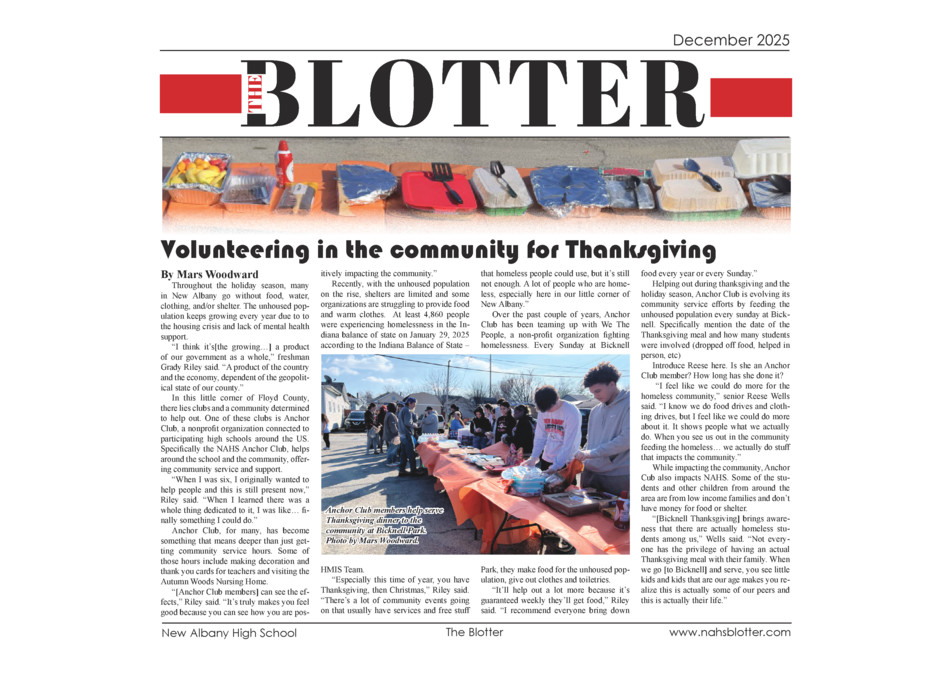
December 2025 Blotter: Community Service, Holiday Traditions, and Student Voices
Abstract
In the December 2025 issue of The Blotter, the focus centers on the spirit of giving and the ways students of NAHS (New Albany High School) engage with their community during the Thanksgiving season, while also reflecting on broader holiday themes. The piece highlights how local organizations address the needs of the unhoused and those facing food and shelter insecurity in Floyd County, amid a backdrop of a housing crisis and gaps in mental health support. It also presents personal perspectives from students and faculty about how they contribute to relief efforts, and what motivates them to take part in ongoing service. (Page 2)
The narrative introduces the Anchor Club at NAHS as a key agent of service, describing its connection to national networks of high school clubs and its work within the school and the broader community. Through hands-on activities such as making decorations, crafting cards for teachers, and visiting care facilities, Anchor Club members see tangible outcomes of their efforts, reinforcing a sense of purpose beyond required service hours. The piece emphasizes that volunteering can be a meaningful experience that strengthens students’ ties to their community. (Page 2)
Alongside these volunteer efforts, the article notes the growing need among the unhoused population in the area and the strain on shelters and support services. It cites statewide data indicating a substantial number of individuals experiencing homelessness and argues that local organizations are stepping up, often in collaboration with other nonprofits, to provide meals, clothing, and essential supplies. The weekly service at Bicknell Park during the holiday season is highlighted as a stable, recurring effort coordinated by Anchor Club and We The People to address immediate needs during Thanksgiving. (Page 2)
The piece also foregrounds a personal dimension by introducing Reese Wells, a senior whose reflections reveal both the momentum for greater action and questions about the scope of student involvement. While the article implies Wells’ connection to the school’s service efforts, it invites readers to consider how long she has contributed and in what formal capacity. Her comments convey a conviction that more can be done to support homeless community members and to demonstrate visible impacts of student service. (Page 2)
In addition to the service narrative, the article connects volunteering to the broader life of the school and its students. It expands on how community outreach at NAHS not only assists those in need but also shapes the school’s culture by raising awareness about vulnerable peers and inspiring ongoing compassion. The text conveys a sense that such efforts are not episodic but part of a larger ongoing commitment to care for others within the NAHS community and its surrounding neighborhoods. (Page 2)
The Thanksgiving sections extend into “Thankful thoughts,” where students recount personal traditions and memories that accompany the holiday. Through interviews with students like Brooke Proffitt and Candace Meyer, the piece explores how holiday rituals—food, family gatherings, nostalgia, and shared activities—shape their sense of belonging and gratitude. The narratives highlight how traditions endure across generations, even as families adapt to changing circumstances and life stages. (Page 2)
The holidays are also framed against a backdrop of public policy and social safety nets. A dedicated segment on government funding during the holiday season discusses a federal shutdown incident, the impact on families who rely on benefits, and the broader social implications. Student reporters present diverse viewpoints, including concerns about aid misuse, the importance of access for those in need, and the moral obligation to support families during winter. (Page 3)
Several voices foreground the discussion about SNAP benefits, minimum wage, and housing costs in Indiana, illustrating how policy decisions reverberate in communities year-round. The coverage includes perspectives from a social worker and students who connect local realities to national debates, underscoring how timely funding influences warmth, heat, food security, and overall well-being for vulnerable households during the colder months. (Page 3)
Beyond diagnosis and critique of policy, the article suggests concrete ways readers can help: donating coats, clothing, and essentials; supporting shelters; volunteering to prepare or serve meals; wrapping and delivering gifts for families; and participating in angel tree programs during the holiday season. The narrative emphasizes that volunteering is accessible and essential, especially when temperatures drop and the demand for basic necessities rises. (Page 3)
The following pages shift to a different facet of the holiday season—cultural expressions of Christmas through media and storytelling. A feature by Charlee Rogers surveys what makes a holiday movie resonant, outlining a framework for evaluating Christmas films that goes beyond mere festivity. The article identifies three tiers of Christmas cinema: films where Christmas is central, plots driven by Christmas that would still hold if the event happened on another day, and movies in which Christmas decorates the backdrop rather than driving the plot. (Page 4)
The analysis further identifies core ingredients of an enduring holiday favorite: emotional resonance that invites kindness and togetherness, nostalgia that ties generations to shared experiences, and originality that prevents the movie from feeling like a tired trope. Rewatchability and quotability are highlighted as practical indicators of a film’s lasting appeal, inviting audiences to return to their favorites year after year. (Page 4)
The piece then presents a roster of memorable contenders, including modern and classic titles, with notes on why each stands out. How the Grinch Stole Christmas (2000) earns praise for its emotional depth and the revitalized Dr. Seuss story, reinforced by strong performances and a message about the meaning of Christmas beyond consumer culture. Love Actually (2003) is celebrated for its interwoven storylines exploring love and connection, offering a mix of joy and poignancy that lends itself to repeated viewings. The Polar Express (2004) is recognized for its childhood wonder and faith-centered themes that resonate with younger audiences. The Nightmare Before Christmas (1993) and National Lampoon’s Christmas Vacation (1989) are noted for their distinctive visuals and quotable humor, respectively, while Home Alone (1990) and The Santa Clause (1994) receive attention for their iconic plots and family-centered warmth. (Page 5)
The discussion continues with additional entries, including The Search for Santa Paws (2010), which leans on nostalgia and warmth centered around animals and the North Pole, underscoring kindness and hope as essential elements of holiday storytelling. The analysis emphasizes how these films balance sentiment with humor, adventure, and familiar traditions, making them appealing to diverse audiences. (Page 5)
A separate feature delves into the perennial debate over fall versus winter, framing it through student perspectives gathered by a Morning Consult survey. While fall is favored for its fashion, color palettes, and comfortable weather, winter garners support for its associations with holidays, cozy moments, and the occasional snow day. The piece explores how personal experiences, family traditions, and holiday calendars influence preferences, illustrating that the choice between seasons often reflects social and emotional associations as much as meteorological realities. (Page 6)
In this seasonal discourse, students describe how holidays, family rituals, and school life shape their feelings about each time of year. The narrative highlights how Christmas and related celebrations evoke generosity—giving gifts, sharing meals, and spending time with loved ones—while recognizing that cold weather can also introduce practical challenges and a desire for home-based warmth. (Page 6)
A separate feature spotlights the school’s annual Mini Musical, an event that blends theatre education with community outreach. Senior performers discuss the collaborative process behind creating the show, which is written by the students and staged by the department head. The production is designed for younger audiences in local elementary and middle schools, as well as NAHS peers, incorporating themes of self-acceptance and the encouragement to shine one's authentic light. The narrative outlines how two theatre classes collaborated to craft a unified performance, including the involvement of a visiting playwright who helped refine the script while ensuring every participant could contribute meaningfully. (Page 6)
The performers reflect on the creative journey—from drafting multiple scripts to selecting and refining a story, and then balancing input from students with the director’s guidance. They describe the challenge of giving every cast member a defined purpose within scenes and the logistics of touring multiple schools within a compressed rehearsal window. The piece also touches on the emotional rewards of performing for young audiences, with students noting how the smiles and excitement of children validate their hard work and dedication. (Page 6)
In a complementary vein, another feature centers on the theme of family, gratitude, and cross-cultural holiday practices. Students from diverse backgrounds share how Christmas is observed in their homes, ranging from traditional Latin American customs to personal faith-based rituals. These voices highlight a spectrum of foods, religious observances, and communal activities—such as late-night gift exchanges, church services, family visits to grandparents, and seasonal culinary delights—that collectively illustrate how the holiday spirit is expressed in distinctive yet interconnected ways. The overarching message is that Christmas serves as a unifying moment for families, communities, and cultures, offering opportunities for reflection, generosity, and togetherness. (Page 7)
The December issue thus weaves together threads of service, memory, culture, and creativity to portray how NAHS students engage with the holiday season on multiple fronts. From actionable volunteering that supports neighbors in need to thoughtful analyses of cinema, seasonal preferences, and performing arts, the publication presents a portrait of a school community that actively participates in shaping a compassionate and connected local culture. (Page 7)