vgf
vgf
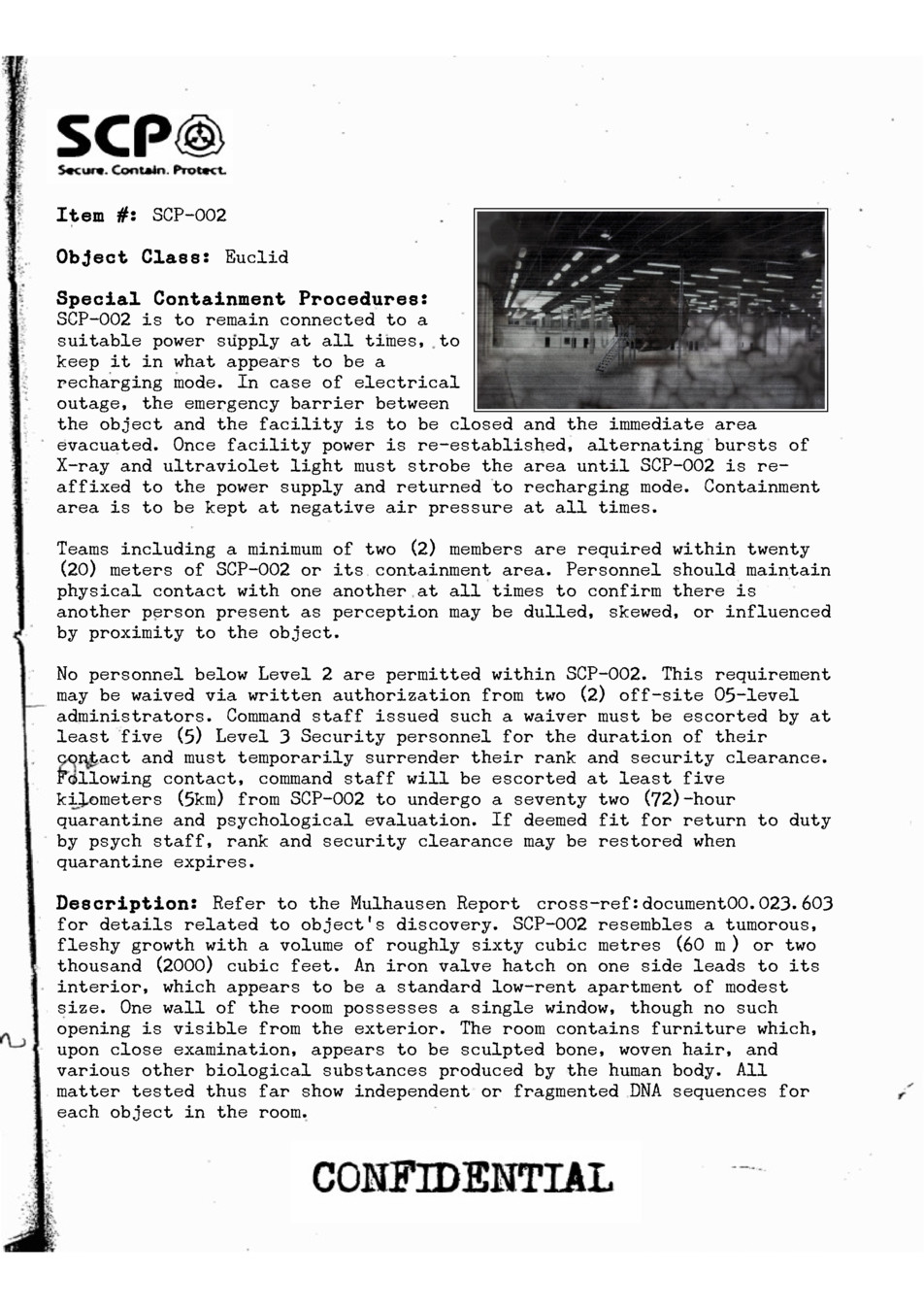
SCP-002, SCP-003, and SCP-004: Containment, Anomalies, and Historical Context — A Comprehensive Blog Summary
SCP-002: The Living Furnishings and the Boundaries of Containment
The object designated as SCP-002 presents as a substantial, living-like mass with a fleshy, tumor‑like appearance, occupying a volume that equates to roughly 60 cubic meters. Its exterior conceals an interior space that resembles a compact, modest apartment, including a single window and furnishings that appear to be crafted from biological materials such as bone, hair, and other human-derived substances. The interior environment suggests a self-sustaining habitat where living bodies can be transformed into inanimate objects within the room. In addition, DNA analysis indicates that each item within the space originates from distinct or fragmented genetic sequences, underscoring a pattern of rapid growth and reconfiguration fostered by the subject’s unique biology. Page: 1
Containment requires continuous connection to a power source, effectively forcing SCP-002 into a perpetual recharging state. Should a facility-wide power outage occur, emergency barriers are to be closed and personnel evacuated from the immediate vicinity. Once power is restored, a rapid sequence of alternating X-ray and ultraviolet pulses is deployed to reattach SCP-002 to its power supply and return it to recharging mode. The containment chamber must maintain negative air pressure, and a minimum of two staff members must operate within a 20-meter radius, all times, with their physical contact maintained to confirm presence and mitigate perceptual dulling produced by proximity to the entity. Access below Level 2 is forbidden unless two Level‑O5 administrators grant written authorization, after which command staff are escorted and quarantined for 72 hours to undergo psychological assessment. Page: 2
The Mulhausen Report is identified as a key cross-reference for historical context on SCP-002’s discovery and early encounters. The object has, over time, been linked to the disappearances of multiple personnel, suggesting a causal mechanism whereby it can attract or consume living beings in ways that lead to their disappearance within its interior space. The ongoing containment narrative stresses that the object’s capacity to convert organic matter into furnishings operates specifically when living humans are introduced into its interior environment. Page: 3
Historical accounts detail the discovery of SCP-002 in a northern Portugal crater, where an object of anomalous composition struck the Earth and began to reveal its interior upon exposure. The initial response involved a security team that moved the object into a large containment container and conducted early testing that, tragically, included disappearances of several test subjects. The subsequent escalation included high‑level orders, elaborate protective measures, and a shift toward a tightly controlled facility environment. Data within the Mulhausen chronology indicates that the containment regime evolved after prior witnesses were eliminated and after additional security personnel were drawn inside the object, effectively increasing the perceived danger and reinforcing the need for rigorous containment protocols. Page: 4
Current practice emphasizes an ongoing balance between caution and access, maintaining robust barriers, controlled contact, and a strict clearance hierarchy. After the Mulhausen incident, SCP-002 entered a secured containment regime designed to minimize external knowledge while preserving the ability to study its mechanics under controlled conditions. The historical arc demonstrates how containment policies adapt in response to evolving understanding of an anomaly’s capabilities, the scale of its physical transformation, and the risk posed to personnel. Page: 5
SCP-003: A Heated, Sentient Apparatus Encased in a Tablet and Its Containment Philosophy
SCP-003 is described as a structure composed in part from chitin, hair, and nails arranged in a configuration reminiscent of a computer motherboard. The artifact is housed on a stone tablet and is accompanied by runes that are not part of any known language. The operational understanding posits that the object has become perceptive and functionally interactive, with a dependency on high ambient temperatures for stability and activity. The containment strategy prioritizes sustained heat, with explicit guidance to maintain a temperature floor of 35°C and ideally keep the subject well above 100°C. In practice, personnel are advised to utilize body heat as a thermal buffer, and anyone using this method is required to report for sterilization afterward. Page: 6
The tablet’s glyphs flicker with pale hues during normal operation, and while these signs of communication are not treated as dangerous, they are treated as benign indicators of the subject’s ongoing link to its environment. The object has demonstrated episodes in which radiation across the spectrum increases during runic activity, suggesting a dynamic relationship between the tablet, its runes, and the surrounding containment area. A specialized attachment to analysis efforts has revealed a link between SCP-003 and additional, unrevealed entities, and the subject is now treated as conscious and spatially sensitive, keeping a secure distance from the referenced off-site element. Page: 7
The essential containment approach recognizes SCP-003 as a heat‑dependent, cognitively aware being whose stability relies on maintaining elevated temperatures. Personnel handling SCP-003 must respect a strict thermal protocol and maintain awareness of the potential need for sterilization when engaging with the subject through its particular heating requirements. The organization acknowledges that the star of SCP-003’s behavior appears to be tied both to the unusual materials that compose it and to its emergent communications and connections to external entities. Page: 8
In terms of environment and safety, the tablet acts as a control surface or anchor for SCP-003, and the runes’ signaling is considered a benign communication mechanism rather than a direct source of danger. The overall governance emphasizes minimizing direct contact while ensuring the subject remains within predictable thermal boundaries. Page: 9
SCP-004: The Doors, Keys, and Time-Space Anomalies Embedded in a Rural Corridor
SCP-004 consists of a set of twelve rusted keys alongside an old barn door that serves as the portal to an abandoned factory located in a data‑protected area. The door, designated SCP-004-1, unlocks a room whose interior is dramatically larger than the exterior environment would allow, and it is connected to a space that behaves as an alternate plane of existence. The twelve keys fit a single lock on the barred door, and exploration has shown that using the wrong key can unleash violent disassembly of the test subjects. Only two of twelve test subjects have survived attempts to enter the room, and those that did survive reported an ever-expanding interior space that cannot be reconciled with the surrounding physical structure. Page: 10
Chronology and testing history documenting SCP-004 outline a pattern of dramatic and dangerous outcomes. Early tests led to severed limbs and scattered remains of test participants, with some samples later recovered in abnormal configurations. The door’s capacity to alter the fabric of space and perception initiated a long-running investigation into the door’s power source and the conditions under which it could be safely interacted with. Page: 11
From the discovery to the escalation of containment, a series of events unfolded that included public safety declarations, the designation of the surrounding area as hazardous, and the establishment of a permanent Site 62 within SCP-004-1 to manage ongoing experiments and secure data backups. The site’s operational history narrates a transition from reactive containment to proactive infrastructure, designed to preserve personnel safety while enabling the long-term study of time-space phenomena. Page: 12
The documented timeline includes dramatic episodes such as a large-scale outage in the early 2000s that precipitated sightings of non-human entities within the affected zone. The blackout incident is linked to time and space distortions, with personnel reporting perceived interactions with creatures and beings that resemble a green, colossal figure and appear during periods of darkness. The anomalies associated with Site 62 are described as both perceptual and spatial, with the interior of SCP-004-1 expanding beyond conventional geometry and with the possibility of access to an alternate plane closely tied to the key system. Page: 13
Time anomalies are a prominent feature of SCP-004’s broader narrative. Time within Site 62 is reported to pass at a different rate than in the outside world, causing staff to perceive extended periods as mere days while weeks or months may elapse otherwise. Likewise, space anomalies suggest that the interior’s dimensions do not align with exterior measurements, complicating safe exploration and containment. In addition, remains and residual phenomena tied to earlier test subjects have persisted in unusual ways, including undiminished warmth and delayed decomposition, implying ongoing processes beyond ordinary physical laws. Page: 14
Looking forward, the research program associated with SCP-004 emphasizes careful management of the keys and the door in tandem with the broader Site 62 framework. The objectives include gaining a deeper understanding of how time-space distortions arise, how perception shifts occur for personnel near the site, and how to control or limit the expansion of the interior space so that it does not overwhelm the surrounding environment. The documentation notes a range of “Time Anomalies” and “Space Anomalies” studies, as well as ongoing efforts to model the relationships among the door, the keys, and the artifacts housed within the facility. Page: 15
Appendix details emphasize the continued need to monitor the mental health effects associated with exposure to SCP-004-related phenomena. The observed effects include deep-seated perception shifts, memories that do not align with external reality, and the possibility of reappearing subjects that reveal altered or distorted histories. The material also references a broader network of data annexes and security protocols intended to prevent leakage of sensitive information about SCP-004’s nature and its implications for containment architecture. Page: 16
Reflections on Containment, Discovery, and the Human Element
Across these three SCP entries, the overarching theme is the precarious balance between curiosity and safety when dealing with entities that defy conventional physics and biology. SCP-002’s living interior and its ability to recruit living matter into furnishings illustrate a direct danger to personnel and a need for extreme physical safeguards, including power continuity, air containment, and restricted access. SCP-003’s thermally dependent consciousness challenges typical containment norms, demanding sustained heat and careful sterilization protocols to prevent unintended exposure. SCP-004 demonstrates how anomalous artifacts can redefine space and time within a secure facility, forcing innovations in site architecture, staffing arrangements, and long-term data preservation strategies. Page: 17
These narratives also reveal the ethical and administrative complexities of handling such anomalies. The Mulhausen incident, the disorienting time-space effects, and the potential dissemination of knowledge beyond site boundaries all underscore the necessity of layered containment policies, interdepartmental coordination, and ongoing risk assessment. The reports emphasize not only immediate safety measures but also the importance of documenting events in a way that future researchers can learn from while minimizing exposure to sensitive or dangerous information. Page: 18
In sum, the SCP entries examined here offer a window into a world where science fiction concepts—living architecture, sentient machines framed by runic signals, and doorways into unknowable spaces—intersect with real-world containment challenges. The material demonstrates how investigators must respond to evolving phenomena with adaptive procedures, clear command structures, and a persistent commitment to safeguarding personnel and the broader public from outcomes that surpass ordinary risk models. Page: 19
As a closing perspective for readers and researchers, the combined study of SCP-002, SCP-003, and SCP-004 highlights the enduring tension between exploration and restraint. It is a reminder that even in a controlled environment, the unknown can redefine what is possible, forcing institutions to constantly reassess procedures, reconfigure spaces, and re-evaluate the very definitions of safety in the face of phenomena that bend time, space, and perception. Page: 20