India This Week December 5, 2025
India This Week December 5, 2025
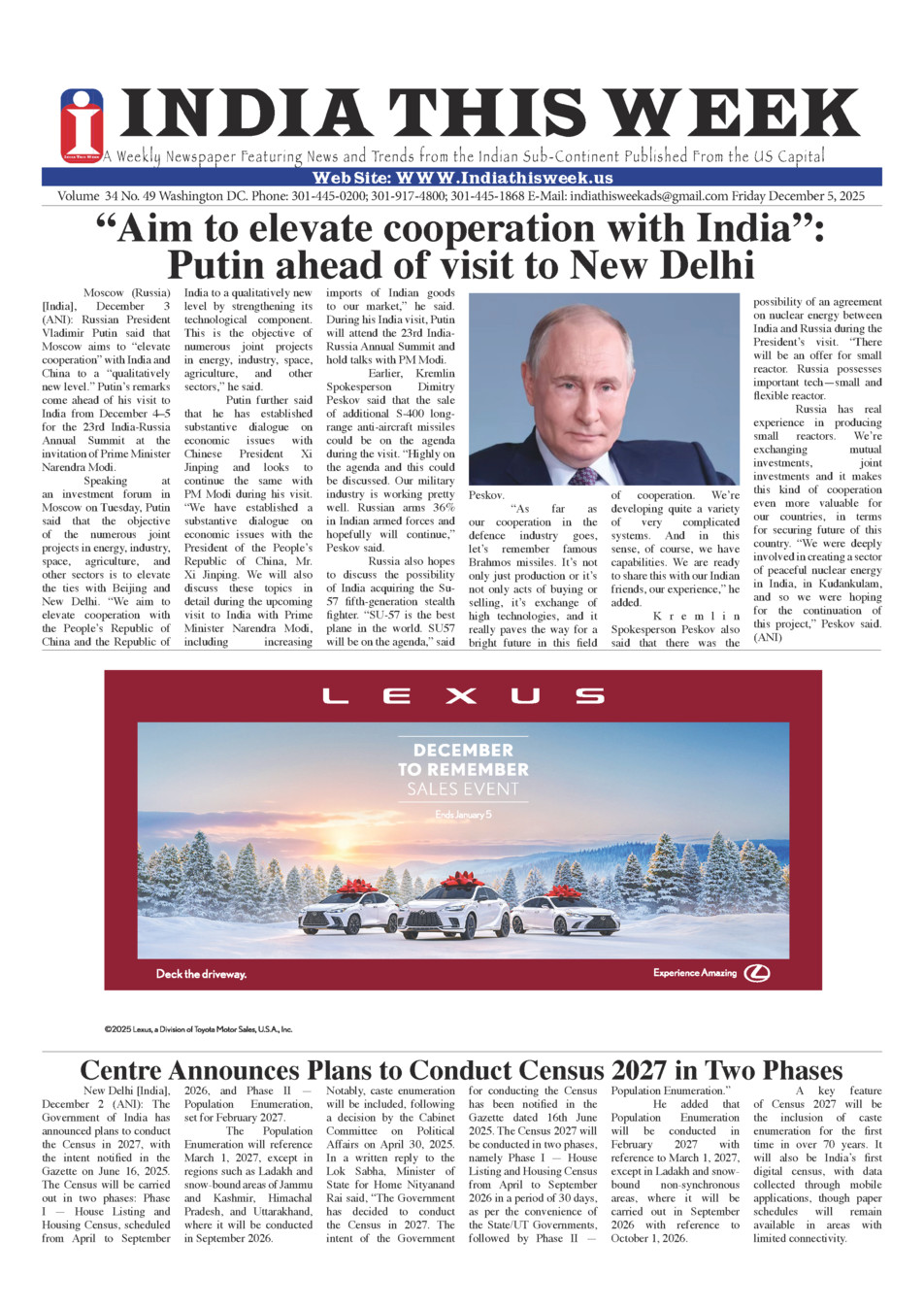
India This Week — Highlights from December 5, 2025: Global diplomacy, domestic governance, and civic discourse
Abstract
The edition captures a broad spectrum of contemporary developments spanning high‑level international diplomacy, domestic political dynamics, and socio‑cultural reflections. Prominent among the foreign affairs narrative is President Vladimir Putin’s emphasis on deepening strategic cooperation with India and China as he prepared to participate in the 23rd India‑Russia Annual Summit in New Delhi. The Kremlin’s messaging underscored efforts to elevate technological cooperation and economic dialogue with both New Delhi and Beijing, signaling a shared agenda across energy, industry, space, agriculture, and defense. This framing anticipates concrete discussions with Prime Minister Narendra Modi during the visit, including prospects for greater Indian export engagement with Russia and a continued dialogue on advanced military technologies and peaceful nuclear cooperation. (Page 1)
In parallel, Russian officials signaled that the summit could explore a broader defense and technology partnership, highlighting the potential for expanded arms cooperation—such as air defense systems and fourth‑generation platforms—alongside assurances of ongoing arms production and technology transfer. The discourse also touched on Kudankulam’s civil nuclear energy program and Russia’s willingness to advance mutually beneficial energy ventures, reflecting a multi‑layered framework for bilateral collaboration that combines strategic security with civilian energy projects. (Page 1)
Turning to census governance, India announced plans to conduct Census 2027 in two phases: a House Listing and Housing Census in 2026, followed by Population Enumeration in early 2027, with March 1, 2027 as the reference date. The plan also marks the first time caste enumeration will be included in the census, a historic shift aimed at furnishing richer social data. The process will be digital‑driven through mobile applications, while keeping paper schedules available where connectivity is limited. A pre‑test was conducted in late 2025 to validate digital systems and survey methodologies, building on lessons from the 2021 census delayed by the pandemic. (Page 2)
On the political front in the United States, the article profiles Sharanjit Singh Thind, a Republican‑leaning candidate for New York’s 18th Congressional District who is positioning himself as a catalyst for job creation in the Hudson Valley. Thind’s platform centers on safeguarding employment in the face of AI disruption, demanding accountability from large tech and financial firms, and leveraging tourism to spur local growth. With an MBA and journalism credentials, his career spans advertising, media, governance roles, and public‑sector advisory work. He has framed his campaign as a practical effort to translate business acumen into legislative impact, including a strategy for mobilizing small donors and self‑funding initial efforts. (Page 3)
The domestic political beat also covers the National Herald matter in India, where the Delhi Police’s Economic Offences Wing filed a fresh FIR naming senior Congress leaders in a money‑laundering case linked to the Associated Journals Limited (AJL). The legal process moved in the backdrop of ongoing scrutiny by the Enforcement Directorate, with court proceedings focusing on cognizance under anti‑money‑laundering statutes. Party leadership framed the development as political vendetta, while allies argued for transparency and due process. The episode underscores how corruption probes intersect with electoral politics and media ownership concerns. (Page 3)
Another thread tracks parliamentary disruption and procedural debates around electoral reforms. The INDIA bloc signaled continued protests and demanded a substantive debate on the Special Intensive Revision (SIR) of voter lists, as the government prepared for a set of legislative business items. Lawmakers pressed for parliamentary discussion on ballot integrity and privacy implications, while the government stressed the administrative character of SIR and urged a focus on constructive dialogue rather than confrontation. The DoT’s Sanchar Saathi app directive, requiring pre‑installation on devices, emerged as a flashpoint in privacy and surveillance debates, with opposition figures portraying it as an overreach and proponents arguing it would curb fraud and protect consumers. (Page 4)
In parliamentary precincts, both chambers observed a mix of adjournments and planned discussions. The Business Advisory Committee allotted time for commemorating the 150th anniversary of the national song and for deliberations on election reforms, signaling an intent to channel debate into a structured schedule rather than ad hoc protests. Floor leaders sought to balance ceremonial occasions with substantive reform conversations, while some opposition voices characterized the revisions as overbearing on citizens’ rights. The overall tempo suggested a high‑stakes winter session defined by electoral governance debates and the politics of rulemaking. (Page 4)
The international front also revisited the contours of the Ukraine crisis. Putin warned Europe about risking direct military escalation if diplomatic efforts failed, while noting that Russia did not seek a broader confrontation but would respond decisively should Western states harden their stance. Reported conversations among U.S. officials and Moscow pointed toward ongoing discussions about a comprehensive peace framework, including a revised 28‑point proposal and considerations around maritime routes and port security affecting global trade. The reporting emphasized the fragility of maritime chokepoints and the potential for renewed hostilities if negotiations stall. (Page 5)
A creative interlude appears in a piece titled The Poetic Pen, in which a prose poem narrates an episode of a baby elephant and her mother struggling in a marsh and being rescued by human effort. The narrative layers a survival story with moral reflections on care, resilience, and interspecies compassion. The poem ultimately threads a spiritual resonance, portraying a rescue as emblematic of grace and salvation. While rooted in a natural vignette, the piece invites readers to consider moral responsibilities toward all beings and the value of courage in crisis. (Page 6)
The issue closes with a reflective reminder of personal faith given in the concluding lines, reinforcing the idea that moral guidance and spiritual truth can illuminate public conversation and civic engagement. This closing note sits alongside a brief reaffirmation of the publication’s ethos: it presents diverse perspectives while inviting readers to evaluate information with discernment. Taken together, the week’s coverage spans diplomacy, governance, civic rights, and moral reflection, offering readers a multifaceted snapshot of transnational and domestic currents affecting the Indian diaspora and beyond. (Page 7)