India This Week~November 28, 2025
India This Week~November 28, 2025
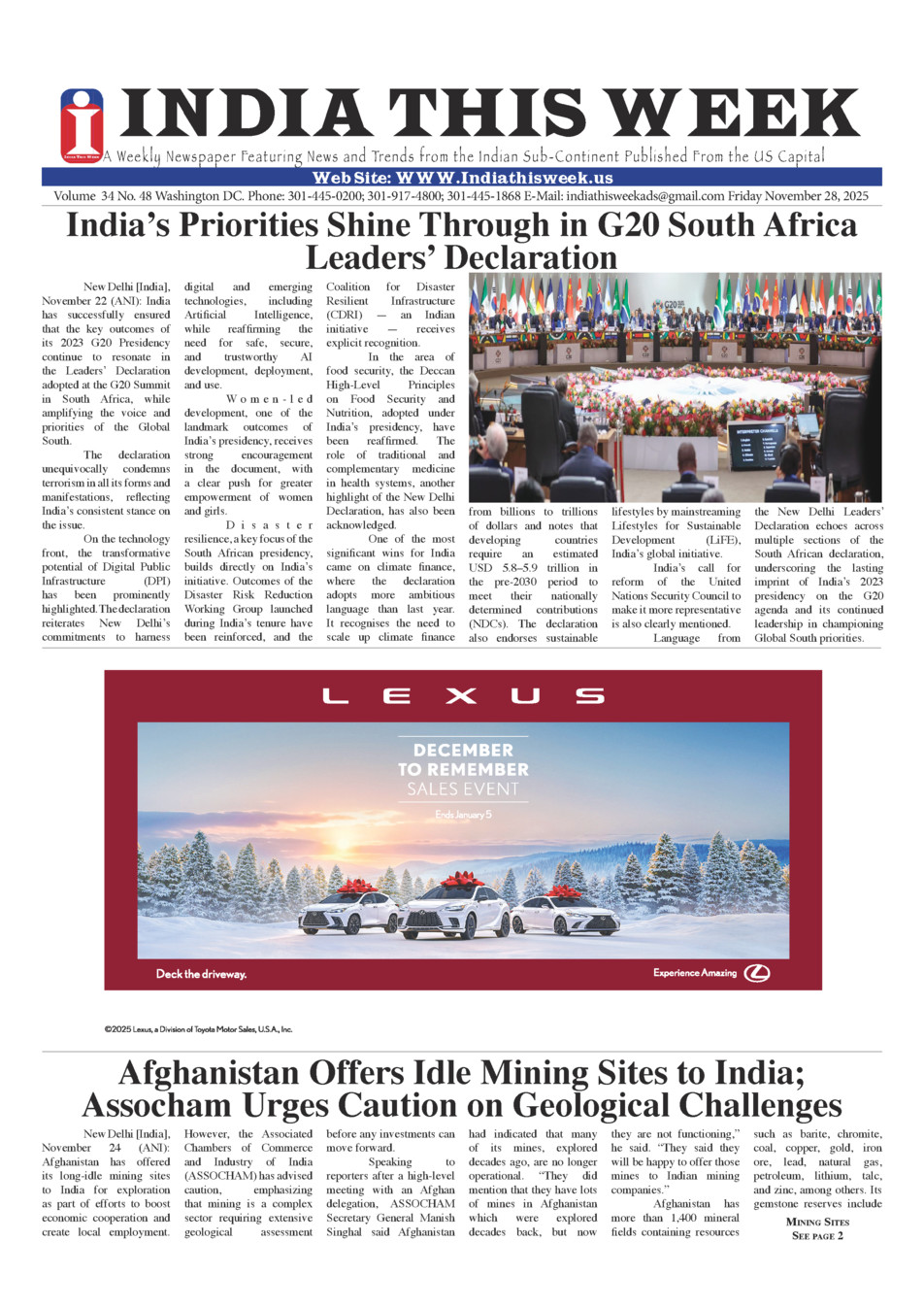
India This Week — A Comprehensive Overview of November 28, 2025: G20 Legacies, Regional Developments, and Global Connections
Context and overarching themes: tracing India’s imprint on global agendas and regional partnerships
The issue presents a mosaic of threads that together reflect how India positions itself on the world stage while engaging with neighbors and partners. It highlights how India’s recent diplomacy continues to shape multilateral outcomes, from the G20 fold to regional economic opportunities, and how domestic institutions—whether in the judiciary, security agencies, or space program—are framed as engines of national development. The coverage also demonstrates the journal’s aim of connecting policy discourse with on‑the‑ground events, whether in New Delhi, Washington, or Kabul, and it foregrounds the interplay between strategic aspirations and practical implementation. In short, the issue reads as a compact briefing on how India seeks to translate its global ambitions into tangible outcomes for citizens, businesses, and international collaborators. (Page 1)
At the heart of the narrative is a continuity claim: the 2023 G20 presidency’s priorities continue to reverberate under a new global configuration centered on the Global South, sustainable development, and digital transformation. The Leaders’ Declaration emerging from the South Africa summit is treated as a conduit through which India’s priorities—terrorism condemnation, technology-enabled development, women’s empowerment, climate action, and reforms in global governance—are kept alive and amplified. This framing suggests a long arc rather than episodic wins, underscoring how one presidency can seed a durable agenda that subsequent presidencies, including the one in South Africa, can carry forward, broaden, and adapt to evolving geopolitical realities. (Page 1)
G20 South Africa Declaration: India’s priorities echoed, with emphasis on security, technology, and inclusive growth
The report outlines how the Leaders’ Declaration in the South Africa G20 forum reinforces the core tenets that India advanced during its own presidency, especially the relentless stance against terrorism in all forms. This consistent emphasis signals to readers that New Delhi regards security as inseparable from development and technology policy—recognizing that safe digital ecosystems are essential to economic inclusion and public trust. The declaration’s attention to Digital Public Infrastructure (DPI) and the responsible development and deployment of artificial intelligence highlights a careful balancing act: India seeks to harness cutting-edge technologies while insisting on safety, security, and trustworthy applications that protect privacy and minimize risks. (Page 2)
A notable thread is the reaffirmation of efforts to elevate women and girls as central agents of development. The document explicitly supports women-led development as a transformative force and commits to expanding opportunities in education, entrepreneurship, healthcare, and public decision-making. This focus aligns with broader global development narratives that view gender equality as a catalyst for resilience, innovation, and sustainable prosperity. The same section also foregrounds disaster resilience, drawing a throughline from India’s own initiatives in climate risk reduction to the broader coalition-building under the South African presidency. (Page 2)
Disaster Risk Reduction (DRR) and the Coalition for Disaster Resilient Infrastructure (CDRI)—a distinctly Indian initiative—receive explicit recognition in the declaration. This signals not only a continuity of India’s leadership in resilience planning but also an invitation for global partners to adopt the same framework, potentially expanding the scale and scope of DRR investments. Parallel to these themes, the document nods to the Deccan High-Level Principles on Food Security and Nutrition—another product of India’s presidency—that reinforces a shared agenda on safeguarding nutrition and stability in food systems, particularly in climate-affected regions. (Page 3)
The declaration also spotlights the role of traditional and complementary medicine within health systems, recognizing its value alongside modern biomedical approaches. This acknowledgment fits into a broader trend of integrating diverse medical traditions into national health architectures and international cooperation agendas. On climate finance, the declaration advances sharper language, signaling a shift toward mobilizing trillions of dollars to meet the climate ambitions of developing countries, and it places explicit numbers on the financing gap that must be bridged to fulfill nationally determined contributions. The LiFE initiative (Lifestyles for Sustainable Development) is mainstreamed, situating behavior change and sustainable living as essential components of global climate strategy. (Page 3)
Another critical dimension concerns reform of the United Nations Security Council to achieve broader representation. The declaration’s call for greater inclusivity in global governance is framed as a continuation of India’s long-standing push for a more representative and democratic international order. The language across the New Delhi Leaders’ Declaration and the South Africa outcome reinforces the sense that many of India’s foundational aims—global south leadership, climate action, inclusive technology governance, and a more equitable geopolitical architecture—continue to shape the trajectory of multilateralism. (Page 4)
Afghanistan: idle mining sites offered, with cautious caveats from ASSOCHAM on geological and operational realities
A separate briefing covers Afghanistan’s invitation to Indian enterprises to explore long‑idle mining sites, signaling a strategic opportunity to boost economic ties and generate local employment. The frank caveats offered by the Associated Chambers of Commerce and Industry of India (ASSOCHAM) emphasize that mining remains a technically demanding sector requiring thorough geological assessments, risk analysis, and careful project planning before investments can proceed. The tone is one of guarded optimism: the Afghan delegation signals willingness to leverage private Indian expertise, while Indian business voices stress that the path from invitation to extraction is neither quick nor simple. (Page 2)
According to industry representatives, a number of Afghan mines have historical data and exploration histories that suggest potential resources, including minerals such as barite, chromite, coal, copper, gold, iron ore, lead, natural gas, petroleum, lithium, talc, and zinc, as well as gemstones like emeralds and lapis lazuli. Yet, many of these mines are not currently operational due to decades of interrupted development, security concerns, and the infrastructural demands of modern resource extraction. The dialogue underscores a dual reality: the country’s resource wealth exists on paper and in scattered deposits, but turning that wealth into steady economic growth requires robust governance, transparent regulation, and reliable banking and logistics channels. (Page 3)
Key practical themes emerge in the discussions: the need for geological surveys to establish accurate resource estimates, the requirement to build local value addition capacities, and the importance of smooth banking channels to facilitate cross-border trade. The Afghan side expressed a preference for Indian investment, while stressing that successful collaboration will depend on overcoming logistical and regulatory hurdles, including visa processes for business travel and the creation of a conducive environment for private sector activity. The ASSOCHAM interlocutors stress that a prudent, incremental approach—rooted in solid data and risk management—will maximize the odds that mining partnerships translate into sustainable employment and broader development benefits. (Page 4)
Judiciary and governance: Justice Surya Kant’s oath as the 53rd Chief Justice of India and his stated priorities
The appointment of Justice Surya Kant as the 53rd Chief Justice of India marks a notable moment in the judiciary’s ongoing effort to address massive case pendency and to modernize dispute resolution. The oath was administered by the President at Rashtrapati Bhavan, underscoring the ceremonial gravity of the moment as well as the constitutional responsibilities that accompany the role. Justice Kant’s background spans constitutional, service, and civil law, with prior service as Advocate General of Haryana and later elevation to the Supreme Court. His career trajectory reflects a blend of public service, legal scholarship, and administrative leadership. (Page 5)
Justice Kant has explicitly identified reducing the backlog of cases as a central priority. He has highlighted the importance of addressing arrears both at the level of individual courts and in a coordinated, pan-India manner. He has also emphasized mediation as a “game changer” that can provide faster, off‑court dispute resolution and relieve pressure on courts. The challenge, he notes, lies in the complexity of cases, with thousands of matters awaiting decisions from larger benches, and this dynamic affects both High Courts and District Courts. The oath ceremony was notable for its international presence, with a broad delegation from multiple countries in attendance, signaling the global interest in India’s judicial leadership and its potential impact on regional legal cooperation. (Page 5)
Looking ahead, Justice Kant’s tenure—set to last until his retirement—will likely focus on practical steps to streamline caseload management, expand mediation infrastructure, and strengthen access to justice across diverse segments of Indian society. His remarks to legal journalists and his public statements reflect a belief that efficiency gains can be achieved through procedural reforms, improved case management, and a renewed emphasis on effective coordination among different levels of the judiciary. The narrative around his appointment frames the judiciary not simply as a passive arbiter but as an active force in enabling inclusive growth and reliable governance. (Page 6)
Law enforcement, cybercrime, and the fight against illicit transnational operations: CBI busts in Lucknow
The Central Bureau of Investigation (CBI) announced the arrest of a key fugitive connected to a transnational cybercrime network and the simultaneous disruption of an illegal call center in Lucknow that allegedly targeted U.S. nationals. The operative, identified as Vikas Kumar Nimar, is said to have played a central role in establishing and running the illicit call centers associated with VC Infrometrix Pvt. Ltd. The case trace links the Lucknow operation to earlier seizures in Pune, Hyderabad, and Visakhapatnam, illustrating a broader criminal footprint across multiple Indian cities. (Page 3)
Crucial investigative steps are outlined: the agency secured a court warrant to locate and arrest the fugitive, the operation involved searches at a range of locations tied to the accused, and the seizure of digital evidence—through laptops and other devices—played a key part in substantiating the criminal activity. The CBI indicates that the investigations are ongoing, underscoring the persistent and evolving nature of cybercrime and the challenges law enforcement faces in curbing it. The dissemination of details—such as the number of laptops recovered and the financial means purportedly used by the network—serves both as a public accountability measure and a warning about the scale and sophistication of such operations. (Page 4)
Space, science policy, and strategic partnerships: ISRO’s trajectory and the India–Japan collaboration
The space domain features prominently through statements from ISRO’s leadership about upcoming launches and long‑term programs. The chairman disclosed plans to launch a U.S. communications satellite in the near term using the LVM-3 launch vehicle on a commercial basis, signaling continued engagement with international satellite programs and commercial space activities. He also noted progress on the Gaganyaan program and new missions, including Chandrayaan‑4 with a targeted return mission in 2028 and Chandrayaan‑5 in collaboration with JAXA. These announcements reflect a sustained push to advance India’s space capabilities while expanding international collaboration in both the civil and research arenas. (Page 6)
The ISRO briefing also touched on ongoing cooperative frameworks with Japan, including the joint lunar mission LuPEX and related discussions about robotic arms for space stations, shared satellite launches for scientific purposes, and the potential for joint support of researchers and private sector players from both countries. This emphasis on bilateral and multilateral space collaboration signals a broader strategy of leveraging partnerships to accelerate technology transfer, reduce costs, and create new opportunities across space-related industries. The Japanese delegation’s engagement with UR Rao Satellite Centre facilities underscores the depth of technical collaboration and the mutual interest in advancing lunar exploration and associated scientific frontiers. (Page 6)
Ruminations on society and leadership: the literary insert “Selling Yourself” and its thematic resonance
Interwoven into the issue is a poem by Rajan George that contemplates the moral costs of compromising integrity for wealth or power. The piece cautions against trading one’s authentic self for short‑term gain, highlighting that a life shaped by ethical constancy is more enduring than any glittering prize that can be bought. The poem’s rhythm, metaphors, and imagery invite readers to reflect on the personal consequences of selling out—whether for monetary reward, social status, or political advantage—and it positions adherence to truth, faith, and inner conviction as the antidote to the temptations of expediency. (Page 5)
Beyond the poem’s immediate moral inquiry, the broader takeaway is a call for steadfastness in public life and professional conduct. The author argues that the true measure of leadership lies not in rapid gains or superficial appearances but in the ability to resist mercenary pressures and to stay aligned with enduring values. This reflective interlude complements the more policy‑driven portions of the issue by reminding readers that sustainable progress hinges on the ethical choices of individuals who shape institutions, influence policy, and steer collective action. (Page 7)
Geopolitical and economic interface: executive diplomacy and industrial opportunities in the India–US corridor
Another thread in the issue centers on high‑level diplomacy and economic diplomacy between India and the United States, illustrated by Ambassador Vinay Mohan Kwatra’s engagements with U.S. lawmakers and policy influencers. The ambassador’s public statements on X reveal a thematic emphasis on expanding cooperation in science, technology, AI, and innovation—areas identified as critical to both nations’ growth trajectories. The conversations with representatives and think tanks emphasize a framework of shared priorities: strengthening security, ensuring energy resilience, expanding trade, and nurturing a fair and mutually advantageous trading relationship. (Page 5)
The reporting notes specific conversations with parliamentary and policy figures and references a related initiative—an effort to leverage digital and AI tools, as well as cross‑border collaboration in research and technology—to advance bilateral strategic objectives. The tone suggests a deliberate and ongoing effort to translate diplomatic goodwill into concrete policy outcomes, with a focus on practical mechanisms such as regulatory alignment, investment opportunities, and intergovernmental dialogues that can unlock commercial and research collaborations. (Page 5)
From policy to practice: deploying innovation and people-centric development in a changing world
The compendium’s spirit is to present how ideas translate into actions that affect ordinary lives. The G20 resonance, Afghan mineral potential, judicial reforms, cybercrime deterrence, cultural memory through literature, space collaboration, and people‑to‑people diplomacy all point toward a worldview in which development is inseparable from security, governance, and scientific advance. The issue narrates a trajectory where national priorities—economic diversification, digital inclusion, climate resilience, and strategic partnerships—are pursued through a blend of policy coherence, institutional capacity, and international collaboration. The recurring message is that sustained progress depends on disciplined execution, transparent governance, and a willingness to engage with diverse partners in pursuit of common goals. (Page 7)
Conclusion: stitching together a multi‑layered agenda for a future‑facing India
Taken together, the articles convey a calculated, multi‑faceted approach to national development that seeks to balance ambition with pragmatism. The G20 legacy remains central, but it is complemented by concrete economic opportunities abroad, domestic institutional strengthening, and a proactive stance on science and technology that aims to multiply India’s influence while delivering tangible benefits to citizens. The pieces about Afghanistan, the judiciary, cybercrime enforcement, and space collaboration illustrate an orientation toward proactive engagement across borders, with risk management, capacity-building, and sustainable development at the core. The journal’s synthesis of these diverse strands paints a portrait of India as a country poised to test new ideas, expand its international footprint, and translate strategic dialogue into practical outcomes that enhance resilience, growth, and inclusive progress for a broad spectrum of stakeholders. (Page 6)