India This Week~November 21, 2025
India This Week~November 21, 2025
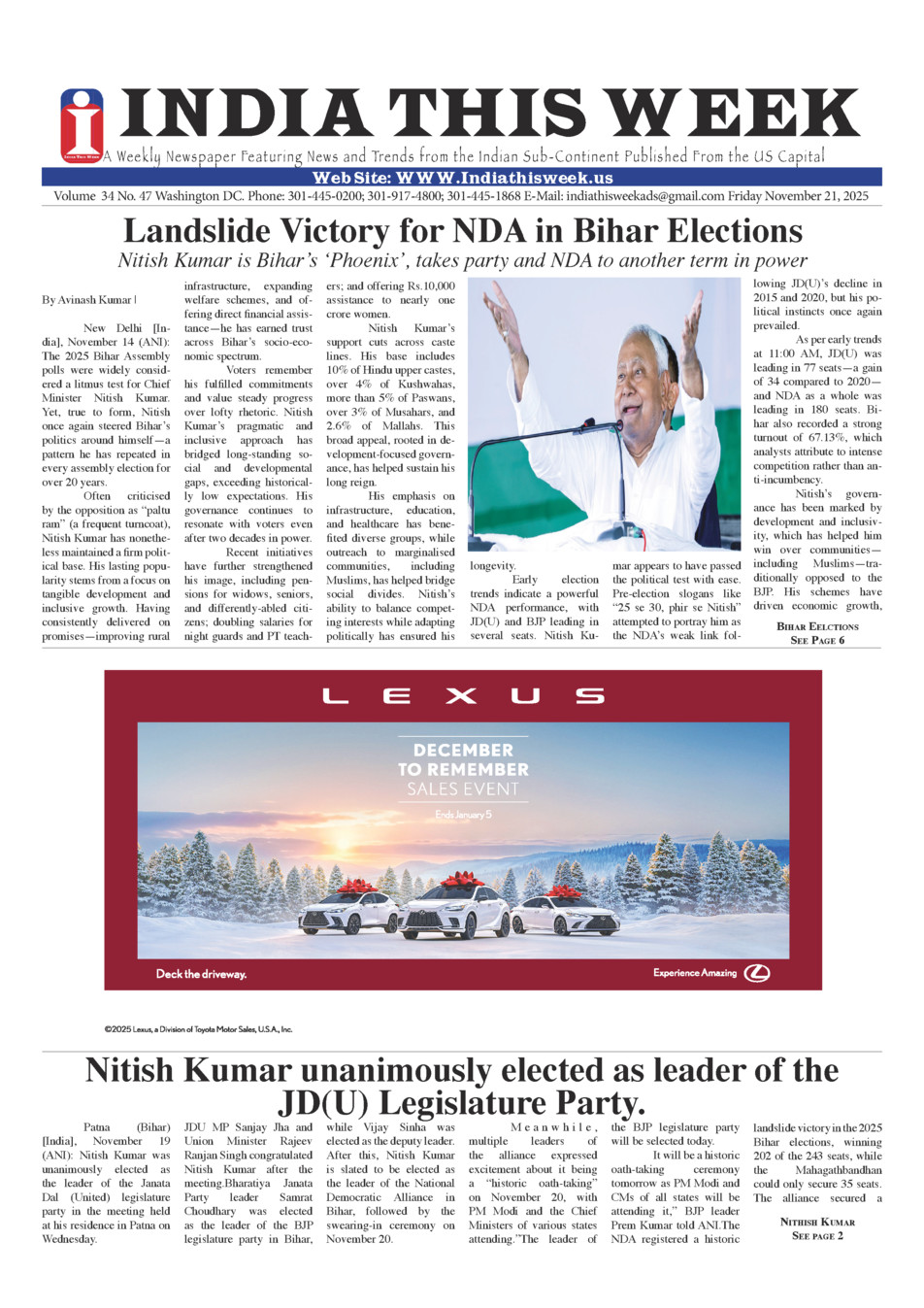
Landslide Victory in Bihar: NDA's Dominant Win and Nitish Kumar's Leadership — India This Week (Nov 21, 2025)
Executive Summary
The 2025 Bihar legislative polls culminated in a sweeping win for the National Democratic Alliance, signaling a robust public endorsement of governance-focused progress over rhetoric. The NDA captured the vast majority of seats, securing 202 of 243, while the Mahagathbandhan trailed with a markedly smaller tally. Voter participation was exceptionally high at 67.13%, a turnout analysts attribute to a fiercely competitive battle rather than broad anti-incumbency sentiment. Early indicators around midday pointed to the NDA’s momentum, withJD(U) posting gains alongside other alliance partners, suggesting a powerful, unified mandate to advance development-oriented policies. The results underscore a political climate in which durable delivery—rather than dramatic upheaval—appears to have resonated with a broad cross-section of voters. (Page 1)
Nitish Kumar emerges from the election as the central architect behind Bihar’s political renewal, praised for knitting together diverse social groups through a record of tangible development and inclusive governance. Supporters highlight a suite of welfare measures and infrastructure investments—ranging from rural development and healthcare to direct financial assistance—that have broadened his appeal across communities, including segments traditionally wary of major parties. Despite persistent criticism from opponents about political flip-floppery, Kumar’s track record of implementing welfare schemes and steady progress has solidified a reputation for pragmatic, people-centered leadership. His long tenure—spanning more than two decades in governance—appears to have built trust that transcends shifting political alignments. (Page 1)
Examining the NDA’s composition reveals a coalition built on a mix of core and regional partners. The Bharatiya Janata Party captured a substantial share of seats, complemented by JD(U)’s strong showing, with smaller allies contributing to the coalition’s overall dominance. The opposition’s seat distribution reflects a fragmented challenge to the NDA, with Rashtriya Janata Dal, Congress, CPI(M), and other outfits garnering comparatively fewer seats. The electoral dynamics were shaped by a two-phase process in early November, contributing to a high turnout and a perception of a broad, cross-caste mandate that tempered traditional political fault lines. (Page 2)
As the results stabilized, party leaders framed the outcome as a testament to unity within a large coalition and the ability to deliver on development promises. Nitish Kumar publicly thanked NDA partners, framing the victory as a culmination of collaborative effort across diverse groups. Prime Minister Narendra Modi and other NDA stalwarts described the mandate as an affirmation of good governance, social welfare, and public service. The presence and involvement of partners like LJP (RV) were noted as part of maintaining a cohesive, broad-based administration ready to govern with renewed vigor. The ceremony surrounding the oath-taking underscored the ceremonial weight of a milestone that parties cited as historic in Bihar’s political history. (Page 3)
In parallel national discourse, Prime Minister Modi highlighted agricultural reforms and the country’s path toward natural farming, framing it as a strategic pivot for India’s future. He pointed to a significant expansion of agricultural exports and the continued delivery of PM-Kisan benefits to millions of farmers. The South India Natural Farming Summit, held in Coimbatore, showcased a bold push toward sustainable, climate-smart farming with a focus on biodiversity, organic inputs, and market linkages for farmer-producer groups. The event drew tens of thousands of participants, signaling a nationwide shift toward modern, scalable agricultural practices and a more resilient rural economy. (Page 3)
Beyond the electoral drama, Bihar’s political narrative benefits from a deeper historical lens on Nitish Kumar’s career. Influenced by early reformist and socialist currents, he navigated the JP movement and subsequent party realignments to become a defining figure in Bihar’s governance. His trajectory—from a JP-era activist to prominent roles within the Janata Party and later as Railway Minister—emphasized social welfare and accessibility for marginalized groups. Since 2005, Kumar has maintained the chief ministership with rare interruptions, a pattern that reflects his ability to balance competing interests and sustain a broad-based mandate. This context helps explain the durability of his leadership and the NDA’s capacity to present a united front in 2025. (Page 4)
The security dimension remains a critical thread in the national conversation. Investigative authorities disclosed diaries linked to past Delhi blast cases, revealing coded references and potential targets linked to a broader conspiracy. The material pointed to a tightly coordinated scheme involving multiple locations and vehicles, with connections to individuals previously associated with other attacks. Notably, investigators confirmed DNA evidence tying one suspect to the Red Fort incident, which had claimed multiple lives, underscoring ongoing threats and the need for vigilant counterterrorism measures. The broader network under scrutiny suggests that investigators are mapping a wider organizational canvas that could inform future preventive actions. (Page 5)
Another strand of public-interest reporting highlights community-level innovation in water management. In Vedancha village, Banaskantha district, residents developed a cost-effective greywater treatment system that now serves thousands of households. The plant, financed with modest public support, treats wastewater for irrigation, groundwater recharge, and livestock needs, delivering ecological and economic dividends. The project epitomizes how small-scale, locally led initiatives can yield transformative outcomes for sanitation, agriculture, and livelihoods, earning national recognition through a prominent innovation award. The success implies potential replication in other rural communities seeking sustainable solutions. (Page 6)
The cultural section of this issue offers a philosophical counterpoint through The Poetic Pen, which examines the tension between chasing pleasures and pursuing a meaningful life. The poem argues that a life oriented exclusively toward ego-driven gratification lacks lasting fulfillment, while acts of service and ethical living cultivate genuine joy and a sense of purpose. It invites readers to reflect on the enduring value of helping others and contributing to something greater than oneself, framing meaning as something that endures beyond personal gratification and temporal circumstances. (Page 7)
Taken together, the pieces in this issue paint a portrait of a country navigating a complex blend of electoral dynamics, developmental aspirations, security concerns, and ethical reflections. Bihar’s political realignment foregrounds governance and inclusive growth as central narratives, while the farming and sustainability stories point toward a longer-term transition to resilient, people-centered livelihoods. The overarching message invites readers to consider how state- and national-level choices translate into daily realities—from farming practices and rural infrastructure to security resilience and community-driven environmental innovations. (Page 8)
Finally, the issue acknowledges the multiplicity of voices shaping public discourse—from political leaders and policymakers to poets and community organizers. This mosaic underscores that progress in a diverse democracy emerges when development is matched with inclusivity, accountability, and a shared commitment to ensuring a dignified standard of living for all citizens. The pages also remind readers to stay informed about evolving policies, social programs, and local initiatives that collectively influence the texture of everyday life across India. (Page 8)