Quantum TechDocs IETM suite for Shipbuilding and Complex Missile systems
Quantum TechDocs IETM suite for Shipbuilding and Complex Missile systems
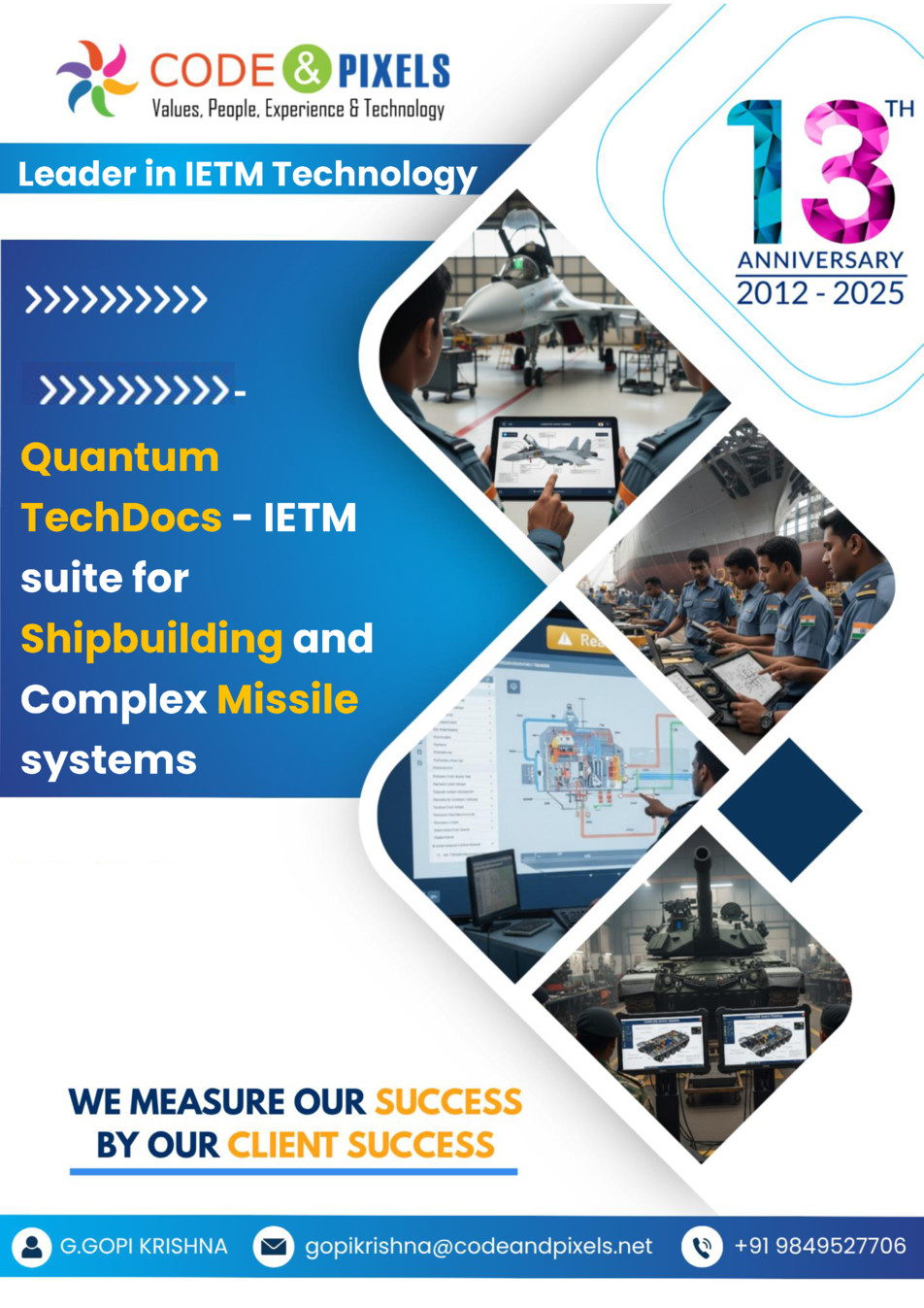
Meta Title: Quantum TechDocs IETM Suite for Shipbuilding and Complex Missile Systems — A comprehensive, user-centered IETM solution transforming intricate defence manuals into a training and operational support ecosystem for shipyards, missile programs, and multi-OEM environments.
Summary: Quantum TechDocs IETM Suite for Shipbuilding and Complex Missile Systems
Overview: A purpose-built IETM beyond simple documentation
Interactive Electronic Technical Manuals (IETMs) are often misunderstood as little more than a digital repository of manuals. In reality, they should function as a cohesive training and operational support framework that stays relevant long after initial handovers. The Quantum TechDocs approach embodies this philosophy, drawing on more than a decade and a half of hands-on IETM work across diverse defence domains. With over a hundred IETM implementations delivered for the Indian Army, Navy, and Air Force, the emphasis is on designing for end users first, so the system becomes an everyday resource rather than a forgotten file. (Page 2)
The core message is clear: an IETM is not a static document collection. When conceived with user workflows in mind, it becomes a dynamic educational and decision-support tool that enhances readiness and mission success. This means creating a digital library that is easy to search, navigate, and cross-reference, while also serving as a training aid and a real-time technical assistant. The ultimate payoff is operational efficiency: faster, more confident decisions under pressure, reduced downtime, and a lower cognitive load for personnel in the field. (Page 2)
From the outset, the goal is to blend engineering excellence with practical usability. A well-crafted IETM supports everyday actions—troubleshooting, maintenance planning, and procedural guidance—without forcing users to hunt through disparate sources. It becomes a living, evolving platform that adapts to new equipment, procedures, and lessons learned, continuously enhancing its value over the lifecycle of a platform or system. The experience is shaped by years of defence project work, ensuring that the solution remains relevant across ships, missiles, and complex multi-OEM ecosystems. (Page 2)
The Reality Today: Common pitfalls of IETMs in defence projects
In many defence programmes, IETMs end up as an assortment of deliverables that fail to deliver real-time value. They can be handed over on physical media, counted as a project line item, or filed away as a routine document set that technicians rarely consult during operations. This disconnect means the true potential of an IETM is left untapped, and the system loses its capacity to support active maintenance, troubleshooting, and training. The risk is that a valuable knowledge resource becomes just another storage burden. (Page 2)
Consequently, organisations often miss the opportunity to convert scattered PDFs, maintenance manuals, and multimedia content into a single, searchable, user-friendly platform. When the IETM is not aligned with how end users work in the field, it fails to speed up decision making, hindered by slow searches, fragmented navigation, and incompatible media. The result is a tool that looks impressive on paper but delivers limited benefits in practice, especially under the pressure of real-world scenarios where every second counts. (Page 2)
What an IETM Is Meant to Be: A multi-faceted asset for training, reference, and decision support
A properly designed IETM acts as a digital library with layered capabilities. It serves as a training aid to accelerate proficiency, a technical assistant to inform correct procedures, and a decision-support tool that helps operators make confident choices during faults or malfunctions. The design principle is to enable rapid access to information—be it procedures, troubleshooting steps, drawings, videos, or checklists—in a single, unified interface. When the system is organized around the user’s needs, it transforms how maintenance and operation teams perform their tasks. (Page 2)
Key features include instantaneous search across the entire database and attached PDFs, one-click access to integrated resources, and a streamlined path from symptom to solution. This reduces the time spent looking for manuals and eliminates the need to juggle multiple sources. The IETM becomes a reliable companion in the field, delivering relevant content at the moment of need and supporting faster, more confident decision making under pressure. (Page 2)
Beyond access to content, an effective IETM consolidates procedures, diagnostics, drawings, multimedia, and compliance documents in a coherent, navigable framework. It is designed to be easy to update and maintain, with an intuitive interface that reduces the learning curve for new users. In short, it is a practical ecosystem for training, reference, and operational guidance that proves its value during critical events and routine maintenance alike. (Page 2)
Case Study: Shipbuilding — Managing complexity with a unified IETM
Shipbuilding represents one of the most intricate integration challenges in defence, integrating hull structures, propulsion, power distribution, navigation, communication, weapon systems, HVAC, hydraulics, and safety equipment. Traditional manuals can’t keep up with the complexity or the lifecycle demands of a modern vessel. An IETM built with the right framework can unify the knowledge across this vast landscape, supporting shipyards, crews, maintainers, and lifecycle teams throughout the vessel’s life. (Page 3)
A warship is not the output of a single vendor; it is an orchestration of hundreds of components sourced from multiple Original Equipment Manufacturers (OEMs). A typical vessel may involve 120+ OEMs, 200+ equipment and subsystem elements, and 1,000+ manuals and supporting documents. This scale creates a documentation management challenge that is difficult to address with conventional approaches. An effective IETM captures all of this content and presents it in a consistent, accessible format, enabling fast retrieval and straightforward cross-referencing. (Page 3)
Consolidation and standardization: A scalable framework for shipyards
Isolating and converting only a subset of major manuals rarely achieves standardized maintenance and reliable onboarding. Faults and failures can occur in any system, so thorough documentation is essential for effective onboard maintenance, troubleshooting, and readiness. If an IETM cannot support all components, its usefulness is inherently limited. The solution lies in a structured, scalable framework that can systematically organize documentation for hundreds of systems, provide a uniform structure, and ensure easy navigation. (Page 4)
Code and Pixels developed such a framework tailored for shipyards. The design emphasizes single-click access, comprehensive organization of all equipment documentation, and a uniform structure across hundreds of systems. The user interface is friendly and intuitive, enabling straightforward updates and ongoing management. AI integration adds another layer of support, enhancing searchability, diagnostics, and proactive guidance. This approach embodies the concept of “One vessel, hundreds of systems, one IETM” through the Quantum TechDocs platform. (Page 4)
Case Study: Missile System Projects — Scaling to dozens of OEMs and thousands of documents
Missile systems exemplify complexity: subsystems such as guidance, propulsion, firing circuits, electronics, communications, warhead integration, and launch handling equipment require synchronized maintenance and precise documentation. The IETM must support real-time guidance, historical records, and compliance documents across these diverse components. An effective IETM facilitates faster troubleshooting, standardization of maintenance practices, and access to platform-specific digital documents—reducing the time and effort needed to diagnose and fix issues. (Page 5)
In a typical missile programme, teams contend with thousands of manuals and tens of thousands of pages, plus numerous drawings, multimedia files, test reports, and reference documents sourced from multiple OEMs. Centralising and standardising this disparate content is a complex, resource-intensive endeavour. The Quantum TechDocs solution addresses this challenge by providing a robust framework to consolidate, structure, and present all these materials in a user-friendly, interactive format. This enables technicians to locate relevant information quickly, follow validated procedures, and maintain consistency across maintenance activities. (Page 5)
The value proposition extends beyond documentation alone. By delivering a unified system that standardizes content across subsystems and OEMs, the IETM becomes a scalable asset that supports lifecycle management, ensures interoperability, and reduces the risk of process drift. The resulting platform helps maintain mission readiness and reduces the training burden on personnel who must navigate complex, multi-vendor configurations. (Page 5)
Why experience matters: A proven approach to IETM delivery
IETM delivery is not a one-time software handover; it is an ongoing process that requires a deep understanding of defence workflows, documentation architecture, and the realities of on-ground operations. Success depends on intelligently structuring documentation to reflect how end users work, designing interfaces that prioritize the user experience, and aligning the solution with operational constraints and timelines. At Code and Pixels, the team brings 15 years of learning and more than 100 defence IETM projects to bear on each new engagement, translating past lessons into practical improvements for new programmes. (Page 5)
The human-centric approach is central: the goal is to empower soldiers and technicians with fast, reliable access to the right information when it matters most. This means anticipating common failure modes, mapping common procedures to intuitive navigation paths, and ensuring that critical content remains accessible even in challenging environments with limited connectivity or rugged hardware. The emphasis on usability, reliability, and operational reality underpins every decision in the development and deployment of Quantum TechDocs. (Page 5)
Conclusion: The case for a professionally engineered IETM that serves the mission
A well-engineered IETM brings clarity during moments of uncertainty, provides answers during breakdowns, and instills confidence in mission-critical situations. The emphasis is on choosing expertise and experience, prioritizing usability, and ensuring that the system truly empowers the soldier rather than becoming yet another unused file. Manuals convey information; an effective IETM delivers actionable answers, guiding operators from symptoms to structured, verified procedures and ultimately to successful outcomes. (Page 6)
The overarching takeaway is that IETMs should not be treated as peripheral project artifacts. When designed with a user-focused mindset, they become essential operational tools that streamline maintenance, training, and decision-making. The goal is to deliver not only software but a robust ecosystem that persists beyond initial deployment, adapts to evolving needs, and remains a reliable partner throughout the lifecycle of complex defence platforms. (Page 6)
Learn More or Request a Demo: How to engage with Quantum TechDocs
For organisations seeking a path to modern, scalable IETMs, the next step is to explore how Quantum TechDocs can translate defence knowledge into a practical, field-ready platform. The offering emphasizes live demonstrations, tailored use-case evaluations, and a collaborative approach to align the system with your specific shipyard or missile programme needs. The emphasis remains on usability, rapid access to critical information, and measurable improvements in maintenance and readiness. (Page 6)
To initiate discussion or request a demonstration, potential clients can connect through the established channels: the official website, the IETM contact address, and a direct phone line. This ensures a streamlined process for scoping, onboarding, and deploying a tailored IETM solution that scales with your programme. The engagement model is built around collaboration, transparency, and a shared commitment to enhancing operational efficiency and soldier readiness. (Page 6)
Final reflections: The path forward with Code and Pixels
In summary, Quantum TechDocs embodies a philosophy of turning complex, multi-OEM documentation into a usable, value-driven ecosystem that supports training, reference, and real-time decision making. The approach draws on extensive experience, a deep understanding of defence workflows, and a steadfast focus on the end user. This combination enables shipyards and missile programmes to achieve standardized documentation, accelerated onboarding, reduced maintenance time, and greater mission assurance. (Page 6)
As defence projects continue to grow in scope and complexity, the need for an IETM that truly delivers on its promise becomes more evident. The Quantum TechDocs platform offers a pragmatic, scalable solution designed to keep pace with evolving equipment, procedures, and operational requirements. For teams seeking a durable, user-friendly IETM that supports both training and live operation, this approach represents a compelling path forward. (Page 6)
Contact details for further information, demonstration requests, or collaboration opportunities are provided through Code and Pixels’ official channels. The team welcomes inquiries aimed at tailoring the IETM to specific platforms, integration needs, and lifecycle requirements, with a commitment to delivering measurable improvements in readiness and performance. (Page 6)
Ultimately, the objective is to ensure that IETMs are not merely digital documents but active enablers of mission success. By combining a structured framework, user-centric design, and real-world expertise, Quantum TechDocs aims to transform how defence organisations manage, access, and apply technical knowledge in complex environments. (Page 6)
Quantum TechDocs IETM suite for Shipbuilding and Complex Missile systems - Flipbook by Fleepit