Magazine 24-25
Magazine 24-25
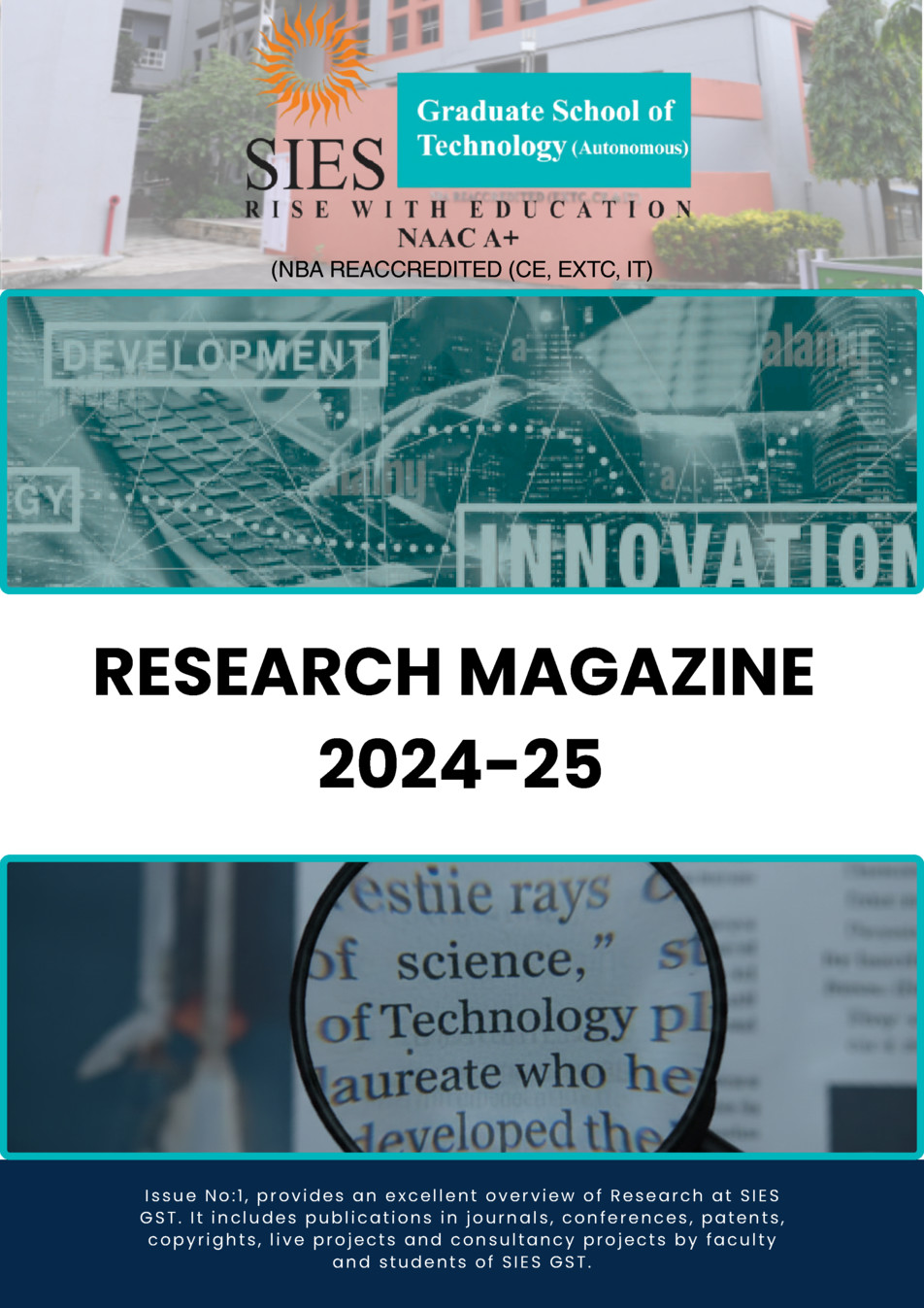
SIES GST Research Magazine 2024-25: A Comprehensive Overview of Journal Publications, Patents, Live Projects and Industry-Driven Innovation Across CE, EXTC, IT
Scope and Purpose
This 2024-25 issue of the SIES GST Research Magazine provides a thorough snapshot of the institution’s scholarly activity across a broad spectrum of departments, including civil engineering, electronics and communication, and information technology, while reflecting the NBA reaccreditation framework. The edition functions as a living archive that aggregates the research outputs produced by both faculty and students, ranging from journal articles and conference papers to intellectual property claims, live projects, and consultancy engagements. It is designed not only to showcase theoretical advances but also to demonstrate practical engagement with industry, policymakers, and community stakeholders. By presenting a curated set of publications, live projects, and consultancy efforts, the magazine communicates how SIES GST translates inquiry into tangible innovation and knowledge transfer. The document serves multiple audiences: researchers seeking references and potential collaborators, evaluators and accreditors assessing quality and impact, and prospective students seeking insight into the institution’s research culture. The organization of content emphasizes accessibility and discoverability, with entries that map to venues, indexing status, and, where available, page numbers. (Page 1)
At its core, the issue acts as a comprehensive record of scholarly production, illustrating how the college integrates research across disciplines with instructional and societal goals. It positions the institution as an active hub of inquiry where faculty mentors and student researchers collaborate to advance knowledge, solve real-world problems, and contribute to sustainable development. The compilation also aims to guide readers through the terrain of current research trends, notable venues, and impactful projects, enabling informed engagement with ongoing work. By foregrounding both the breadth of topics and the quality signals associated with indexing and publication venues, the magazine reinforces a narrative of rigorous scholarship coupled with practical relevance. (Page 1)
Indexing, Publication Venues, and Catalog Structure
Within the issue, an explicit index catalogs the scholarly outputs by category and publication venue. Each entry lists the paper title and author roster, the journal or conference name, standard identifiers such as ISSN and DOI, the indexing status (including Scopus, SCI, WoS, UGC CARE, or others), and pagination within the magazine. This structure underscores two core aims: ensuring visibility for each contribution and enabling reliable traceability to external bibliographic databases. The catalog also reveals the breadth of collaboration across disciplines, highlighting co-authorship patterns that span different departments and external partnerships. Moreover, the presence of page numbers for many entries enhances navigability, allowing readers to locate details and supplementary materials with ease. Taken together, the index serves as both a bibliographic registry and a navigational map for SIES GST’s research activity. (Page 2)
Beyond mere listings, the catalog demonstrates how the institute communicates scholarly outputs to a global audience. It aligns titles, venues, and indexing signals with the corresponding research communities, making it simpler for readers to identify relevant work for reading, citation, or collaboration. The index also reflects the institution’s commitment to rigorous documentation, ensuring that every contribution can be verified, accessed, and linked to its source. Because many entries include DOIs or stable URLs, the magazine doubles as a bridge between internal research activities and external scholarly ecosystems. This connective function is essential for building partnerships, enabling cross-institutional projects, and supporting informed decision-making by industry partners and funding bodies. (Page 2)
Thematic Clusters and Representative Areas
Several thematic clusters emerge as core pillars of the collection, underscoring the diversity of activity at SIES GST. In the mechanical and manufacturing domains, the issue emphasizes studies on automotive component reliability and preventive analysis, alongside strategic examinations of Industry 4.0 adoption in Indian manufacturing SMEs using systematic methods such as ISM and TOPSIS. These topics illustrate a coherent focus on reliability engineering, process optimization, and digital transformation, anchored in both theoretical modeling and applied case studies. By presenting case-based research that couples empirical insights with decision-analytic frameworks, the magazine highlights how industrial challenges can be tackled through structured problem-solving approaches and data-informed decision making. (Page 3)
Energy systems and thermal engineering emerge as another vibrant strand. The catalog includes work on low-grade heat recovery through heat exchanger design, analyses of coil configurations for enhanced thermal transfer, and the optimization of CNC turning parameters for tool steels to promote sustainable manufacturing. Together, these studies demonstrate a clear link between advanced thermal sciences and practical concerns about energy efficiency, resource conservation, and environmental stewardship. Through a blend of analytical modeling, experimental validation, and design optimization, the authors contribute to the body of knowledge on heat transfer performance, equipment reliability, and sustainable production workflows. (Page 4)
Advanced data science and intelligent systems feature prominently as well. Papers explore reinforcement learning and other AI-driven optimization techniques for aerodynamic design—such as airfoil shape optimization—along with ML applications in health, safety, and public communications. Predictive modeling for stroke risk, sentiment analysis in health-related discourse, and medical image analysis illustrate the versatility of machine learning across engineering and biomedical domains. These works emphasize methodological rigor, including clear data provenance, model specification, evaluation metrics, and reproducibility considerations, thereby advancing the credibility and transferability of AI-enabled insights. (Page 5)
Security, privacy, and trusted computing are also central themes. The collection includes explorations of zero-trust architectural simulations, blockchain-based access control for secure data sharing, privacy-preserving approaches for digital forensics, and robust routing strategies for mobile ad hoc networks. Such studies reflect a holistic approach to cyber-physical security, combining theoretical constructs with practical deployment considerations. The integration of blockchain, cryptography, and secure system design demonstrates an awareness of the need for trustworthy infrastructure in environments where rapid data exchange and privacy concerns intersect with regulatory obligations. (Page 6)
In addition to engineering and security, the issue surveys wearable technology, IoT-enabled health monitoring, phishing detection, explainable AI, and related topics. These areas emphasize human-centered design, real-time data analytics, and resilient interfaces that support both clinicians and end users. The convergence of sensing technologies with intelligent analytics showcases a forward-looking agenda in which devices and software co-evolve to deliver safer, more proactive health and security outcomes. (Page 7)
Across these clusters, the entries collectively reveal a robust ecosystem of collaboration among senior researchers and students. The variety of topics demonstrates that SIES GST maintains an interdisciplinary culture in which engineers, data scientists, and cybersecurity specialists contribute to shared goals while exploring domain-specific questions. The catalog’s breadth signals a strategic emphasis on bridging theory and practice across multiple domains, ensuring that research remains relevant to industry, society, and policy. (Page 7)
Collaboration, Community, and Notable Contributors
Several authors appear repeatedly across entries, signaling well-established research groups that drive momentum in specific domains. For instance, a researcher focused on automotive systems and manufacturing analytics features prominently across multiple papers, while another author pursues machine-learning-driven modeling and simulation work. Additional contributors bring diverse perspectives by applying AI to design, security, and health-related problems, highlighting both the breadth and depth of individual portfolios. The repetitive appearance of core contributors points to stable labs, active research programs, and ongoing projects that span various topics and methodological approaches, underscoring a culture of mentorship, collaboration, and sustained scholarly activity. (Page 9)
The magazine also offers a sense of the collegial network that underpins the institution’s research vitality. Co-authorship patterns illustrate how teams comprising faculty and students collaborate to tackle complex problems, share expertise, and mentor early-career researchers. Such dynamics not only accelerate project timelines but also nurture a generation of researchers who are accustomed to working across disciplines, data sources, and publication venues. This collaborative model enhances both the quality and reach of research outcomes, contributing to a more interconnected scholarly community within and beyond the campus. (Page 8)
Publication Venues, Indexing, and Global Reach
The collection maps a diverse array of venues, including Springer- and Wiley-hosted journals and conference proceedings, MDPI publications, and other international outlets spanning engineering, computer science, and health informatics. Each entry is linked to standard identifiers such as ISSN and DOI, which aids in precise attribution and long-term accessibility. The indexing signals—whether Scopus, WoS, or other databases—serve as a proxy for international visibility and scholarly influence, helping readers gauge the potential impact and reach of the work. This emphasis on reputable venues and indexing demonstrates the institute’s intent to place research in high-caliber platforms that facilitate cross-border collaboration, citation, and broad dissemination. (Page 10)
In addition to traditional print and conference channels, several entries reflect engagement with open-access models and international collaborations, illustrating the global footprint of SIES GST’s research portfolio. The inclusion of DOIs and persistent links ensures that readers can locate full texts, abstracts, or related materials, reinforcing the accessibility and traceability of scholarly outputs. The cross-referencing to additional datasets, repositories, or publisher sites further strengthens the integrity and usefulness of the catalog for researchers seeking to extend or replicate work. (Page 10)
Access, Digital Platforms, and Reader Experience
Access to the compilation is facilitated through a digital flipbook platform, which aggregates the presented material and offers direct navigation to individual papers where possible. The online gallery complements the printed index by providing clickable links, abstracts, and related resources that enhance readability and exploration. This digital approach supports transparency and broad dissemination, enabling researchers, students, and external readers to engage with the institute’s outputs beyond a traditional bibliographic listing. The emphasis on user-friendly navigation reflects a commitment to making high-quality research accessible to a wider audience, including potential collaborators and funding bodies. (Page 11)
Beyond convenience, the online format reinforces the magazine’s role as a bridge between internal research activities and the international scholarly community. By coupling stable identifiers with live links to publisher pages and repositories, readers can quickly verify sources, assess methodological details, and pursue deeper reading. The digitized presentation also opens possibilities for updates, corrections, and future editions, ensuring that the magazine remains a living record of ongoing discovery and innovation at SIES GST. (Page 11)
Strategic Value, Industry Impact, and Knowledge Transfer
Strategically, the magazine embodies a bridge-building purpose: it translates scholarly inquiry into practice through live projects and consultancy engagements that connect academia with industry. This orientation aligns with the broader mission to promote technology transfer, skill development, and informed decision-making across sectors such as infrastructure, manufacturing, information technology, and healthcare. By featuring applied studies alongside theoretical investigations, the issue communicates that rigorous research can yield tangible improvements in processes, products, and services, while also contributing to policy discourse and societal well-being. (Page 12)
The catalog’s emphasis on practical impact is complemented by its focus on methodological rigor and reproducibility. Readers are encouraged to scrutinize data sources, experimental setups, analytical frameworks, and evaluation criteria, creating a culture of accountability that underpins credible research dissemination. The inclusion of industry-relevant topics—ranging from energy efficiency and sustainable manufacturing to cybersecurity and AI-assisted health solutions—highlights the institute’s responsiveness to contemporary challenges and opportunities in a rapidly evolving technological landscape. (Page 12)
Reader’s Guide, Opportunities, and Next Steps
For readers aiming to engage with the research community, the compilation functions as a map to opportunities for collaboration, publication, and innovation. It points to potential co-authors, suggests suitable journals and venues for future submissions, and highlights emerging topics where industry needs intersect with academic inquiry. The cross-disciplinary themes—data science, security, IoT, AI, energy efficiency, and manufacturing innovation—signal fertile ground for partnerships, joint projects, and interdisciplinary training that can prepare students for industry-ready careers. (Page 13)
In summary, the 2024-25 edition of the SIES GST Research Magazine stands as a robust inventory of scholarly effort, engineering ingenuity, and knowledge dissemination. It demonstrates the institute’s steadfast commitment to high-quality research, collaborative learning, and the translation of ideas into concrete solutions that advance technology and society. The publication invites readers to explore, connect, and contribute to a thriving ecosystem where education, research, and industry reinforce one another. (Page 14)