India This Week~November 14, 2025
India This Week~November 14, 2025
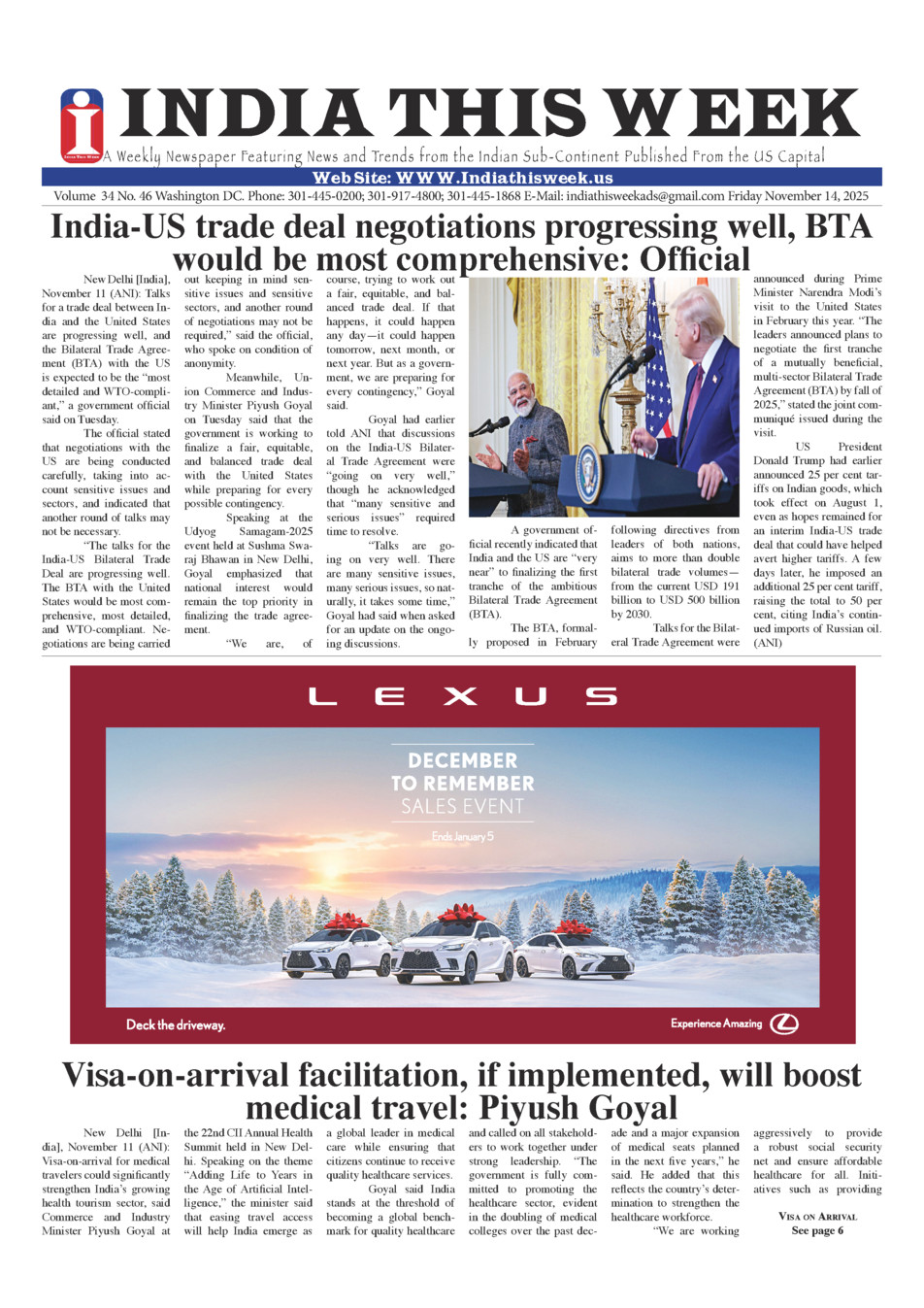
Meta: India This Week — November 14, 2025 — Trade Talks, Health Initiatives, Security Developments, and Community Highlights
Overview of India‑US Trade Talks, Economic Initiatives, and Health Tourism Prospects
The edition outlines a set of high‑stakes economic and trade discussions between India and the United States, emphasizing that negotiations on a Bilateral Trade Agreement (BTA) are advancing with a focus on creating the most detailed and WTO‑compliant framework possible. An unnamed government official stressed that negotiators are proceeding with care, taking into account delicate sectors and sensitive issues, and suggested that another full round of talks might not be required if progress continues as anticipated. The overarching objective behind these talks is to bolster bilateral commerce beyond current levels, supported by a long‑term target to significantly expand trade volumes by 2030. The article situates these developments within the broader context of the strategic bilateral relationship, including recent high‑level engagements and a shared aspiration to shape a favorable framework for multi‑sector cooperation. (Page 1)
In parallel, India’s Commerce and Industry Minister highlighted the government’s commitment to concluding a trade deal that is fair, balanced, and aligned with national interests, while preparing for all contingencies. At a major industry event in New Delhi, the minister underscored that this approach prioritizes national interests and acknowledges that a comprehensive agreement could come together swiftly or take longer, depending on how talks unfold in the coming months. The statements reflect a readiness to move decisively if the terms align with India’s strategic goals, and they emphasize that political will and market realities will guide the timing of a final accord. (Page 1)
The narrative indicates that multiple voices within the administration acknowledge the sensitivity of specific sectors and areas of concern, underscoring a careful, patient approach to finalizing a first tranche of the BTA. While officials speak of progress and near alignment on core issues, there is also recognition that achieving a robust, WTO‑compliant outcome requires addressing non‑trivial questions about market access, investment rules, and sectoral safeguards. The article portrays a government that is intent on avoiding rushed concessions and prioritizing clear, enforceable terms that could underpin durable, mutually beneficial trade growth. (Page 1)
A key strategic element highlighted is the ambition to more than double bilateral trade from roughly USD 191 billion to USD 500 billion by 2030, a goal linked to the broader political and economic alignment between New Delhi and Washington. The timing of these negotiations traces back to a February policy directive, with subsequent statements suggesting both momentum and some caution as negotiators work through sensitive issues. The emphasis on a multi‑sector approach signals the willingness to pursue a comprehensive package that spans goods, services, investment, and technology, rather than a narrow, limited agreement. (Page 2)
The article also points to a broader ecosystem of economic diplomacy, including ongoing lookouts for complementary partnerships. It notes that the first tranche could pave the way for deeper cooperation in areas where both economies have shown converging interests, and it places the India‑US dialogue within the wider landscape of strategic partnerships. Although specific terms remain under discussion, the reporting frames the BTA as a vehicle to secure a durable, investment‑friendly framework that could support a new era of bilateral trade growth and technology collaboration. (Page 2)
Beyond trade negotiations, the coverage underscores the potential for other policy levers to boost international business ties, including visa policy reforms and sectoral facilitation. There is an emphasis on ensuring that any progress on market access does not undermine domestic industry needs, while also signaling a shared desire to create predictable and transparent rules for multinational firms operating in both markets. Taken together, these threads paint a picture of a proceeding, measured, and strategy‑driven effort to redesign the commercial architecture governing India’s interactions with one of its most consequential trading partners. (Page 2)
The Health Tourism angle is introduced as a parallel policy stream, with political leaders highlighting visa facilitation for medical travelers as a potential accelerant for India’s growing health‑care export sector. The objective is to position India as a global destination for high‑quality medical care while ensuring access to advanced services domestically. The discussion includes calls to expand medical education capacity, including a significant increase in nursing professionals, and to strengthen the healthcare workforce as part of a broader effort to sustain inclusive growth and shared prosperity. The Heal in India framework is presented as an integrated approach, combining modern medical services with traditional wellness practices to attract international patients and provide affordable care. (Page 6)
Security, Diplomacy, and Global Events: Mali Kidnapping Case and Delhi Metro Blast
The issue of security features prominently with reports of a kidnapping in Mali involving five Indian nationals. The Indian Embassy in Bamako issued statements confirming the incident, noting ongoing collaboration with local authorities and the company involved to secure the safe release of the abductees. The broader security environment in Mali is described as increasingly unstable, with the al‑Qaeda‑linked Jama’at Nusrat al‑Islam al‑Muslimin (JNIM) tightening its control around Bamako, and fuel shortages exacerbating the crisis by interrupting transit and logistics networks. The piece also references international advisories urging Indian and other foreign nationals to depart the country if possible, reflecting a heightened risk landscape for expatriates and aid workers in the region. (Page 2)
The narrative further explains that the abduction follows a pattern of attacks and displacement that has characterized the Sahel region for years, with foreign workers and infrastructure projects increasingly targeted. It notes how the Malian authorities have engaged in security operations to locate and secure those taken, while the Indian MEA and diplomatic channels have remained vigilant, urging caution and emphasizing the government’s priority on safeguarding Indian citizens abroad. The report situates the incident amid broader geopolitical shifts in the region, including the presence of mercenary forces and shifting alliances that complicate regional stability. (Page 2)
Separately, the report recounts a high‑level diplomatic engagement linked to India’s economic diversification and regional partnerships. It highlights discussions with business leaders and diaspora communities as vehicles for expanding commercial ties and knowledge exchange. The emphasis is on leveraging Indian expertise in technology, manufacturing, and services to cultivate a broader ecosystem of collaboration with foreign partners, reinforcing the core idea that diplomacy and trade are mutually reinforcing tools for resilience and growth. (Page 4)
The same section also touches on a brutal incident in New Delhi involving a blast near the Red Fort metro station, which resulted in multiple casualties and injuries. The government promptly expressed condolences, while authorities launched a comprehensive response, including a rapid deployment of security and forensic teams and heightened measures in central Delhi. The coverage underscores the gravity of the attack and the determination of leadership to oversee a thorough investigation, gather facts, and ensure accountability. It reflects a broader pattern of domestic security challenges that are integral to India’s ongoing governance agenda and international image as a stable, vigilant democracy. (Page 4)
In the wake of the Delhi incident, there is an emphasis on leadership briefings and ministerial oversight. Top officials publicly reaffirmed their commitment to safety, while law‑enforcement agencies coordinate with national security agencies to examine all possible angles, ensuring public communication remains accurate and measured as investigations proceed. The piece stresses that a transparent, evidence‑based inquiry will be essential to restoring public confidence and informing any future policy or security adjustments designed to prevent a recurrence of such events. (Page 4)
Another thread in the coverage describes a separate diplomatic encounter in the United States, where Commerce and Industry Minister Piyush Goyal met with a business delegation led by Utah Senate President J. Stuart Adams. The discussions focused on expanding collaboration in advanced fields like artificial intelligence, clean energy, minerals, academia and research, biotechnology, aerospace, and high‑end manufacturing. The report notes that this engagement is part of a broader push to broaden Indo‑U.S. cooperation in strategic sectors that can drive innovation, job creation, and competitive advantage for both economies. (Page 4)
The article also references ongoing regional diplomacy by Indian leadership and its impact on broader economic partnerships. It points to a sequence of bilateral interactions—ranging from Australia to the United States—that are advancing a cohesive policy arc designed to deepen economic ties and create more resilient supply chains. The coverage suggests a recognition that real progress in these areas requires sustained political will, ongoing dialogue, and a shared commitment to open markets, investment protection, and practical reform in regulatory frameworks. (Page 4)
Parallel to these diplomatic strands, the publication highlights cultural and social initiatives that illustrate India’s soft power and community engagement in the Washington region. The Karuna Charities, a Maryland‑based nonprofit, organized major events aimed at serving women, children, and families in need. The 12th Annual Golf Tournament, held under challenging weather, brought together participants, sponsors, and volunteers to support charitable programs. A subsequent 25th Annual Diwali Gala attracted a wide audience, featuring cultural performances, a formal program, and fundraising activities that underscored the organization’s dedication to community service. (Page 5)
The Karuna Charities profile provides a deeper understanding of the organization’s mission, which centers on alleviating hardship and expanding opportunities for education and welfare. The group’s leadership highlights ongoing initiatives such as meals for shelters, donations to food banks, and scholarships for students at key regional institutions. The narrative also notes the organization’s historical role during the COVID‑19 pandemic, when it mobilized resources to assist families in need, reinforcing a broader theme of civic responsibility and philanthropic collaboration within the Indian diaspora and allied communities. (Page 5)
The piece on health policy expands to emphasize India’s potential to become a premier global destination for medical travel, contingent on addressing current challenges and capitalizing on investments in healthcare infrastructure and human resources. It discusses the Heal in India framework as a holistic strategy that combines modern medicine with traditional wellness practices, including Ayurveda, yoga, and detoxification therapies. Key industry voices advocate for expanding nursing education and capacity by tens of thousands to meet growing demand abroad and at home, while calling for a user‑friendly digital platform to help international patients compare options and navigate services efficiently. (Page 6)
The editorial column, The Poetic Pen, offers a reflective critique on the corrosive effects of hatred and the value of choosing empathy over enmity. It urges individuals to resist manipulation by those who foment division and exploitation, arguing that maintaining integrity, justice, and kindness ultimately serves one’s own well‑being. The author cautions against revenge and urges readers to cultivate a compassionate stance that recognizes shared humanity and the dignity of others, framing virtue as a practical path to personal peace even in the face of injustice. (Page 4)
In a separate policy update, the edition reports a shift in U.S. visa policy under the Trump administration that expands the criteria for assessing an applicant’s eligibility to enter the United States. The guidance directs visa officers to consider an applicant’s health status, including chronic conditions such as diabetes and obesity, as possible indicators of future reliance on public benefits. This broader health assessment framework marks a departure from earlier focuses on communicable diseases alone and signals a more expansive interpretation of public charge risk. The coverage notes that the new guidelines also invite consideration of family dependents with special health needs, potentially broadening the scope of admissibility decisions for many applicants. (Page 7)
The closing sections of the publication reiterate practical details about the magazine’s publishing model and editorial team, along with contact information for readers seeking ad placements or press communications. It underscores that the opinions expressed by individual contributors may not necessarily reflect the views of the publication, while reaffirming a commitment to timely, diverse coverage of developments affecting the Indian diaspora and bilateral relations. The document ends with standard legal and administrative notes, emphasizing the publication’s independent stance, operational channels, and a call for reader engagement and feedback as the week’s news cycle continues to unfold. (Page 7)
Editorial Note: If Only We Can Drop Hatred
The Poetic Pen column serves as a contemplative meditation on how harboring resentment undermines personal growth and societal harmony. It argues that adopting an ethos of understanding and compassion is not a sign of weakness but a strategic choice that protects one’s own well‑being. By warning against revenge and manipulation, the author invites readers to cultivate virtue, fairness, and empathy as a means to navigate conflict and uphold moral integrity. The piece reinforces the idea that living with integrity ultimately frees one from the burden of hatred, enabling more constructive responses to adversity and wrongs done by others. (Page 4)
Meta and Credits: Publication Details and Accessibility
The collection closes with standard publication notes, acknowledging the editorial team and contributors who shape the weekly issue. It reiterates the publication’s role as a forum for ideas and information relevant to the Indian community in the United States and beyond, while clarifying that the op‑eds and features reflect individual perspectives rather than institutional positions. Readers are reminded of the publication’s contact channels for subscriptions, advertisements, and press materials, reinforcing its openness to audience participation and ongoing dialogue about trade, security, health, and social initiatives. (Page 7)