Rizal's Newspaper
Rizal's Newspaper
Rizal: Life, Exile, Education, and Nation-Build — A Synthesis from Veritas Aeterna
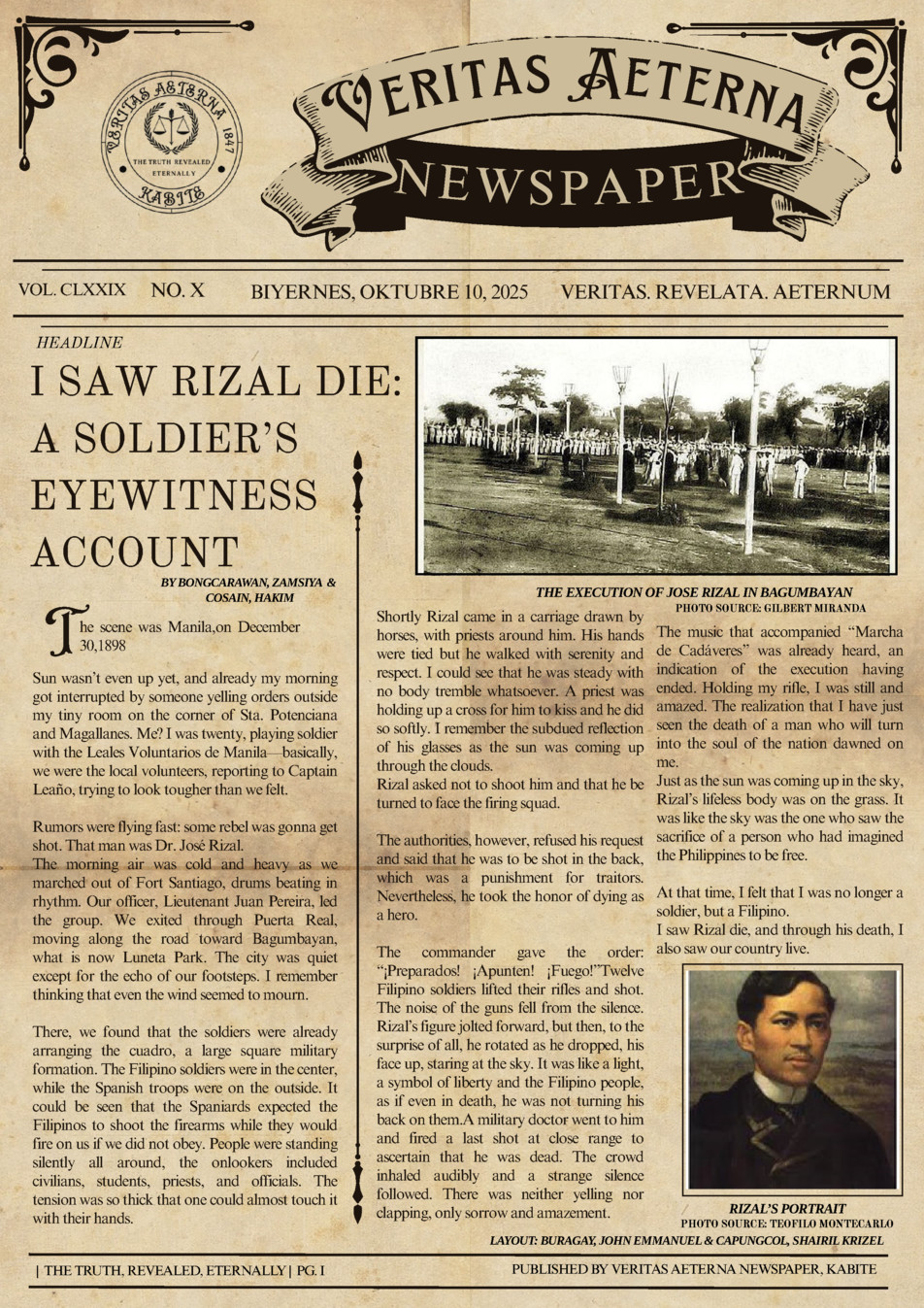
Eyewitness Account of Rizal’s Execution (p. I)
On a dawn when Manila had not yet fully stirred, a vivid scene unfolded as a young volunteer recounts how the morning air carried a heavy stillness before the inevitable act. The narrator—then a twenty-year-old among the Leales Voluntarios de Manila—found himself part of a formal military assembly as the procession moved toward Bagumbayan. The layout of the crowd reflected a charged atmosphere: Filipinos in the center surrounded by Spanish troops, with every spectator weighing the moment that would ensure the future of a nation’s memory. In the quiet, the ebb of fear seemed almost tangible, replaced by a solemn expectation that something monumental was about to occur. (p. I)
The image of Dr. Jose Rizal arriving in a carriage, calm and composed, anchors the narrative: his hands bound, yet his demeanor unbroken, and a cross lifted by a priest to be kissed by him. The sight of Rizal adjusting to the moment with quiet dignity and the subtle glint of sunlight reflected in his glasses underscore a paradox of vulnerability and resolve. The scene is punctuated by the cadence of a funeral march that signals an ending, yet the mood hints at a deeper, unresolved calling for a people’s future. (p. I)
The execution unfolds with blunt efficiency: the firing squad’s order—“Preparados, Apunten, Fuego”—and the synchronized discharge of rifles. Rizal reels forward, then turns as he falls, eyes toward the sky, a posture that the witness interprets as a symbolic moment of fidelity to a higher ideal even in death. The immediate aftermath—medical verification, silence among the crowd, and the absence of triumphalism—frames Rizal’s end as a seed for national awakening rather than a mere display of punishment. The observer, who had once believed himself a soldier, feels a transformation in his very identity, recognizing that Rizal’s death embodies the birth of a nation’s conscience. (p. I)
The episode closes with a poignant realization: Rizal’s sacrifice was not just the removal of a political adversary but the ignition of a collective memory that would guide generations. The scene becomes a touchstone for what it means to belong to a people’s story—an emblem of liberty, dignity, and the enduring question of how truth and courage can outlive a single life. (p. I)
Dapitan: The Exile That Became a Revolution (p. II)
Rizal’s relocation to Dapitan in 1892—an exile dictated by colonial authorities—emerges in this account as a deliberate act that reframed constraint into purpose. Rather than retreating from public life, he cultivated a sphere of influence through quiet leadership, turning isolation into a laboratory for social renewal. He established a school for local boys, teaching essential subjects while integrating lessons on discipline, responsibility, and the dignity of work. The aim was not merely to transmit knowledge but to cultivate the mindset needed for self-government and resilient community life. (p. II)
Beyond classroom work, Rizal applied his engineering and medical training to practical improvements. He designed an accessible water supply to bring clean water to households, and he extended medical care to patients from neighboring towns, treating all with equal concern regardless of social status. These acts—education, infrastructure, and healthcare—are framed as a form of peaceful revolution: a method of elevating communities through knowledge, service, and a steadfast refusal to accept poverty as fate. Local historians describe this period as Rizal’s most potent, nonviolent contribution to nation-building, demonstrating leadership through example rather than through force. (p. II)
Today, Rizal’s Dapitan home is preserved as a museum, with letters, tools, and books that testify to a life of disciplined inquiry and practical service. The artifacts remind visitors that leadership begins with small, deliberate acts of care for others. In this light, exile becomes a lasting legacy: a testament to how purposeful, everyday work can create the conditions for a more educated and just society. (p. II)
Rizal as a Farmer: The Dapitan Experience (p. II)
Beyond his identity as a writer and physician, Rizal’s passion for agriculture stands out as a formative dimension of his outlook on national development. The text emphasizes that Rizal saw farming not merely as sustenance but as a strategic instrument for achieving self-reliance and social progress. His perspective treats agriculture as a noble calling—an avenue through which a nation can secure its independence by empowering ordinary people to contribute meaningfully to the common good. The argument ties his literary work to lived practice, illustrating how the portrayal of rural life in his novels was matched by his own involvement in farming and rural improvement. (p. II)
Rizal’s background—growing up in a family that leased land and managed farmers—fueled his belief that the dignity of labor deserves public recognition. The narrative cites his references to farming within Noli Me Tangere, where agricultural life is portrayed with a seriousness that mirrors its importance to national vitality. The idea is not romanticization but a concrete recognition that agrarian strength underwrites political autonomy, and Rizal’s hands-on approach to agriculture demonstrates his conviction that development begins at the grassroots level. (p. II)
The Young Rizal: Genius Seed Before the Hero (p. III)
Rizal’s formative years in Calamba, Laguna, reveal a mind shaped by prodigious curiosity, disciplined learning, and a deep sense of responsibility to his community. Born in 1861 as the eleventh of eleven children, he grew up in a family that valued education and moral rigor. His mother, Teodora Alonso, taught him the fundamentals of literacy and character, while his father, Francisco Mercado, instilled in him the discipline of study and a reverence for knowledge. From an early age, Rizal demonstrated precocious abilities in reading, writing, and artistic expression, traits that would later fuse into a powerful intellectual force. (p. III)
As a student, Rizal pursued excellence at every stage: excelling in Biñan with mentors who recognized his talent, then advancing to the Ateneo Municipal de Manila where he consistently earned high honors. These early experiences formed the foundation of a lifelong habit of learning, not for personal prestige but to equip himself to uplift others. His education is presented here not as a solitary achievement but as a preparation for a vocation—an educator of minds and a challenger of injustice. (p. III)
Even in youth, Rizal displayed a synthesis of scientific thinking and artistic sensibility, a combination that would define his writings and his approach to social reform. This section underscores how his early life crystallized the virtues of inquiry, discipline, and empathy, shaping the writer-activist who would later critique oppressive structures with reason and compassion. The portrayal emphasizes that Rizal’s genius was tempered by humility and a steadfast commitment to truth, values that later inspired a generation to pursue national dignity through knowledge and civic virtue. (p. III)
Dr. Jose Rizal’s Home and the Broader Portrait (p. III)
The narrative extends to Rizal’s enduring legacy beyond his life: the home he built in Calamba, now a museum, stands as a physical reminder of his hands-on approach to living a life of purpose. The exhibits—letters, tools, and books—recount a period when Rizal’s workshop as a thinker and craftsman became a blueprint for disciplined, purposeful inquiry. The text also references the broader arc of Rizal’s personal life, including his relationships with significant figures such as Leonor Rivera and Josephine Bracken, and his monumental literary achievements—Noli Me Tangere and El Filibusterismo—that exposed social injustices and helped ignite Filipino nationalism. (p. III)
Accompanying the biographical materials are portraits and discussions of his collaborations with La Solidaridad, a newspaper founded by Rizal and fellow reformists to articulate their vision for a more just society. The museum narrative emphasizes how Rizal’s life—intellectual rigor, moral courage, and love for country—continues to illuminate the path toward reform through education and reason. It closes with the idea that Rizal’s life was a continuous act of teaching, not merely a historical account of a hero’s deeds, but a living invitation to emulate his commitment to truth and service. (p. III)
La Solidaridad and the Political Vision: The Pen as Catalyst (p. IV)
The final section centers on Rizal’s role as a public intellectual and his contribution to a larger reform movement via La Solidaridad, a platform for articulating a modern, reform-oriented Filipino nationalism. The narrative also features an editorial piece, The Pen that Awakened a Dormant Nation, which argues that Rizal’s moral leadership transcended his own era. Through his writings—Noli Me Tangere, El Filibusterismo, and other polemics—Rizal exposed injustices, critiqued corruption, and urged a people to pursue reform through knowledge and ethical action rather than violence. (p. IV)
The editorial presents Rizal as the conscience of the nation, whose insistence on critical thinking and principled action challenged both colonial authority and prevailing social complacency. It contends that true freedom entails more than political independence; it requires a shared commitment to integrity, education, and solidarity. The piece also invokes a famous line—Ang Kabataan ay Pag-asa ng Bayan—to remind readers that the next generation carries forward Rizal’s legacy when they choose truth, justice, and active citizenship over expedience. In this light, Rizal’s life becomes a continual invitation to resist corruption, to cultivate knowledge, and to work toward a more humane and equitable society. (p. IV)
Together, these components—personal biography, communal initiatives, intellectual contributions, and editorial reflections—compose a comprehensive portrait of Rizal as a thinker, builder, and moral guide. The collection argues that his example remains relevant for contemporary readers who seek to understand how individual courage, disciplined learning, and compassionate service can collectively advance a nation. The message is clear: Rizal’s legacy is not confined to the past but is an ongoing call to emulate his steadfast pursuit of truth and freedom in the face of present-day challenges. (p. IV)
Closing Synthesis: Rizal as a Living Blueprint for Today (Overall)
Across the narratives, Rizal emerges as a multifaceted leader whose influence rests on the union between intellect and service. His execution is remembered not as a mere punishment but as a turning point that catalyzed a national consciousness, pushing Filipinos toward a more conscious assertion of identity and civic responsibility. In Dapitan, exile becomes a school of civic virtue, where education, infrastructure, and medical care translate into tangible improvements for ordinary people. The Dapitan years articulate a model of leadership grounded in practical action and steadied by a vision of a self-reliant, educated society. (p. I–II)
Rizal’s early life demonstrates how a curious, disciplined, and morally rooted upbringing can cultivate a person capable of sparking a broad reform movement. His family background, his schooling, and his earliest achievements collectively illuminate how personal development, when tethered to the welfare of the community, can evolve into a national project. The Young Rizal narrative and the biographical materials about his home life underscore that a nation’s awakening begins with individuals who cultivate knowledge, integrity, and compassion from childhood onward. (p. III)
The La Solidaridad era and the subsequent editorial reflections insist that the true measure of Rizal’s impact lies not only in his written works but also in his enduring argument for a humane, educated citizenry. His insistence on truth, reform, and unity remains a living invitation to modern readers to confront corruption and injustice with reasoned critique and collective action. The repeated refrain—education as the path to freedom and moral responsibility as the backbone of national progress—positions Rizal as a timeless mentor whose life can guide present and future generations toward a more just and enlightened Philippines. (p. IV)
In sum, Rizal’s story—from a bright, disciplined youth through a life of public service and intellectual leadership, to a martyr’s vow for national dignity—offers a powerful template for building a resilient, educated, and compassionate society. His life demonstrates that liberty is secured not merely by political change but by a culture of learning, reflective ethics, and steadfast dedication to the common good. For readers today, Rizal’s example remains a compass: pursue truth with courage, teach and uplift others, and insist that freedom be grounded in justice and universal human worth. (p. I–IV)