India This Week~October 10, 2025
India This Week~October 10, 2025
India This Week — October 10, 2025: Comprehensive blog summary of key developments
Overview: a week of diplomacy, politics, culture, and science shaping India's global footprint
This edition surveys a range of developments that span bilateral diplomacy, regional elections, educational and defense collaborations, as well as cultural milestones. The central threads include a high‑level exchange with a US think‑tank delegation led by Walter Russell Mead aimed at deepening India‑US ties, ongoing dialogues on trade with the United States and the European Union, and notable policy steps such as California recognizing Diwali as a state holiday. The report also covers Bihar’s election timetable, a landmark MoU linking IIT Madras with the Indian Navy to bolster naval technology and engineering, and ongoing public health and safety concerns tied to the broader socio‑economic context. Together, these pieces illustrate India’s push to balance domestic governance with international engagement, while highlighting regional incidents and cultural observances that resonate across communities. (Page 1)
Strengthening India–US ties and trade negotiations
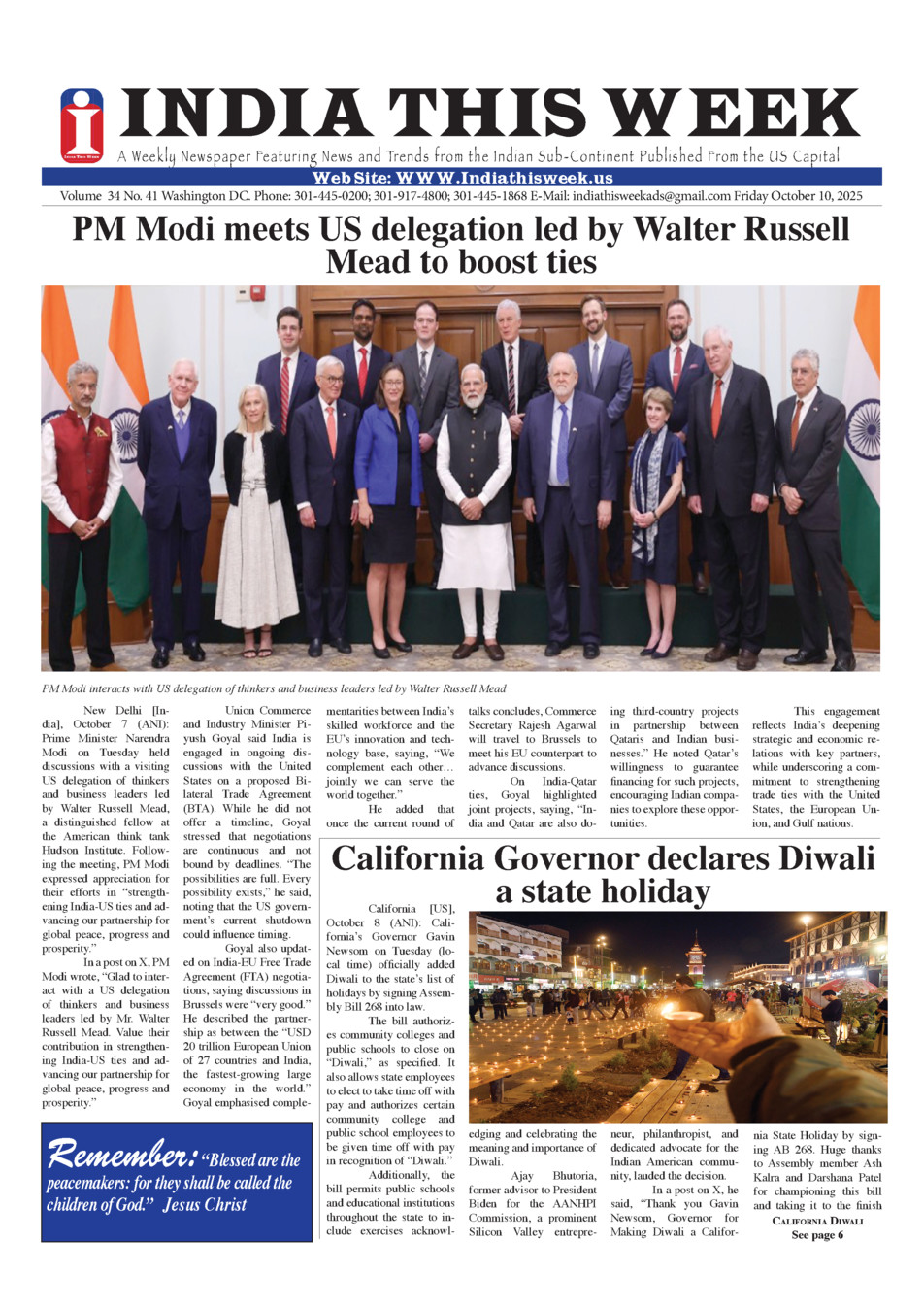
Prime Minister Narendra Modi hosted a visiting US delegation of prominent thinkers and business leaders, led by Walter Russell Mead, to discuss avenues for reinforcing the bilateral relationship and advancing global peace, progress, and prosperity. Modi’s public post underscored appreciation for those efforts and their potential to contribute to a durable partnership. In parallel, Union Commerce and Industry Minister Piyush Goyal indicated that negotiations for a Bilateral Trade Agreement with the United States remain ongoing, stressing that talks are continuous and not bound by hard deadlines. He also provided an upbeat assessment of India–EU Free Trade Agreement discussions, describing the partnership as a collaboration between two dynamic economies. These comments reflect a broader strategy of expanding trade and investment ties with major partners, leveraging India’s skilled workforce and technological strengths. (Page 1)
India’s strategic economic diplomacy: EU, Qatar, and beyond
Goyal highlighted the complementary strengths between India’s capabilities and the EU’s innovation ecosystem, calling for a mutually beneficial framework that could unlock global value and support development. He also noted ongoing efforts to advance joint projects with Qatar, including third‑country ventures backed by financing from Qatari partners. Taken together, these remarks point to a deliberate approach to diversify India’s strategic economic partnerships—nurturing collaboration with the United States, the European Union, and Gulf states to reinforce growth, technology transfer, and global supply chains. (Page 1)
California’s Diwali recognition: a milestone for cultural inclusion
In a landmark policy move, California Governor Gavin Newsom signed AB 268 to officially add Diwali to the state’s holiday calendar. The measure permits public schools and community colleges to observe Diwali, and allows state employees to take paid time off, with similar provisions for certain education sector workers. Public institutions are also empowered to acknowledge and teach the festival’s meaning and significance. The decision drew praise from community leaders, including Ajay Bhutoria, who celebrated the measure as a meaningful step toward recognizing the Indian diaspora’s contributions and fostering inclusive civic life. (Page 6)
Community condolences and cultural observances: Indian embassies abroad
The Indian Embassy in Italy expressed condolences for the deaths of four Indian nationals in a road accident in Matera and extended consular support to affected families, while also noting a separate incident near Grosseto involving two Indians from Nagpur. In the United States, the Indian Embassy joined vibrant Vijayadashami celebrations at the ISKCON Temple in Maryland, recognizing ISKCON’s role in promoting spirituality and interfaith harmony. The event saw participation from state and local dignitaries, reflecting the close cultural ties and active diaspora engagement that thread through India’s international presence. (Page 2)
Dussehra greetings and political resonance across the country
Alongside diplomatic gestures, President Droupadi Murmu’s Vijayadashmi remarks highlighted the festival’s moral symbolism, while Indian officials and political leaders used the occasion to emphasize democratic values, governance, and national unity. The messaging framed Vijayadashmi as a time to reflect on truth, justice, and collective progress, themes echoed across public discourse as the country approaches the Diwali season. The coverage also notes how Vijayadashmi is tied to Navratri’s nine days and the cultural emphasis on renewal and communal harmony. (Page 2)
Bihar elections: schedule, processes, and the political landscape
The Election Commission announced dates for the Bihar Legislative Assembly elections, set to run in two phases with results on November 14. A Special Intensive Revision of voter lists was also approved, a move that provoked reactions from both ruling and opposition parties. Union Home Minister Amit Shah and BJP president JP Nadda lauded the timetable as a festival of democracy, while critics from the Congress and other opposition outfits questioned the EC’s handling of the revision process and alleged concerns about transparency. Analysts note a keen contest between NDA and INDIA bloc, with new entrants like Jan Suraaj potentially influencing the vote share. Historical data from the 2020 elections is cited to illustrate shifting alliances and the potential impact of various regional players. (Page 4)
Implications for governance and electoral fairness
As Bihar gears up for polling, senior leaders from the NDA and opposition partisans alike framed the elections as a test of development and governance, with expectations of a mandate grounded in outcomes and delivery. Debates around the Special Intensive Revision (SIR) have fueled discussions about electoral integrity, voter list accuracy, and the role of new political entrants in shaping future government formation. The discourse underscores the centrality of credible institutions in supporting democratic processes and ensuring that elections reflect the will of diverse communities across the state. (Page 4)
IIT Madras signs MoU with Indian Navy to strengthen naval research
In a landmark collaboration, IIT Madras and the Indian Navy formalized an agreement to advance research in naval technology, ocean engineering, and related disciplines. The MoU was signed at IIT Madras in the presence of senior officials, reflecting a shared commitment to strengthen indigenous maritime capabilities. Professors Kamakoti and Sannasiraj, along with other faculty members, outlined how the partnership would enable joint research, capacity building, and access to advanced facilities such as the institute’s towing tank and experimental labs. The agreement is described as a pivotal step toward integrating academic expertise with national defense priorities, reinforcing Atmanirbhar Bharat through concrete projects and talent development. (Page 5)
Strategic and industrial synergies: IIT Madras–Navy collaboration in practice
Academic leadership emphasized that the collaboration will open pathways for researchers and students to engage in real‑world naval projects, including capacity‑building programs, internships, and knowledge transfer. The MoU also signals a broader vision of academia and the armed forces working together to design next‑generation platforms, improve hydrodynamic modeling, and advance ocean engineering capabilities that align with India’s strategic needs. (Page 5)
Space and Defence Industries Exhibition in Chennai
Chennai hosted a prominent expo highlighting the state’s growing footprint in space and defense manufacturing. Tamil Nadu Chief Minister MK Stalin spoke about the state’s manufacturing leadership, noting double‑digit growth and a robust ecosystem that supports India’s space ambitions. The government announced welfare measures for public sector workers, including a 20% bonus and ex‑gratia payments, with a focus on boosting morale and facilitating festive celebrations. The event underscored Tamil Nadu’s role as a manufacturing hub and its contribution to India’s strategic sectors, including space and defense technology. (Page 5)
Public health updates and safety concerns: the Cold‑rif cough syrup case
The death toll linked to the Coldrif cough syrup case in Madhya Pradesh rose to 19 as a two‑year‑old child from Junnardeo died in Nagpur after extended treatment. Authorities have deployed a task force to monitor treatment across hospitals and coordinate with families, with the government promising coverage of medical expenses for affected children. This tragedy highlights ongoing concerns about drug safety and regulatory oversight, alongside the state’s commitment to provide necessary support for affected families during a difficult period. (Page 7)
Disaster events and regional tragedies: landslide and governance responses
In Bilaspur district, Himachal Pradesh, a fatal landslide struck a private bus during heavy rains, resulting in multiple deaths and injuries. Local authorities coordinated rescue operations, deployed SDRF teams, and prioritized medical care for the injured, while the Chief Minister called for continued relief efforts and updates. The incident underscores the vulnerability of hill districts to extreme weather and the importance of proactive disaster management and infrastructure resilience in the face of seasonal challenges. (Page 7)
Cultural and economic highlights from Tamil Nadu
The Tamil Nadu government showcased its proactive approach to supporting workers and public sector enterprises, including a wage bonus program and enhanced welfare measures aligned with the state’s strong manufacturing base. Stalin highlighted the sector’s role in sustaining employment and attracting investment, with a focus on public sector workers and women’s workforce participation. The initiatives are framed as part of broader developmental goals, reinforcing the state’s leadership in industrial growth while integrating social protection measures that enable a more inclusive growth trajectory. (Page 5)
Poetic interlude: The Poetic Pen by Rajan George
A literary piece titled The Poetic Pen provides reflective lines on moral choices, consequences of one’s actions, and the importance of integrity. The poem cautions against sowing harm and emphasizes the value of truthfulness as a foundation for personal strength and societal harmony. It sits alongside the news items as a contemplative counterpoint, inviting readers to consider the ethical implications of power, influence, and human conduct. (Page 8)
Closing note: synthesis of themes and forward look
The issue encapsulates how India is navigating a complex mix of international diplomacy, domestic political dynamics, regional security considerations, and cultural renewal. From high‑level dialogues with global partners to ground‑level policy enactments—such as Diwali recognition in California and targeted science–defense collaborations—the publication frames a trajectory of greater global engagement paired with sustained attention to governance, health, and community well‑being. The recurring emphasis on inclusive growth, strategic partnerships, and resilience in the face of natural and public health challenges suggests a multi‑layered approach to national progress. (Page 9)