India This Week~September 26, 2025
India This Week~September 26, 2025
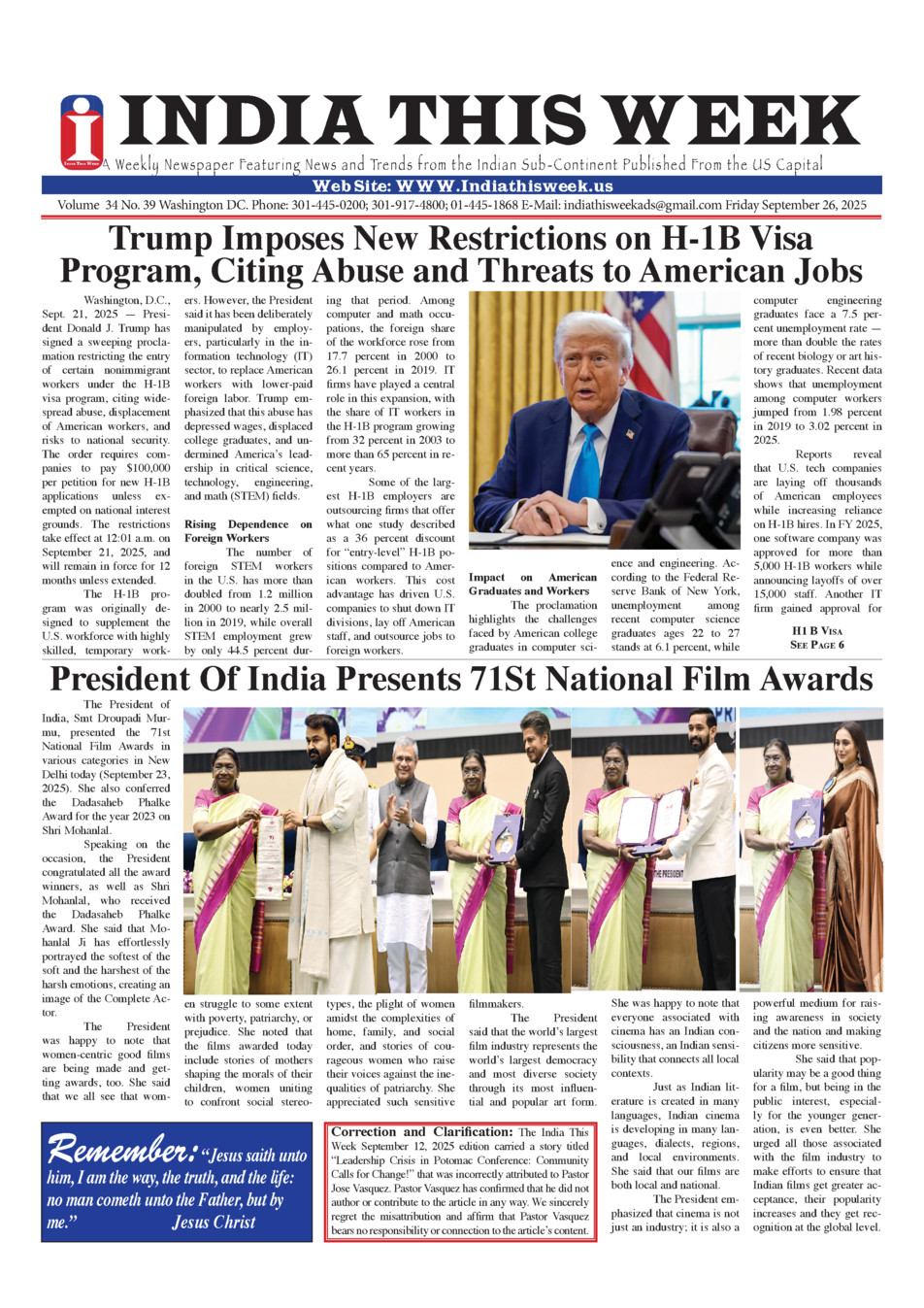
India This Week — Comprehensive Summary of the September 26, 2025 Issue
H-1B Visa Proclamation and Its Domestic and Global Implications
The most consequential policy move highlighted in this issue is a broad new set of restrictions on the U.S. H-1B visa program, justified by concerns about misuse, wage suppression, and potential threats to American workers. The measure, announced by President Trump, states that petitions for new H-1B entrants will require a substantial fee, effectively placing a financial barrier on fresh entries while preserving opportunities for those already in the pipeline or on existing visas. The mechanism envisions a one-time payment of $100,000 per petition for most applicants, with certain exemptions available only under national interest provisions. (Pg 6)
Officials frame the reform as a necessary correction to past practices that allowed low-wage foreign labor to fill roles that could have been filled by Americans, especially in technology-centric occupations. The proclamation argues that entry barriers will deter unscrupulous firms from exploiting the program to displace domestic workers and depress wages. In practical terms, the policy is designed to apply to new entrants entering the United States after the defined effective date, while existing visas and petitions filed before that date remain outside its scope. (Pg 6)
Administrators outline a phased enforcement plan that involves cross-agency coordination among the Department of Homeland Security, the State Department, and related agencies. They indicate that the policy will be trialed for a 12-month period, subject to possible extension based on its effects on the labor market and national security considerations. Beyond the immediate fee, the government signals downstream steps such as revising prevailing wage standards and prioritizing higher-paid applicants in the visa lottery, implying a broader shift toward prioritizing American workers in high-skill sectors. (Pg 6)
Analysts point to data showing a historical rise in foreign STEM workers in the United States and a persistent gap between the growth of these workers and the expansion of domestic STEM employment. The discourse notes that segments of the tech industry have depended on H-1B flows, while some firms have pursued offshoring or outsourcing models to reduce costs. The policy frames the issue as a balance between competitive pressures in a global economy and a defensible commitment to American innovation and wage growth. (Pg 6)
Observers caution that such sweeping changes could reshape how U.S. tech firms staff critical projects, potentially accelerating transitions to contingency workers or alternative visa categories that can accommodate high-skill roles. The proclamation acknowledges that there will be a transition period for current employees and existing projects but underscores a broader objective of re-aligning incentives so that domestic workers are prioritized in the long term. (Pg 6)
While the administration emphasizes that existing visa holders are not suddenly affected, stakeholders worry about the signal this sends to the global talent pipeline and the competitive posture of the U.S. tech sector. The policy’s reach into education pipelines and training programs is also under discussion, as employers anticipate how to adjust recruitment and job design to align with new wage and eligibility criteria. (Pg 6)
In tandem with the policy announcement, government spokespeople point to a broader economic narrative—one that couples protectionist impulses with strategic investments in domestic innovation and workforce development. They present the H-1B adjustment as a lever to strengthen U.S. leadership in science and engineering while ensuring that high-skill labor remains a driver rather than a substitute for American workers. (Pg 6)
Finally, the document notes that the proclamation invites a period of review through the next H-1B lottery to decide whether to extend or refine the policy based on observed impacts. It also signals that rulemaking by the Department of Labor will be pursued to raise prevailing wage levels, signaling the intentional coupling of wage policy with visa eligibility criteria. The overall tone emphasizes a recalibrated balance between talent mobility and national labor priorities. (Pg 6)
71st National Film Awards: Mohanlal Honored, Voices from Indian Cinema
A major cultural highlight covered in this issue is the conferment of the Dadasaheb Phalke Award for 2023 to acclaimed actor Mohanlal, celebrated as a landmark moment for Indian cinema. The President of India delivered the formal recognition in New Delhi, underscoring Mohanlal’s expansive career across multiple languages and genres and praising his sustained excellence, versatility, and ability to evoke a wide range of emotions on screen. The ceremony also reflected the broader diversity of Indian cinema and its capacity to unite audiences through compelling storytelling. (Pg 4)
Statements from dignitaries and the film fraternity paid tribute to Mohanlal as a complete actor whose performances have traversed regional boundaries and touched audiences nationwide. By highlighting his work in Malayalam cinema alongside notable performances in Tamil, Telugu, Kannada, and Hindi productions, the report situates his achievement within a larger narrative of Indian film’s global reach. The discourse surrounding the award also frames cinema as not only an entertainment industry but a powerful engine for social dialogue and cultural identity. (Pg 4)
In his own remarks, Mohanlal expressed humility and gratitude for the honor and stressed that the achievement belongs to the broader Malayalam cinema ecosystem and the many collaborators who contributed to his journey. The celebrations—from collaboration with fellow artists to the recognition by the prime minister and other leaders—were presented as a testament to the enduring vitality of regional cinema within India’s national tapestry. (Pg 4)
Beyond the individual recognition, the coverage signals a renewed emphasis on women-focused and socially relevant storytelling, with observers noting that the national film awards have increasingly celebrated narratives that address gender, social equity, and cultural representation. The coverage underscores the vitality of a cinematic ecosystem that spans linguistic communities and reinforces India’s cultural diplomacy on the world stage. (Pg 4)
India-Morocco Ties and Diaspora Engagement: A Diplomatic Appetite for Growth
The issue profiles Morocco’s outreach to India as part of a broader strategy to diversify Africa-Asia ties. In remarks during a visit to New Delhi, Morocco’s Secretary of State for Industry underscored the importance of deepening economic collaboration and leveraging Morocco’s geographic position as a conduit to both African and European markets. The dialogue emphasized open economies, shared commitments to market-driven growth, and the potential for enhanced trade in sectors ranging from industry to technology and agriculture. (Pg 5)
Ambassadors and senior officials highlighted ongoing and prospective collaborations, including fertilizer supply chains and balanced trade strategies, as practical foundations for a more robust bilateral relationship. They stressed the importance of open channels for Indian delegations to visit Morocco and explore opportunities in various sectors, signaling a mutual interest in expanding mutual gains beyond traditional partnerships. (Pg 5)
In parallel, comments from Indian officials and foreign ministers underscored a shared aspiration toward strategic cooperation that can serve as a model for Global South partnerships. The discussions also touched on defense and security dimensions, signaling a convergence of interests that could shape regional stability and economic resilience. The narrative frames Morocco as a gateway to Africa and Europe, offering a platform for coordinated action on trade, technology transfer, and investment flows. (Pg 5)
Conversations with Morocco’s ambassador to India reinforced a pragmatic approach: reduce trade imbalances, expand collaboration across sectors, and cultivate a joint agenda that strengthens food security and technological capability. The dialogue suggested that the relationship is evolving from a collection of transactional exchanges toward a more strategic and integrated partnership with lasting benefits for both countries. (Pg 5)
Alongside these diplomatic currents, the coverage highlights broader regional dynamics, including the role of open markets and pragmatic cooperation in addressing global supply challenges. The Morocco-India conversation reflects a larger trend toward South-South collaboration as nations seek to diversify supply chains, deepen technical cooperation, and create avenues for shared prosperity in a rapidly changing global economy. (Pg 5)
Shashi Tharoor Urges the Diaspora to Speak Up: A Call for Active Engagement in U.S. Policy
In a statement reported from New Delhi, Congress MP Shashi Tharoor advised the Indian-American diaspora to take a more proactive stance in shaping U.S.-India policy. He argued that advocacy and outreach to political representatives are essential to ensure that bilateral relations reflect shared interests and values. Tharoor’s invitation to engage is framed as a response to observed apathy and a belief that louder, more coordinated voices can influence policy trajectories on trade, security, and people-to-people ties. (Pg 5)
The discourse places particular emphasis on encouraging constituents to communicate with representatives about matters that affect the India-U.S. relationship, including immigration policy, visa regimes, and economic cooperation. The message frames diaspora involvement as a practical and patriotic contribution to a strategic partnership that has substantial implications for both countries’ economic and security landscapes. (Pg 5)
As part of the broader narrative on South Asian connectivity, the Tharoor remarks underscore how diasporas can act as bridges for investment, cultural exchange, and policy dialogue. The piece situates Indian-Americans as a critical stakeholder group whose voices can help align diplomatic priorities with the aspirations of a diverse set of communities across North America. (Pg 5)
Germany’s Open Door to Highly Skilled Indian Professionals amid H-1B Debates
With concerns about U.S. visa changes intensifying, the German ambassador to India highlighted Germany as a stable and attractive destination for Indian professionals with high-demand skills. The envoy portrayed Germany’s migration framework as orderly, predictable, and designed to reward merit and expertise rather than serve as a loophole for labor arbitrage. The keynote message was clear: Germany welcomes top Indian talent, offering it the opportunity to contribute meaningfully to the country’s economic and social fabric. (Pg 6)
The ambassador elaborated on comparative advantages, noting that Indian professionals in Germany tend to command higher earnings and play significant roles in sectors such as information technology, management, science, and technology. He framed mobility as a mutually beneficial exchange—a chance for Indian workers to advance professionally while Germany benefits from their skills and innovation. The commentary also positioned Germany as a counterweight to hiring patterns in other countries that have recently tightened immigration rules. (Pg 6)
Against the backdrop of the U.S. H-1B policy shift, Germany’s message seeks to attract a steady stream of skilled labor by emphasizing reliability, transparency, and sustained career opportunities. The report suggests that Germany’s approach could influence talent flows and perhaps prompt other European destinations to articulate similar appeals to Indian professionals who may be weighing options across multiple markets. (Pg 6)
EU-India Relations and High-Level Diplomatic Exchanges
Beyond bilateral exchanges, the issue captures a set of high-level conversations that position India as a central player in global diplomacy and economic strategy. Discussions around India’s ongoing negotiations with the European Union, and the potential for interim trade agreements, are framed against a broader context of shared democratic values and converging interests. The reporting emphasizes both the strategic and commercial dimensions of these ties, suggesting a trajectory toward stronger cooperation on trade facilitation, technology transfer, and policy alignment on global challenges. (Pg 6)
In parallel, the coverage ofJaishankar’s meetings with U.S. counterparts and other global interlocutors highlights ongoing efforts to sustain a robust and pragmatic partnership with the United States. The emphasis is on practical cooperation in defense, cybersecurity, energy, and regional security, with the understanding that a resilient bilateral framework requires continuous engagement with a wide range of actors, including those in Europe, Africa, and the Indo-Pacific region. (Pg 6)
The narrative also points to the broader ambition of shaping multilateral dialogues that advance the Global South’s interests, underscoring a collective approach to reforming international institutions and governance mechanisms. Through such diplomacy, India seeks to reinforce its strategic autonomy while fostering inclusive growth that can benefit a diverse set of partners across continents. (Pg 6)
Market and Local Advertisements: A Glimpse into Community Life
Interwoven with international coverage, the issue includes practical notices and retail notices that reflect daily life in immigrant communities. The ads feature local merchants and services, offering competitive prices and promotions designed to engage readers in regions such as Herndon and surrounding areas. These blocks of content illustrate how a newspaper oriented toward a diaspora audience blends global news with everyday consumer information, helping readers navigate both distant and nearby opportunities. (Pg 6)
While not a front-page policy story, the retail features provide context for readers who balance professional responsibilities with family needs. The listings, price highlights, and store promotions serve as a reminder that news media in immigrant communities often doubles as a practical guide to lifestyle and consumption, reinforcing social ties and supporting local businesses. (Pg 6)
editors and distribution teams note that such sections can shift with market conditions, seasonal promotions, and regional supply chains, but their inclusion remains a staple of the publication’s strategy to remain relevant in readers’ everyday lives. The blending of policy analysis and local commerce mirrors the broader aim of the issue: to present a panoramic view of how global events intersect with the daily realities of Indian and South Asian communities abroad. (Pg 6)
Editorial Reflections and Editorial Corrections
In a brief editorial interlude, the magazine acknowledges a recent correction regarding attribution for a piece titled Leadership Crisis in a Potomac Conference. The clarification notes that the article was not authored by the individual previously credited and reiterates the publication’s commitment to accuracy and accountability. This acknowledgment underscores the publication’s adherence to journalistic standards and its willingness to correct errors when they are identified. (Pg 2)
The editorial gesture also frames the rest of the issue as a careful curation of stories—from policy debates and diplomatic dialogues to cinematic milestones and diaspora advocacy—that together illuminate how transnational communities navigate complex political and cultural landscapes. By foregrounding accuracy, the publication aims to cultivate trust among readers who rely on it for nuanced and timely information. (Pg 2)
Concluding Synthesis: Toward a Coherent View of a Global Indian Identity
The collective material presented across this issue paints a portrait of a globally engaged Indian society balancing appetite for opportunity with concerns about national interests. The H-1B policy shift, if implemented as described, would recalibrate labor market dynamics and accentuate the role of skilled immigration in domestic innovation while elevating wage thresholds to reflect a merit-based framework. The coverage suggests that the policy’s real-world effects will unfold over time, with potential ripple effects for education, industry, and international competition in STEM fields. (Pg 6)
Concurrently, Mohanlal’s recognition at the National Film Awards reinforces the cultural prominence of Indian cinema as a vehicle for regional storytelling that resonates on a national and international scale. The coverage frames cinema as a catalyst for dialogue about gender representation, cultural diversity, and the power of art to shape public imagination, while also highlighting the economic vitality of the film industry as a driver of soft power and cultural diplomacy. (Pg 4)
Dialogue with Morocco, and the broader Africa-India axis, signals an orientation toward diversified partnerships that leverage geographic positioning and shared development interests. The discussions suggest practical avenues for collaboration—from agricultural supply chains to technology transfer—while also recognizing the strategic value of open markets and balanced trade. These conversations are framed as components of a wider strategy to expand the Global South’s influence within the global economy. (Pg 5)
Diaspora engagement remains a recurring theme, with calls for greater political participation and advocacy as essential elements of a robust bilateral relationship with the United States. The piece on Shashi Tharoor’s appeal to Indian-Americans underscores how diaspora communities can act as a bridge between home country policy priorities and host-country political realities, ultimately influencing policy outcomes in ways that reflect shared values and interests. (Pg 5)
In a broader European context, Germany’s invitation to highly skilled Indian professionals highlights alternative migration pathways and a competitive global labor market for top talent. This comparative lens helps readers understand how immigration policy, corporate strategy, and national competitiveness intersect in a world where skills mobility can shape economic trajectories across borders. (Pg 6)
Taken together, the issue presents a nuanced, multi-layered narrative about how a dynamic Indian identity is being expressed through policy, culture, diplomacy, and everyday life. It invites readers to consider how domestic reforms interact with global opportunities, and how the diaspora can actively participate in shaping a future where exchange, respect for diverse perspectives, and shared prosperity are central to India’s evolving role on the world stage. (Pg 6)
Ultimately, the pages converge on a common theme: progress arises from deliberate choices that balance protection of domestic interests with openness to the world’s talent, ideas, and cultures. Whether through reform of immigration policies, celebration of cinematic achievements, or the cultivation of new international partnerships, the issue presents a blueprint for a resilient, forward-looking Indian presence in a global system that rewards collaboration, innovation, and inclusive growth. (Pg 6)