India This Week~September 5, 2025
India This Week~September 5, 2025
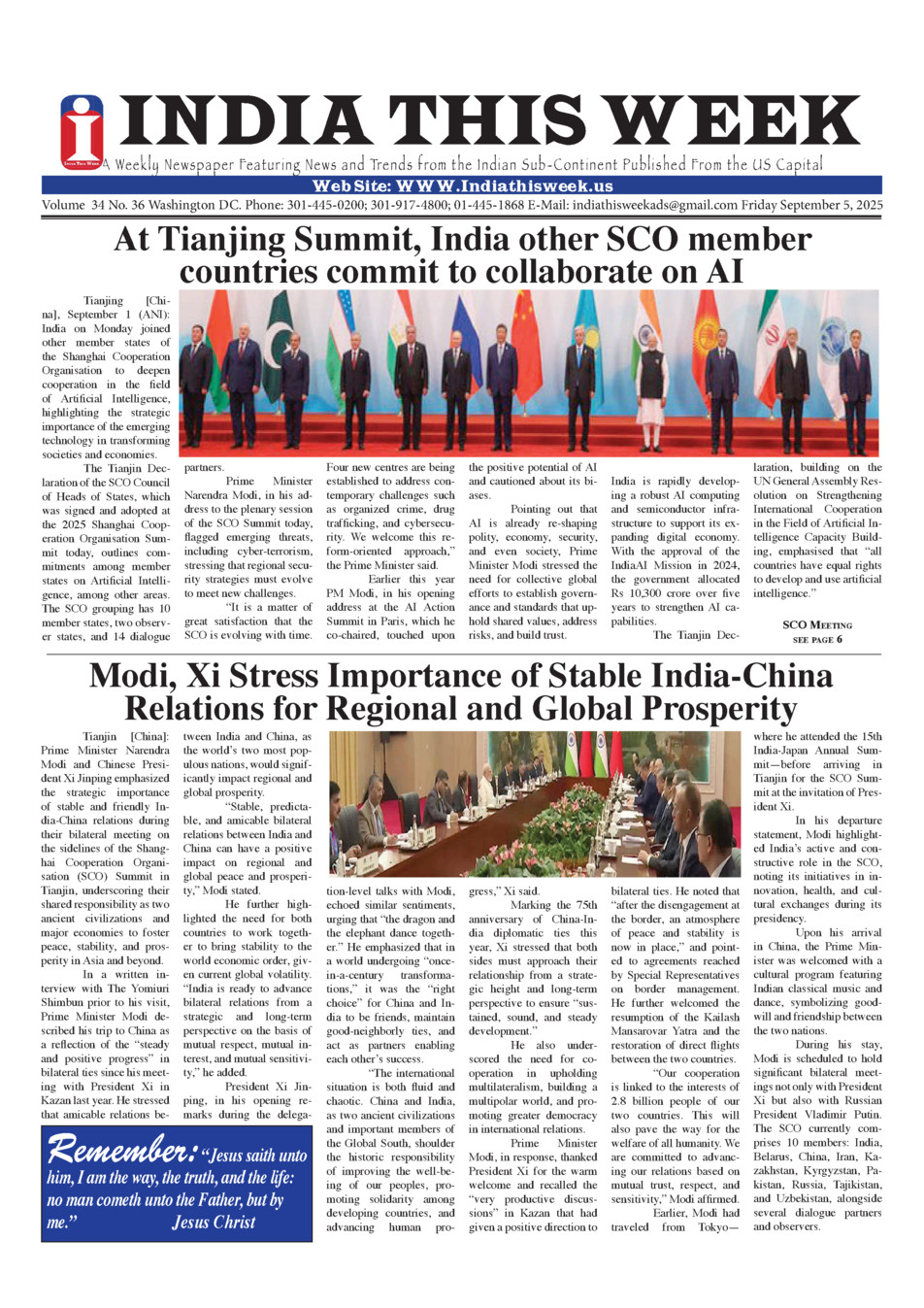
India This Week — Key Updates: SCO AI Cooperation, India-China Dialogue, Drones, Semiconductors, and Public Discourse (Sept 5, 2025)
Tianjin Summit and SCO AI Cooperation: A New Era of Multilateral AI Governance
The Shanghai Cooperation Organisation gathering in Tianjin produced a formal declaration in which member states commit to deepen collaboration in artificial intelligence, recognizing the transformative potential of AI for economies and societies while underscoring the need for governance that aligns with shared values and international norms. The Tianjin Declaration, adopted at the summit, frames AI as a priority alongside other strategic areas and signals an intent to enhance capacity-building across member states, reinforcing the idea that equitable access to AI advancement should be a global common good. (Page 6)
In his remarks to the summit, Prime Minister Narendra Modi highlighted the evolving security landscape shaped by cyber threats and other non-traditional risks, stressing that regional security architectures must adapt to these challenges. He welcomed the SCO’s reform trajectory, including the creation of new regional centers focused on organized crime, drug trafficking, and cybersecurity, viewing these as practical steps toward better governance and safer digital ecosystems. (Page 6)
Leaders at Tianjin also reflected on earlier global AI discourse, noting the positive implications of intelligent systems while cautioning against biases and unchecked reach. India’s own AI strategy—supported by the approval of the IndiaAI Mission with substantial investment over five years—was cited as a key element in building indigenous capabilities and fostering responsible development that can contribute to a fairer, more inclusive digital era. The declaration reiterates a principle of equal rights to develop and use AI, echoing concerns about fairness, trust, and international collaboration. (Page 6)
Modi-Xi Summit: Stability and Prosperity Through a Persistent India-China Partnership
During their bilateral engagement on the sidelines of the SCO Summit, Prime Minister Modi and Chinese President Xi Jinping stressed the centrality of a stable, constructive, and long-term relationship between India and China. They described the two civilizations and economies as natural partners with a shared responsibility to foster peace, regional balance, and economic growth across Asia and beyond. The dialogue underscored the importance of not merely avoiding conflict but actively cultivating mutual trust and cooperation. (Page 6)
In remarks that complemented the broader diplomatic narrative, Xi emphasized that maintaining good-neighborly ties and productive collaboration remain essential for tackling global volatility. He highlighted the need for both sides to manage border issues prudently, pointing to the disengagement and related agreements as a foundation for restored mobility and people-to-people links, including resumed Kailash Mansarovar Yatra and direct flight connections. Modi acknowledged these steps and framed them within a broader agenda of stable, predictable engagement designed to unlock joint opportunities. (Page 6)
PM Modi’s SCO Vision: Security, Connectivity, and Opportunity as the Core Pillars
At the SCO Council of Heads of State meeting in Tianjin, Modi articulated a clear three-pillar framework—Security, Connectivity, and Opportunity—that would guide India’s engagement with the group and its partners. He framed security as the bedrock of development, cautioning that terrorism and separatism threaten regional and global progress. He cited recent terrorist incidents in the region as sobering reminders of the challenges that must be confronted through a coordinated, multilayered approach. (Page 6)
On connectivity, Modi highlighted strategic projects designed to deepen trade and integration with Afghanistan and Central Asia, such as port and corridor initiatives, which are intended to stitch together regional economies and reinforce trust through practical cooperation. He also proposed expanding the SCO’s remit beyond state actors by advocating for broader collaboration in entrepreneurship, innovation, digital inclusion, and even the preservation of shared Buddhist heritage, all while exploring a Civilisational Dialogue Forum to celebrate the civilizations represented within the SCO. (Page 6)
Defence, Drones, and Indigenous Innovation: India’s Ambition to Lead in High-Tech Manufacturing
Defence Minister Rajnath Singh delivered a high-profile address in Noida, announcing that drones manufactured domestically would be designed to resist detection by certain U.S. or Chinese systems, reflecting a push toward self-reliance in critical defense technologies. He underscored the rapid growth of India’s drone sector, highlighting the Noida facility’s evolution from a small team to a major engineering hub with hundreds of scientists and engineers and thousands of jobs created. The remarks also drew attention to a robust aero engine test bed and advanced manufacturing capabilities that position India at the forefront of next-generation defense tooling. (Page 5)
Singh framed this progress within a broader narrative of Atmanirbhar Bharat, stressing that the country is increasingly capable of designing, developing, and manufacturing its own drones and related systems, reducing dependence on foreign suppliers. He pointed to the broader defense ecosystem’s shift from import reliance to domestic capability, noting synergies with high-complexity manufacturing and research that enable rapid tech transfer, better supply chains, and elevated global competitiveness. (Page 5)
New Appointments and Diplomatic Roles: Deepak Mittal to the UAE
In a move aimed at strengthening India’s strategic footprint in the Middle East, Deepak Mittal was named India’s next Ambassador to the United Arab Emirates. Mittal, a seasoned Indian Foreign Service officer from the 1998 batch and former ambassador to Qatar, is set to take over from Sunjay Sudhir. His prior engagements in diplomatic outreach, including liaison with regional players and key interlocutors, are expected to contribute to deepening India-UAE relations, a cornerstone of New Delhi’s regional diplomacy. The appointment reflects ongoing efforts to expand political and economic cooperation with Gulf nations, as well as to sustain close collaboration with partners in the broader Indian Ocean region. (Page 4)
India’s UAE relationship has grown substantially since 1972, particularly under recent leadership visits and high-level exchanges that have reinforced a comprehensive partnership spanning trade, energy, defense, and people-to-people ties. Mittal’s tenure will likely emphasize continuity with this trajectory while pursuing new avenues for collaboration in areas such as technology, investment, and regional security. (Page 4)
Family Life and Public Wellness: SASDAC’s Weekend Focus on Mental Health
The Southern Asia Seventh-day Adventist Church’s SASDAC division recently conducted a Family Life Ministry Weekend that centered on emotional well-being, strengthening family bonds, and mental health awareness. Led by Joseph Eapen and Dr. Neena Eapen, the event showcased the church’s commitment to nurturing families through programs designed for youths, parents, and couples, reinforcing a holistic approach to spiritual and relational health. (Page 3)
Dr. Thomas Idiculla, a psychiatry instructor at Harvard Medical School and president of Agape Ministries International, delivered keynote presentations on biblical perspectives related to family life, emphasizing foundational principles like robust faith, relationship integrity, clear direction, and effective communication. He also highlighted pressing societal stressors—ranging from substance use and mental health challenges to the impact of the internet, shifting views on marriage and gender, and pandemic-era consequences—that disproportionately affect young people and families. The event urged reducing stigma around mental illness and promoting early professional support, while advocating for community-based support networks to provide safe, non-judgmental spaces for those seeking help. (Page 3)
With attendance exceeding 100 participants across generations, the weekend underscored the importance of practical guidance for strengthening family life and building resilient homes, aligning with SASDAC’s broader mission to foster spiritual, emotional, and relational well-being in the community. (Page 3)
India’s Semiconductor Leadership and Semicon India 2025: Leapfrogging in Wireless Technologies
Ahead of Semicon India 2025, industry leader commentary underscored India’s accelerating progress in critical wireless technologies and semiconductor design, signaling a deliberate move to outpace global competition. Chris Ripley, president and CEO of Sinclair, highlighted significant investments in India that are advancing next-generation wireless solutions and homegrown designs, including chips integrated into widely used devices. He offered a tangible example—a tablet powered by an India-designed D2M chip—to illustrate how India is leapfrogging global peers in core tech areas and driving innovation both domestically and in the international market. This perspective frames India as a rising hub for semiconductor design, with implications for jobs, exports, and strategic autonomy. (Page 5)
Semicon India 2025, hosted in New Delhi, promises a comprehensive program spanning semiconductor fabrication, advanced packaging, and digital manufacturing. Modi’s inauguration and a CEOs’ roundtable are expected to foreground a robust ecosystem that includes the Design Linked Incentive scheme, startup growth, international collaboration, and a forward-looking roadmap for India’s semiconductor sector. The conference aims to draw thousands of attendees from dozens of countries, with speakers from government and industry exploring policy implementation, workforce development, and the investment climate needed to sustain momentum in India’s tech economy. (Page 5)
Historically, Semicon India events have traveled a path of expanding India’s technology footprint: Bengaluru (2022), Gandhinagar (2023), and Greater Noida (2024) laid groundwork for a sustained national program. Semicon India 2025 is positioned to amplify this trajectory, reinforcing India’s role in global supply chains, AI-enabled innovation, and advanced manufacturing practices, while showcasing domestic capabilities to design, test, and scale cutting-edge semiconductor technologies that support both consumer devices and critical infrastructure. (Page 5)
Oil, Diplomacy, and Strategic Geopolitics: US Perspectives on Russian Oil and Indian Diplomacy
A recent briefing by U.S. lawmakers framed Indian refiners as signaling a potential reduction in Russian oil imports, a move attributed to pressure from Washington amid broader tensions over tariffs and energy security. The delegation’s discussions with senior Indian policymakers—including the External Affairs Minister and the National Security Advisors—were described as paving the way for shifts in energy sourcing that could constrain Moscow’s ability to finance its geopolitical activities. The narrative presented suggests a deliberate alignment with U.S. energy and strategic objectives, illustrating how energy policy intersects with security and diplomatic signaling in the Indo-Pacific. (Page 7)
The breadth of the delegation’s travels extended beyond India to Pakistan, where discussions focused on counterterrorism, intelligence-sharing, and regional security cooperation. The involvement of partners from the United Kingdom, Australia, and Ukraine indicated a wider cooperative framework designed to bolster regional resilience in confronting shared threats. The discourse emphasized the interlinkages between energy choices, security commitments, and diplomatic partnerships, shaping a broader strategy for the Indo-Pacific that acknowledges the complex realities of great-power competition and regional stability. (Page 7)
The Poetic Pen and Reflections on Leadership: A Cultural Interlude
The issue also features a poetic reflection on power, responsibility, and ethical governance, urging readers to consider how leaders balance public service with accountability and integrity. The piece invites contemplation of the responsibilities that accompany influence, highlighting themes of honesty, transparency, and the long-term welfare of the community as essential to sustainable leadership. (Page 8)