Pragmatic Consulting Summer 2025 Newsletter
Pragmatic Consulting Summer 2025 Newsletter
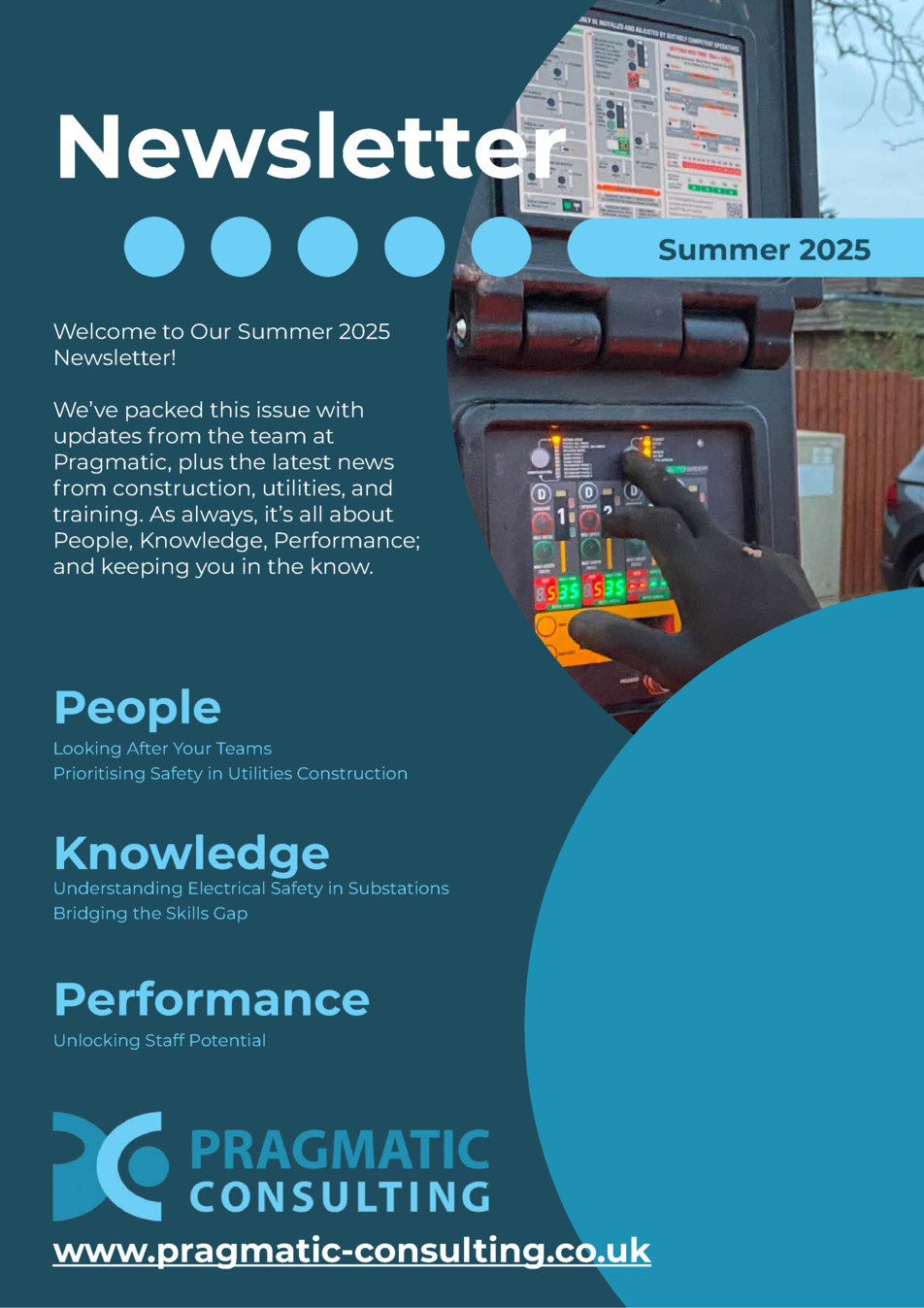
Pragmatic Consulting Summer 2025 Newsletter — Highlights on People, Knowledge, and Performance
Summary
Welcome to Pragmatic Consulting’s Summer 2025 issue, a comprehensive update that foregrounds our core values—people, knowledge, and performance—as driving forces behind every initiative across the construction, utilities, and training spheres. The edition weaves together reflections from our team with sector insights, underscoring how people and performance intersect with practical knowledge to deliver tangible results. (Pg1)
Throughout, the newsletter emphasizes expert guidance from our consultants, practical tools designed to lift knowledge and performance, and fresh progress reports on training programs accompanied by recent success stories. It also highlights our ongoing commitment to community involvement and to sharing actionable intelligence that readers can apply in their own operations. (Pg1)
In the wake of recent events, Pragmatic Consulting celebrated significant community and capability milestones. The company completed The Myton Hospice Moonlight Walk 2025, turning an enjoyable community occasion into meaningful support for a vital local charity. The night stood out for its atmosphere of shared purpose and generosity. (Pg2)
A landmark development this year was the official opening of Pragmatic’s Wakefield Training Centre on 3 March 2025. Located at the Penny Appeal Campus in Thornes Park, Wakefield, the facility marks a new chapter in our ability to deliver targeted training with enhanced capabilities. The fundraising effort connected to the centre’s launch raised £1,870, combining staff contributions with corporate support, and every pound helps fund Myton Hospice’s care for patients and families facing life-limiting illness. The centre has already welcomed its first delegate, and bespoke equipment installations are underway to create a modern, fully equipped learning environment. (Pg2)
Wakefield now hosts a broad slate of courses—CITB, SMSTS, SMSTS-R, SSSTS, SEATS, Streetworks/NRSWA, First Aid, and more—reflecting Pragmatic’s commitment to accessible, industry-relevant training. The issue also acknowledges the collective effort of colleagues and supporters who contributed to the event and the centre’s launch, expressing gratitude to everyone who helped make these milestones possible. (Pg2)
In a broader strategic move, Pragmatic announced The Myton Hospices as its Charity of the Year, alongside attaining accreditation as a National Living Wage Employer. This combination signals a deepening commitment to fairness, integrity, and respect across our organisation and the communities we serve. To sustain and grow this impact, the rest of the year will see £1 donated from every eligible course booking to The Myton Hospices, aligning commercial activity with charitable support. (Pg3)
To clarify which bookings contribute to the charity, Pragmatic designates a broad range of courses as eligible, spanning electrical, water, and confined-space categories, as well as a wide assortment of CABWI and NRSWA-related offerings, including the National Living Wage-aligned courses that reflect our wage accreditation. The aim is to channel sustained support to The Myton Hospices while maintaining high standards in training provision. (Pg3)
Beyond fundraising, Pragmatic highlights the Living Wage Foundation’s principles: the real Living Wage reflects living costs and exceeds government minimums, ensuring wages align with everyday needs. Since founding in 2013, Pragmatic has sought to empower today’s workforce and tomorrow’s talent, embedding People, Knowledge, and Performance into every client engagement and learning solution. (Pg3)
The newsletter provides links to the Living Wage Foundation and The Myton Hospices to offer readers context about these commitments and the organisations involved. It reiterates Pragmatic’s ethos—treating people as the core asset of the business and pursuing a work environment where fair pay and professional development are standard practice. (Pg3)
Manual handling is the opening focus of a dedicated feature on People Looking After Your Teams. In physically demanding sectors like utilities and construction, handling tasks such as lifting equipment or moving materials is routine, yet it remains a major source of injuries. The piece underscores the long-term health risks and potential downtime stemming from musculoskeletal issues. (Pg4)
The article on safety in utilities construction stresses that safety is not merely a compliance issue but a core determinant of project success. It cites industry data showing a notable portion of the workforce does not feel fully secure on site, highlighting a persistent need for stronger safety protocols and cultural commitment. (Pg4)
Building a culture of safety requires visible leadership, clear communication, and active involvement from employees at all levels. Ongoing training and safety education help teams recognise hazards and appreciate the importance of safety in every task, turning safety from a box-ticking exercise into a shared practice. (Pg4)
Manual handling best practices are explored in depth, covering risk reduction, long-term health considerations, on-site efficiency, and the programmatic elements that strengthen safety culture. The discussion emphasises PPE, proper handling techniques, and the importance of structured training to keep workers informed and prepared for real-world scenarios. (Pg4)
The piece also points to the role of technology in safety—tools such as 3D modeling and drones enable precise project visualization and safer inspection of difficult-to-reach areas, reducing exposure to hazardous conditions and manual inspection burdens. (Pg5)
Training must reflect the realities teams face on the ground. The article argues for practical, job-relevant instruction that improves decision-making under pressure, and notes that compliance with national occupational standards—such as those from Energy & Utility Skills—provides a structured framework for risk assessment, emergency procedures, and equipment use. (Pg5)
Keeping a workforce informed and supported is highlighted as a simple, high-impact step toward building a safer, more capable team. The piece anchors its guidance in accessible resources, including HSE guidance on manual handling and related safety materials. (Pg6)
The Essentials of Understanding Electrical Safety in Substations is introduced through a detailed explainer on BESC AME training. The piece outlines the criticality of electrical safety—reducing burns, fires, property damage, and electrocution risks—and frames training as a cornerstone for safe operation near energized equipment. (Pg7)
In the discussion of the BESC AME scheme, the article clarifies its purpose: a purely assessment-based credential for access, movement, and egress in electrical environments, not a course for executing operational tasks like cable jointing. Successful assessors gain certification valid for three years and must retake the assessment to renew. (Pg7)
The Energy & Utility Skills Register (EUSR) is presented as the recognised third-party body that develops and manages BESC AME and ensures providers meet consistent standards. The text emphasizes that, because BESC AME is an assessment, learners still need appropriate training to reach the knowledge and skill level required for the assessment, including familiarity with safety procedures and documentation. (Pg7)
With the skills shortage in the UK construction and utilities sectors, the article outlines drivers such as an ageing workforce, reduced apprenticeship intake post-Brexit and the pandemic, and underrepresentation of women and minority groups. These factors contribute to a demand for new approaches to training and recruitment. (Pg8)
Government responses to the shortage are featured, including Skills England as a cross-sector skills development body, Homebuilding Skills Hubs to accelerate construction apprenticeships, and the Sun Apprenticeship Reforms designed to shorten shortages-occupation apprenticeships and ease entry requirements. The discussion also highlights the enduring value of apprenticeships in providing practical, paid learning across the industry. (Pg8)
The piece on apprenticeships underscores their role in building a skilled, knowledge-driven workforce. Apprenticeships offer hands-on experience while earning a wage, making construction and utilities more accessible to a broad range of learners and helping to bridge the talent gap with on-the-job training. (Pg8)
Performance and staff potential are the focus of a dedicated section on day-one impact and ongoing development. The article cites CIPD research showing that a sizable share of new hires leave within the first year, often due to unclear expectations or insufficient onboarding support. It notes that well-designed onboarding can markedly boost performance and retention, while unmanaged development can leave existing staff underutilised. (Pg9)
From Induction to Impact presents practical strategies for effective onboarding, including setting clear, measurable performance expectations; pairing new hires with mentors for guidance; and weaving organizational values into early experiences to accelerate alignment with company goals. For current staff, continuous development, cross-training, and opportunities for secondments are recommended to keep people engaged and to build resilience within teams. (Pg9)
A culture that performs is portrayed as a product of leadership and ongoing investment in people. When leaders champion development, recognise progress, and invite feedback, performance improves alongside morale and retention. The message is clear: treating staff development as a core business priority yields tangible gains in productivity and capability. (Pg9)
In-house training is positioned as a flexible, cost-effective means to upskill teams. Pragmatic offers tailored, organisation-specific training delivered on a schedule that aligns with business needs, rather than relying solely on public courses. This approach gives organisations greater control over timing and location, maximizing relevance and impact. (Pg10)
Flexible training options are highlighted, with offerings that can occur at the customer’s site, online, or at Pragmatic’s own training centres. Readers are invited to reach out to Pragmatic to explore tailored solutions and book arrangements that fit their operations. (Pg10)
Open courses are showcased, including those delivered at Pragmatic’s new Wakefield training centre. The section explains that a wide range of utility and construction training is available, with sessions designed to reinforce essential competencies and ensure compliance with industry standards. Courses can be booked online and are open to individuals as well as teams. (Pg11)
The catalog of offerings covers a spectrum of CITB-accredited trainings and specialist modules such as BESC AME Substation, EUSR categories, water-related modules, and health-and-safety topics. These are available across multiple locations—Stoneleigh Park, Wakefield, Trafford Park—and online, with costs and dates listed for upcoming sessions. (Pg11)
While the calendar is expansive, the newsletter notes that the listed dates are not exhaustive and that additional sessions will be added across all training centres. Readers are encouraged to consult Pragmatic’s website for up-to-date scheduling and to explore the breadth of courses on offer. (Pg12)
Finally, the edition features a Flipbook Gallery hub summarising Pragmatic’s publications and media assets, including magazines, catalogs, reports, and portfolios, as a resource for readers seeking further detail beyond the newsletter. The gallery section signals the breadth of Pragmatic’s communications and training materials. (Pg13)
Thank you for engaging with the Summer 2025 edition; your involvement, feedback, and support help us expand our impact on clients, learners, and the communities we serve. We look forward to continuing the conversation and partnering with you on future initiatives. (Pg13)
Pragmatic Consulting Summer 2025 Newsletter - Flipbook by Fleepit