India This Week~March 6, 2026
India This Week~March 6, 2026
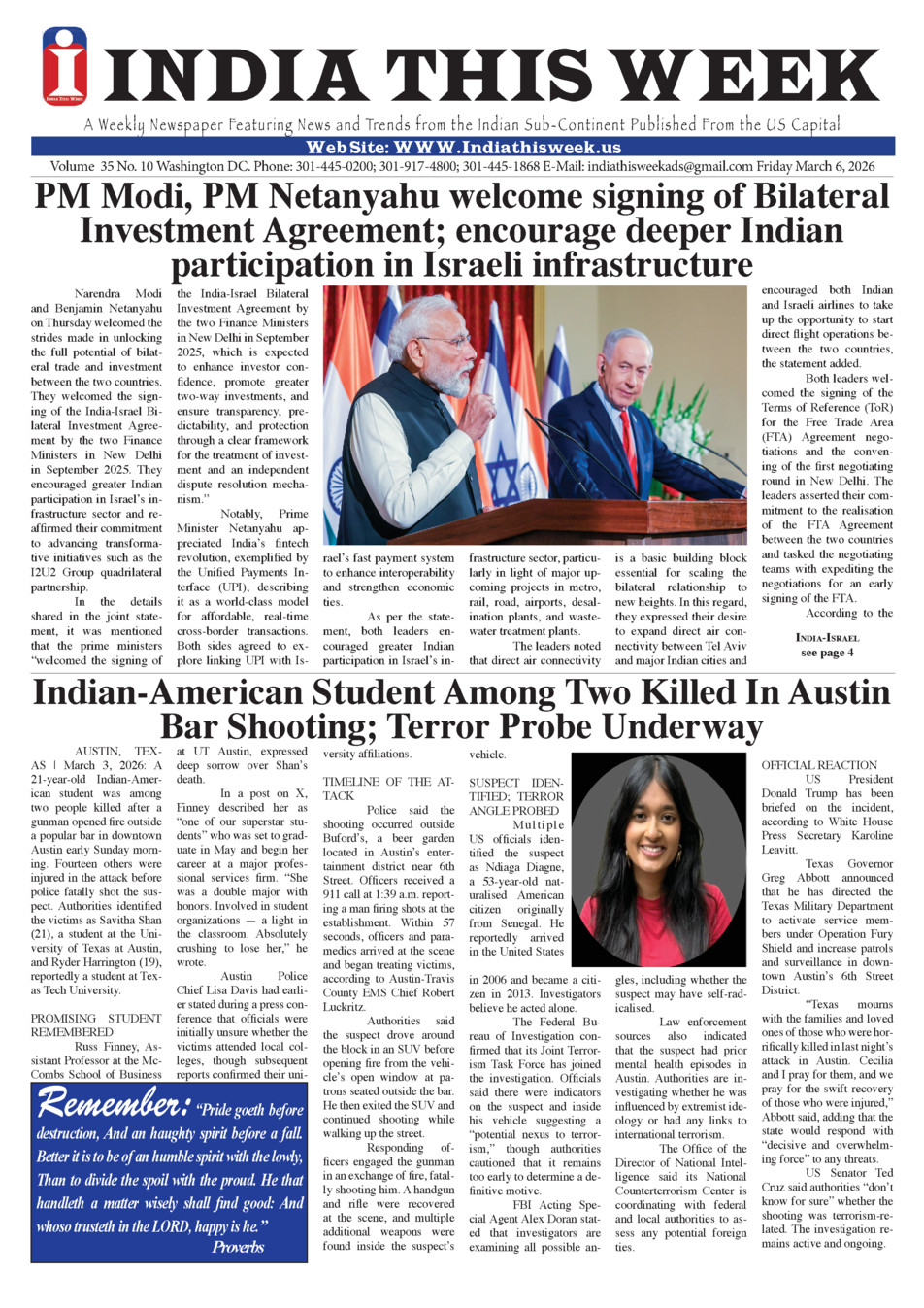
India This Week — March 6, 2026: A comprehensive briefing on critical Indo-Israeli, Indo-Canadian, and regional developments, plus security events shaping the global agenda
Diplomatic and economic momentum from the Modi–Netanyahu engagement
The leaders of India and Israel underscored the forward trajectory of their bilateral relationship by welcoming the signing of the Bilateral Investment Agreement (BIA) that their finance chiefs finalized in New Delhi in late 2025. They stressed the importance of expanding Indian participation in Israel’s infrastructure landscape and reaffirmed a shared commitment to transformative partnerships, including the I2U2 quadrilateral framework. The joint statement highlighted several benefits anticipated from the BIA: greater investor confidence, increased two‑way investment, and a transparent, predictable regime with clear protections and an independent mechanism for dispute resolution. Prime Minister Netanyahu singled out India’s fintech evolution, especially the Unified Payments Interface (UPI), praising it as a globally credible model for affordable, real-time cross‑border transactions. In parallel, both sides discussed exploring interoperability between UPI and Israel’s fast payments ecosystem to strengthen cross-border financial flows. The discussion also touched on air connectivity and broader economic‑security cooperation, signaling a multi‑layered blueprint for closer collaboration in critical sectors. (Page 1)
A somber incident in Austin: victims, investigation, and national responses
A deadly shooting outside a popular downtown Austin venue early on a Sunday left two students dead and several others wounded, prompting a rapid emergency response and a major investigative effort. Among the deceased were Savitha Shan, a 21-year-old University of Texas at Austin student, and Ryder Harrington, a 19‑year‑old reportedly linked to Texas Tech University. The attacker’s gunfire injured numerous patrons at the outdoor seating area outside Buford’s, prompting police and EMS to respond within minutes. Investigators recovered a handgun and a rifle from the scene, and additional firearms were found during searches of the suspect’s vehicle and residence. Ndiaga Diagne, a 53-year-old naturalized American citizen from Senegal, is identified as the suspect; officials say he appears to have acted alone. The FBI’s Joint Terrorism Task Force joined the investigation as authorities examine possible terrorism links or radicalization, while evaluating mental health considerations. The incident drew swift reactions from U.S. leaders and state officials, with the White House briefing indicating President Trump’s awareness of the event and Texas Governor Abbott directing heightened security measures in downtown Austin. The broader inquiry continues as authorities assess potential foreign connections and the prevailing security environment. (Page 1)
Modi–Carney talks in New Delhi: aiming for deeper India–Canada economic ties
Prime Minister Narendra Modi welcomed Canadian Prime Minister Mark Carney for high‑level discussions in New Delhi, focusing on strengthening bilateral collaboration across a wide spectrum—trade, energy, minerals, education, technology, and people‑to‑people ties. Building on prior interactions in G7 and G20 settings, the leaders reviewed progress in the India–Canada strategic partnership and charted a path toward a substantial economic framework. External Affairs Minister S. Jaishankar also engaged with his Canadian counterpart to reinforce shared commitments in a forward‑looking partnership. A key highlight of the talks was Modi’s assertion that the two nations should target roughly fifty billion dollars in bilateral trade by 2030, accompanied by the early finalization of a Comprehensive Economic Partnership Agreement to unlock new investment and job opportunities. Canadian pension funds’ significant Indian investments were cited as evidence of deep trust in India’s growth trajectory. The day included a session with business leaders at the India–Canada CEOs Forum, intended to translate policy discussions into practical channels for cooperation. (Page 2)
Remembering a promising student and reflections on leadership in uncertain times
A tribute to a standout student featured in the issue, recalling the dedication and achievements that characterized the academic and professional potential of a young scholar. The piece frames leadership and humility as guiding virtues, drawing on a biblical proverb about prudent handling of matters and the dangers of hubris. The narrative emphasizes the value of wise stewardship, a steady approach to complex challenges, and the importance of aligning personal ambition with the common good. In this reflection, the authors share the optimism that diligent students bring to their fields and to the broader community, underscoring the aspiration that their talents be harnessed for constructive ends. (Page 2)
India–Israel defence convergence and a move toward a special strategic partnership
In a landmark development following Prime Minister Modi’s visit to Israel, India and Israel expanded their defence relationship and formalized elevated cooperation under a special strategic partnership. The two governments affirmed a robust trajectory in defence collaboration, including cybersecurity, counter‑terrorism, and cross-border security initiatives, and highlighted 27 agreements spanning technology, manufacturing, and innovation. They outlined a multi‑year plan to deepen cyber cooperation: joint programs, capacity building, and the integration of security‑by‑design principles, with regular exercises and knowledge exchange. The leaders also announced the establishment of a Center of Excellence in Cybersecurity in India, born from a Letter of Intent with an Indian partner organization. They stressed the importance of not only defense hardware and software interoperability but also a shared commitment to peace and stability in the region, with explicit references to regions of concern and efforts to combat terrorism in all its forms. (Page 4)
Strengthening cyber and financial collaboration: MoUs and dialogues with a broader strategic lens
The bilateral agenda between India and Israel extended beyond defense into critical cyber and financial domain cooperation. The leaders welcomed agreements that enhance cyber policy dialogue, including a framework for joint cyber incident response and the sharing of best practices across governmental and private sectors. They noted the agreement on a cross‑border payments linkage between NPCI International and MASAV as a step toward smoother financial exchanges, and the launch of an India–Israel Financial Dialogue intended to deepen monetary collaboration. This financial‑tech dimension complements ongoing negotiations around a broader Free Trade Area, designed to accelerate investment opportunities, enable more dynamic business interactions, and provide mutual protections within a transparent governance regime. The momentum signals a strategic move toward integrated, technology‑driven economic alignment between the two tech‑savvy democracies. (Page 4)
India–Austria cooperation: broad‑spectrum engagement spanning peacekeeping, trade, and education
High‑level exchanges between India and Austria focused on expanding cooperation across diverse domains, including peacekeeping operations, trade, science and technology, and educational ties. The meeting in New York, involving India’s Permanent Representative to the United Nations and Austria’s Deputy Defense Minister, produced a shared sense of potential to deepen bilateral and multilateral cooperation. The talks followed a series of strategic engagements signifying a broadening of the partnership, including prior Foreign Office Consultations and high‑level visits. In parallel, Austria emphasized its program to attract Indian students to its leading technical universities, reflecting the partners’ intent to cultivate a skilled workforce through sustained educational collaboration. The discussions also highlighted the importance of people‑to‑people links and ongoing collaboration within multilateral fora, with a view to delivering tangible outcomes for both nations’ economies and security architectures. (Page 7)
From credentials to collaboration: deeper voices driving Indo‑European cooperation
In the course of ongoing diplomatic exchanges, ambassadors and officials reaffirmed their commitment to sustaining robust official interactions and planning future consultations. The series of engagements underscored a shared understanding that a well‑coordinated approach to foreign policy and development assistance can unlock broader strategic gains. The emphasis on regular exchanges aims to translate high‑level commitments into practical actions—ranging from scientific and educational exchanges to joint projects in technology, trade, and security. As these relationships mature, both sides expect to harness their respective strengths to confront global challenges, whether in regional stability, economic resilience, or digital governance. (Page 7)