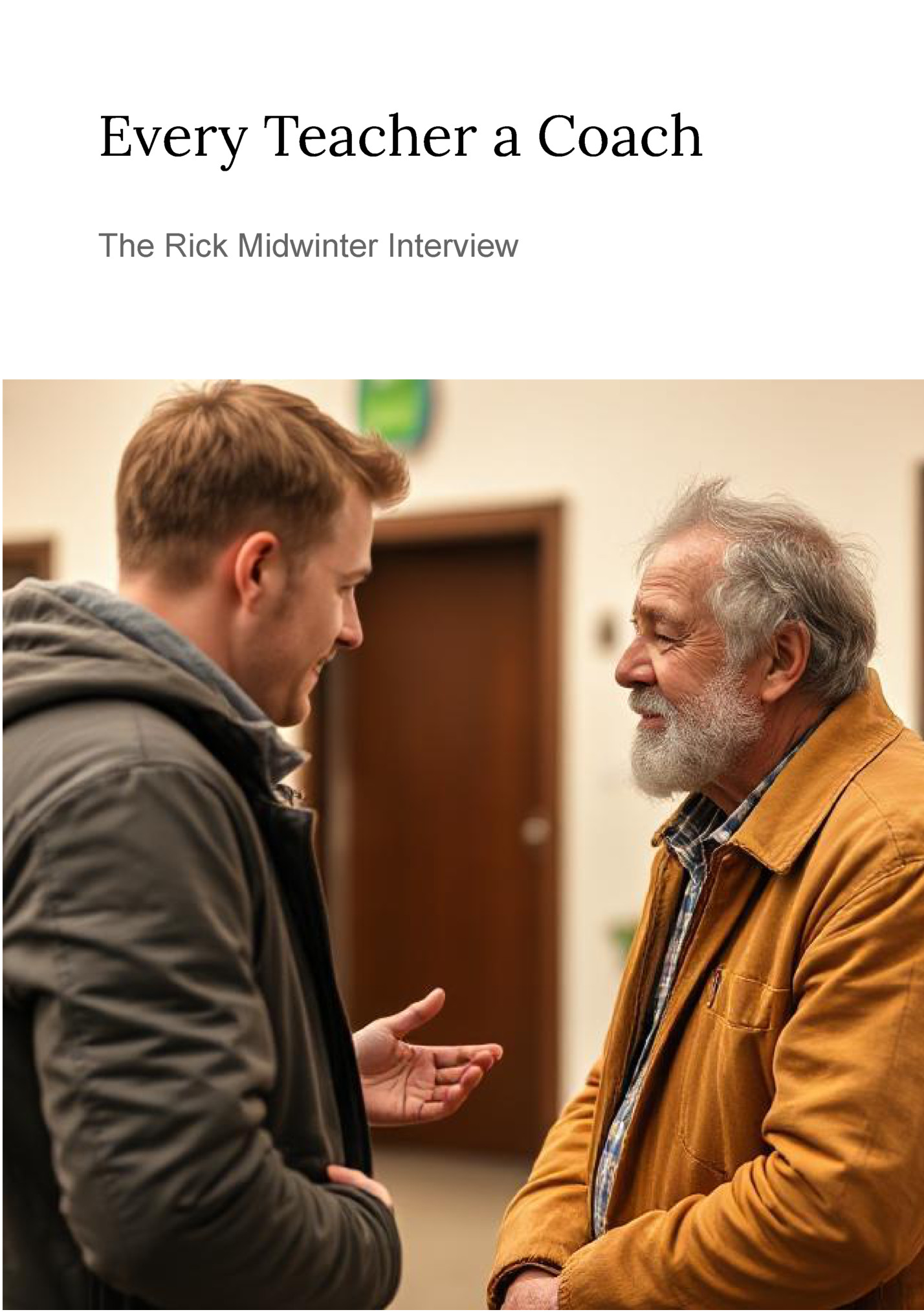
The Rick Midwinter Interview
I didn’t expect to stay this long. When the editor of Education Horizons Magazine first asked me to interview Rick Midwinter, the assignment was clear enough. Spend a day with the man who had made a quiet career out of “coaching” teachers and students. Ask the tough questions. Find out whether all this talk of curiosity, conversation, and “holding space” was just another education trend, a softer, slower way of handling the same old problems. I wasn’t hostile. Just skeptical. Teachers, after all, are under enormous pressure curriculum standards, test results, measurable outcomes. What place was there, really, for all this uncertainty Rick seemed to champion? What I found, over the course of our conversations, surprised me. Rick didn’t evangelize. He didn’t defend. He didn’t try to impress.
patient, powerful curiosity, a willingness to sit with ‘not knowing’, and to invite me into it, too. This book is the result of that day, and of the slow shift that happened not only in how I saw Rick’s work, but in how I saw my own. I offer this to anyone who still believes that education is more than information transfer. To anyone who suspects that what matters most happens not in the outcomes, but in the spaces between questions and answers. And to anyone willing, perhaps tentatively, to stay curious a little longer. You may, as I did, find something you didn’t expect.
Introduction 2 Chapter 1 Foundations of Inquiry 6 An exploration of Rick’s early questioning in his Maths teaching 6 Chapter 2 Versatility of Questioning – Across Subjects and Borders 13 Adapting questioning techniques to a new subject 13 Chapter 3 Discovering the Language for What Was Already There Discovering Co-Active Coaching and shifting to client focus Chapter 4 Teaching the Students, Not the Subject 17 17 21 Not a rejection of curriculum, but a re-centering of purpose. 21 Chapter 5 Teaching and Coaching Side by Side – Lessons from an International School 25 Blending coaching and teaching in a school environment 25 Chapter 6 When Coaching Meets Resistance – Lessons in Patience 30 Coaching challenges not only practice, but power.30 Chapter 7 Coaching Teachers – Lessons from the National Education Agency 35 Stories from the National Education Agency 35 Chapter 8 Choices to Be Proud Of – Storytelling as Coaching 40 Monthly talks with students; sharing real-life decisions 40
Doubly Unknown Coaching is a shared inquiry, “We explore what neither of us knows.” 44 44 Chapter 10 Practical Coaching Skills for Every Classroom – Asking and Listening 49 Every lesson is a relationship. 49 Chapter 11 Demonstrating Coaching – Bringing Practice to Life 53 Hearing students’ needs behind their language Chapter 12 The Courage to Stay Curious 53 57 The best training doesn’t sound like training, it feels like permission. 57 Epilogue: Leaving Room for Growth 60 Practical Strategies for a transformative, student-centered approach to education 62 1. Asking Instead of Telling 62 2. Listening Between the Words 63 3. Creating Safe, Reflective Spaces 63 4. Surfacing the Learner, Not Just the Learning 64 5. Teaching the Student, Not the Subject 64 6. Embracing Shared Discovery (“The Doubly Unknown”) 65 7. Demonstrating Trust and Vulnerability 65 8. Coaching Through Storytelling 66 9. Framing Learning Around Student Curiosity 66 10. Practicing Patience and Holding Space 67
An exploration of Rick’s early questioning in his Maths teaching At the agreed time, I arrived at Rick’s office ready to ask him questions he would struggle to answer. I wanted my article to reveal who he really was. I had done my research and was ready to dive straight in. Interviewer Rick, you’ve written about your early years teaching Mathematics, how even then, before any formal coach training, you relied heavily on questioning. Some might argue that in Mathematics, there’s little room for ambiguity, you either know the answer or you don't. How did you reconcile that with your desire to ask rather than tell? Rick Midwinter It’s true that Mathematics has clear structures, right and wrong answers. But what is easy to miss is that getting to the answer isn’t a linear process. It’s a branching journey of missteps, reasoning, intuition, and sometimes brilliant observations along the way. When I asked my students questions, it wasn’t to catch them out. It was to uncover the architecture of their thinking, the gaps, the leaps, the quiet assumptions.
shape of their own thinking processes. Interviewer (pressing a little) But surely, there were pressures, even then. Curriculum targets. Test scores. Did you ever feel tempted to abandon the slow work of inquiry for the quicker fix of direct instruction? Rick Midwinter (after a pause) Of course. There’s a tremendous gravitational pull toward efficiency in education. Tell them what they need to know. Get them through the syllabus. I felt it every time a deadline loomed. But what I discovered, almost by accident, was that when students were invited to surface their own understanding, even if it was partial or messy, their retention was stronger. The confidence was stronger. They didn’t just have the answer. They owned it. Interviewer Was this instinctive for you? Or was there a particular moment that shifted your approach? Rick Midwinter (leaning in slightly) It was a cold morning, Year 9 set two. I asked a student,
balanced. She hesitated, then said, “Because... the equals sign is like a scale, and both sides have to be the same weight.” It was imperfect. It wasn’t textbook language. But it was profoundly right in spirit. And I realised then, if I had just told her the definition, that metaphor, that deeper grasp, might never have surfaced. From that point on, I started trusting questions more than explanations. Interviewer (challenging gently) Some would say that’s inefficient. That students need clear, direct teaching to succeed in exams. Rick Midwinter (firmly) Direct teaching has its place. Clarity matters. But ownership matters more. If education is reduced to transmission, the teacher speaks, the student writes it down, then we may fill notebooks, but we empty their minds of initiative. I would rather have a student stumble toward understanding through their own thought than recite perfect answers they barely comprehend.
they’ll have to rely on their own capacity to think. Interviewer (leaning in slightly) You paint a compelling picture of inquiry-based teaching. But I wonder, were there times it didn’t work? Times when you questioned your own approach? Rick Midwinter (after a pause, quieter) Yes. Often. It’s easy, years later, to trace a neat arc of gradual, deliberate development. But living it? It was messy. There were lessons where my questions fell flat. Where the students stared at me in silence, or grew restless. There were days I abandoned questioning entirely and defaulted to explanation, because it was faster, and frankly, less exposing. Interviewer (picking up) Less exposing, for them, or for you? Rick Midwinter (small smile) Both. When you teach by questioning, you expose your own uncertainty. You give up control over the pace, the neatness, the moment when understanding 'clicks.'
Fleepit Digital © 2021